Portuguese
  Spanish


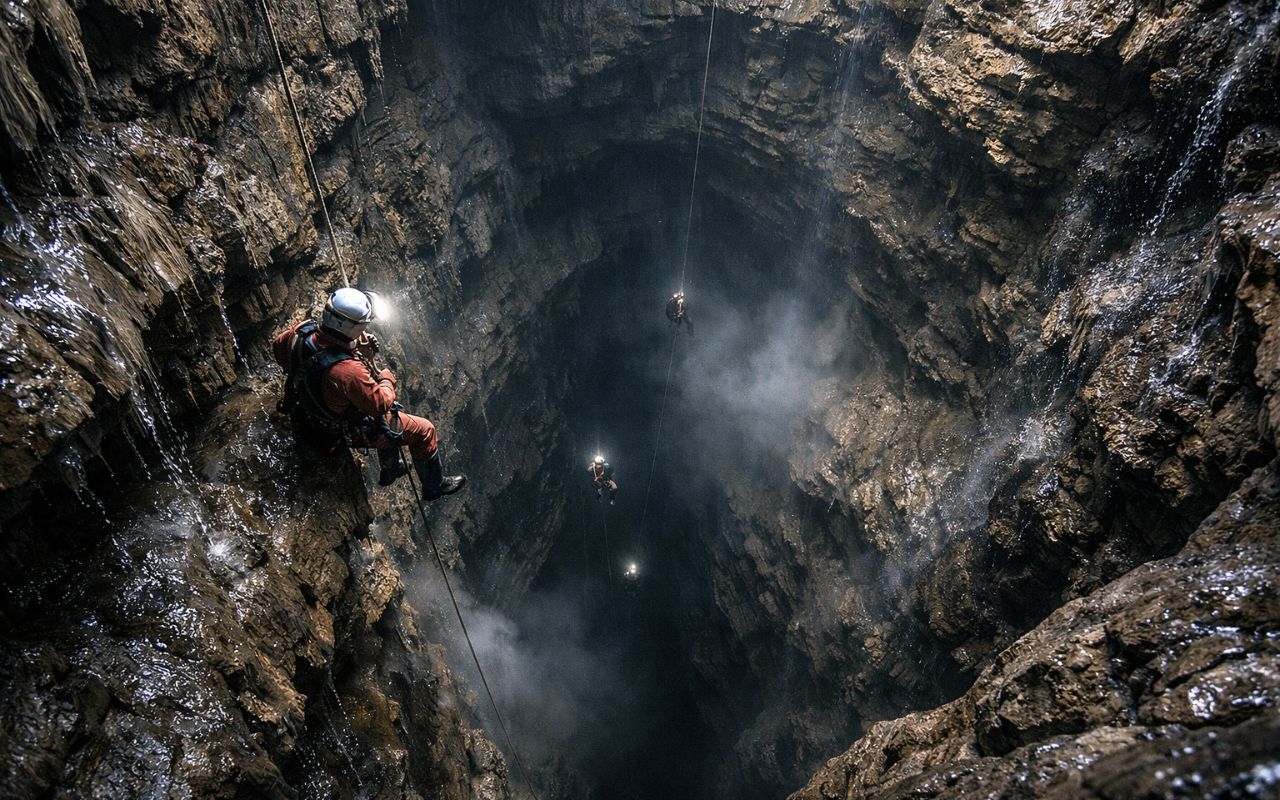

Explore the Veryovkina Cave, the deepest cave in the world, with over 2,200 meters of depth, a unique ecosystem, and extreme challenges for explorers.
The Veryovkina Cave, located in the Arabika massif near the Black Sea in Georgia, impresses with its extraordinary dimensions. With over 2,200 meters of depth, it is officially the deepest cave in the world.
To put it into perspective, the Burj Khalifa, the tallest skyscraper on the planet at 843 meters, would fit more than two and a half times inside the abyss.
This contrast highlights the magnitude of the site and the fascination it evokes among scientists, spelunkers, and adventurers.
-
Orphaned Youth Turns Dismissed Idea into Global Prestige with Innovative Wristwatch

-
English Skills Boost Career Opportunities in the Oil and Gas Industry

-
Brazil Secures Second Place at WorldSkills 2024 in Lyon, with 64 Young Professionals and 8 Medals, Including Gold from a Rio de Janeiro Hairdresser

-
3,000 Military Personnel from 10 Countries, Including US and Chinese Marines, Train Together in Brazil’s Savanna: Operation Formosa Becomes Largest Naval Ground Exercise Before First Cancellation Since 1988



Life adapted to extreme conditions: the Veryovkina Cave is a unique ecosystem
Exploring the deepest cave in the world means facing temperatures between 4ºC and 10ºC, constant humidity, and a complete absence of natural light. Even in this hostile environment, surprising forms of life exist.
Bacteria that feed on minerals and blind fish demonstrate extraordinary adaptations, while underground rivers flow through the tunnels, creating complex ecosystems that may harbor still unknown species.
This extreme isolation makes the cave a true natural laboratory, allowing scientists to study biological adaptations and geological processes rarely observable on the surface.
Fascination and risk: expeditions that challenge human limits
Reaching the depths of the Veryovkina Cave requires preparation and technique. The entrance already features a vertical shaft of 32 meters, followed by narrow passages, submerged chambers, and flooded areas.

Photographer Robbie Shone reported in August 2024: “A huge torrent of white water appeared from a hole, and I was stunned to see this enormous white wall of water entering our small home.”
Not all explorers come out unscathed: in 2020, spelunker Sergei Kozeev died after becoming trapped at 900 meters deep, reinforcing the cave’s nickname as the “cave of death.”
Despite this, new expeditions continue, combining fascination, discovery, and danger.
Discovery: decades of exploration
The Veryovkina Cave has been explored for nearly 50 years, and its depth record has been confirmed after more than 30 expeditions.
Researchers believe there are still unexplored sections that could further increase the cave’s depth.
Each new exploration reveals unknown passages, enormous chambers, and underground corridors that defy any conventional map, keeping the site as one of the last natural frontiers on the planet.

Natural heritage and preservation: lessons from the cave
More than a geological record, the deepest cave in the world is a natural heritage.
Its dimensions and ecosystem provide insights into biological adaptation, underground formations, and the limits of human exploration.
Each expedition contributes to mapping the unknown and reinforces the need to preserve this unique environment, reminding us that nature still holds secrets that surpass any human creation, even gigantic monuments like the Burj Khalifa.
Source: GAZETA SP