





 Portuguese
  English
  Spanish
  5 min of reading
  0 comments


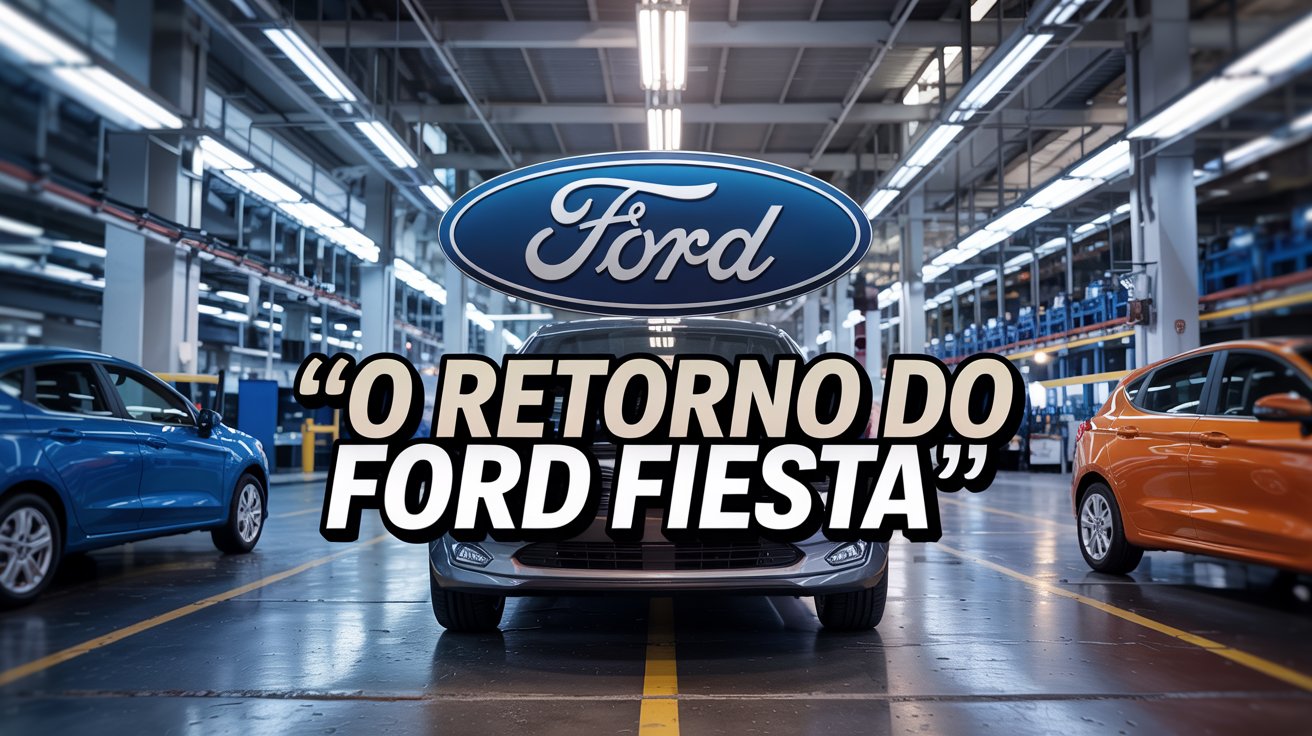
Collaboration Between Ford and Volkswagen May Result in New Electric Compact Models That Could Redefine the European Market, Bringing a Possible Updated Version of the Fiesta, Adapted to New Demands for Sustainability and Technological Innovation.
The Ford Fiesta, one of the most popular compacts in the history of European automotive, may gain a new lease on life thanks to an unusual alliance with Volkswagen.
Speculation revolves around the use of the German automaker’s MEB Entry platform — the basis for future urban electric models, such as the ID.1 and ID.2 — which could be shared with Ford to develop a new compact car, possibly a direct replacement for the Fiesta.
The decline in Ford’s sales in Europe has forced the automaker to seek alternatives to maintain relevance in the market.
-
The car stored for 38 years: when opening the barn door, what appears is breathtaking and looks like a scene from a movie!

-
Fiat works miracles in the Brazilian market, lowers the price of its 0 km hatch to R$ 69,990, reestablishes the model as the cheapest car in the country, and reignites the battle against Kwid and C3.
-
Chevette with cooking gas: How the gas cylinder ends up being used in cars clandestinely and why this makeshift solution can result in leaks, explosions, damaged engines, and seized vehicles.

-
Fiat launches the new 2027 Toro hybrid with 48V, 176 hp, an electric motor of 15.5 hp, a 0.85 kWh battery, up to 7% fuel savings, 8% fewer emissions, and possible exemption from IPVA.

In 2024, the company sold 426,307 vehicles across the 27 European Union countries, plus the United Kingdom, Norway, Iceland, Liechtenstein, and Switzerland.
This number represents a decrease of 87,174 units compared to 2023, reducing its market share to 3.3%.
The beginning of 2025 was also not promising: from January to March, there was a decline of 1.9% in demand compared to the same quarter of the previous year.

Partnership with Volkswagen Rekindles Hopes
To counteract the loss of competitiveness, Ford has invested in electric cars developed in collaboration with Volkswagen.
This strategy has already yielded results like the Explorer SUV, a reinterpretation of the VW ID.4, and the recently launched Capri, based on the ID.5.
Both are produced at the Cologne plant in Germany, as part of an ambitious project to electrify Ford’s European portfolio.
The collaboration is not expected to stop there.

According to Martin Sanders, head of sales and marketing at Volkswagen — and former CEO of Ford Europe — the partnership has been “very, very, very successful.”
In an interview with the British magazine Auto Express, he stated that the agreement could be expanded, leaving open the possibility of new joint projects: “We do not rule out new opportunities to share technologies,” he said.
This statement sparked speculation about the revival of the Fiesta — or a similar model — using the base of Volkswagen’s compact electric vehicles.
The move could also involve a new generation of the Ford Ka, aligned with demands for sustainable urban mobility and zero emissions.

The Difficult Reality of Current Models
Despite the joint releases, the fruits of the Ford and Volkswagen alliance still face obstacles.
The production of the Explorer and Capri models slowed down in 2024, just a few months after manufacturing began.
Ford’s justification was the “rapid deterioration of market conditions for electric vehicles.”
This statement reflects the instability of the sector, which faces rising production costs, a slowdown in sales, and inadequate charging infrastructure in many regions of Europe.
The numbers confirm the challenge:
Only 1,919 units of the Ford Capri were sold in 2024 — and production began in September.
By March 2025, 2,511 Capris were sold, while the VW ID.5, which shares the same base, recorded 3,611 units in the same period.
The underwhelming performance raises doubts about European consumers’ receptivity to these shared electrified models.

Ford Benefits from VW’s Scale — and Vice-Versa
For Volkswagen, the alliance brings benefits beyond passenger cars.
Ford still holds considerable strength in the commercial vehicle market — a strategic segment for both automakers.
The new Transporter, for example, is nothing more than a Transit with the VW logo.
The new generation of the Amarok pickup shares the same base as the Ranger.
In South America, Volkswagen still sells the Amarok of its own design but is already preparing to replace it with a new model developed in partnership with the Chinese SAIC.
The “badge engineering” strategy — when different brands use the same designs with slight alterations — has become increasingly common in a sector seeking scale and cost reduction.
In this scenario, the technical cooperation between Ford and Volkswagen represents a robust alternative to traditional mergers and acquisitions, especially in times of energy transition.

Would a New Electric Fiesta Be Viable?
Although Ford has not officially confirmed the return of the Fiesta, the current scenario favors a relaunch of the compact in electric version, aligned with the environmental requirements of the European Union.
It is worth remembering that European legislation provides for a ban on the sale of combustion cars by 2035, which accelerates the race for sustainable alternatives.
The new generation of the electric VW Golf, expected by the end of the decade, will also use the modern SSP platform from the Volkswagen Group.
In the not-so-distant past, imagining a Ford using the same base as a Golf would have seemed inconceivable — today, this reality is not only possible but may also be strategic for both brands.
With the discontinuation of the Focus and Mondeo, and faced with difficulties in selling its new electric models, Ford seems to have realized that joining forces is better than fighting alone.
And Volkswagen, for its part, gains momentum by expanding the use of its platforms, taking advantage of Ford’s reach and tradition in specific markets.
The Future of Mobility Depends on Alliances
The eventual return of the Ford Fiesta — now as an electric car developed with German technology — symbolizes a new chapter in the global automotive industry.
More than nostalgia, the revival of the compact can represent an agile and efficient response to demands for accessible, sustainable urban cars that are adapted to new consumer requirements.
If realized, the project could pave the way for a new wave of affordable electric vehicles designed for dense cities and aimed at young audiences.
The era of electric cars will not be dominated only by robust, high-cost SUVs, and partnerships like this are crucial to balancing the market.
And what do you think, could the return of the Fiesta in electric version win over European and Brazilian drivers once again? Share your opinion in the comments!







Seja o primeiro a reagir!