





 Portuguese
  English
  Spanish
  5 min of reading
  0 comments


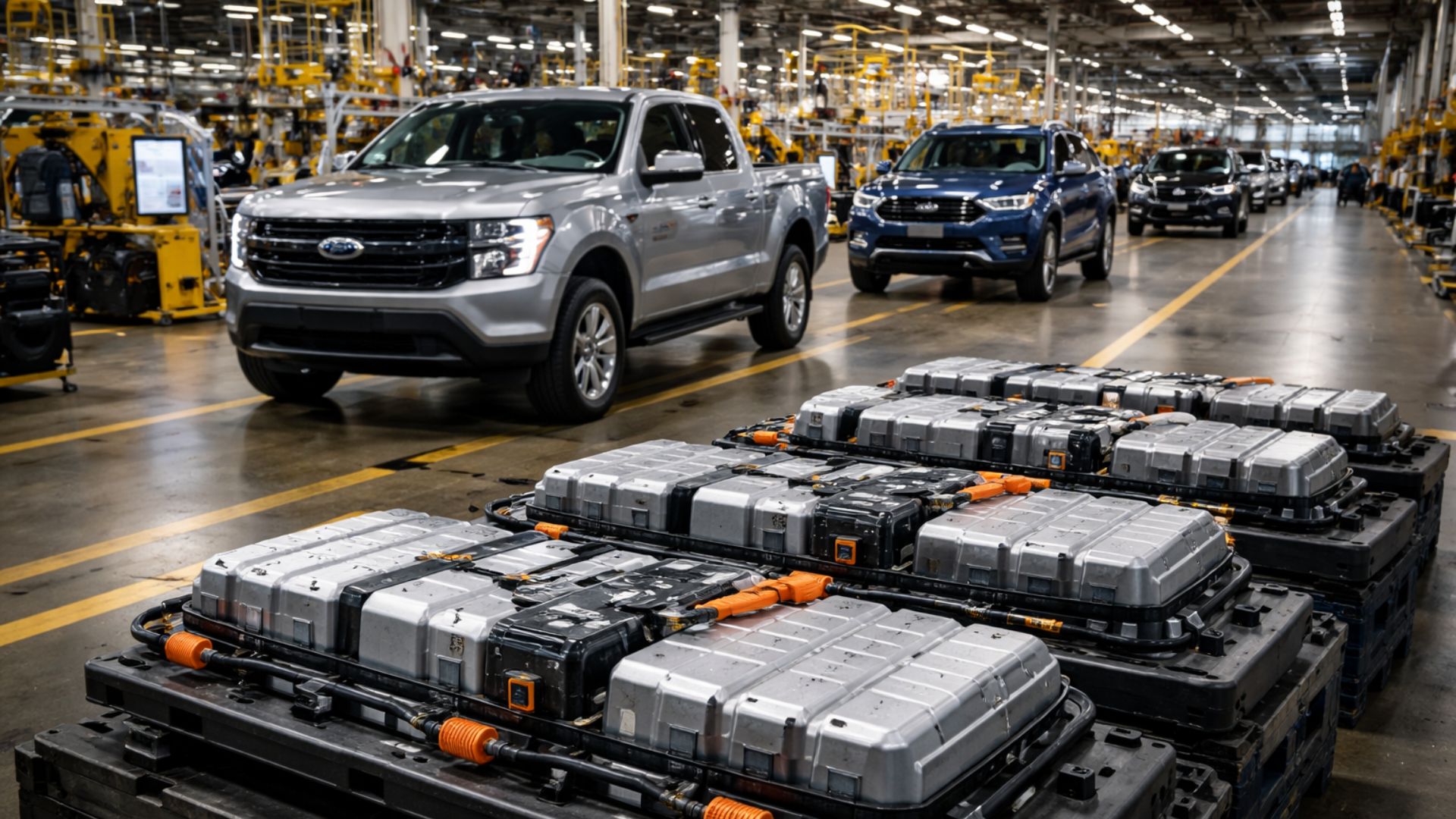
Billion-Dollar Restructuring Leads Manufacturer to Cancel Electric Projects, Convert Battery Plants, Reduce Workforce, and Revise Industrial Timelines While Maintaining Electrification in the Long-Term Plan Focused on Hybrids and Lower-Cost Technologies.
Ford has decided to revise its strategy for electric vehicles by announcing that it will record US$ 19.5 billion in accounting charges related to a broad restructuring of the electrification business, following successive losses and the reassessment of industrial projects.
The plan involves the cancellation of an electric pickup truck planned for the F-Series line, the conversion of battery plants, and the prioritization of combustion and hybrid vehicles, according to information released by the manufacturer itself.
According to the company, most of the charges will be recognized in the fourth quarter, with additional portions distributed over the following fiscal years.
-
The institute that trained the greatest aerospace engineers in Brazil has just opened its first campus outside São Paulo after 75 years: ITA Ceará will have R$ 445 million, new courses in energy and systems, and classes are expected to start in 2027.

-
Luciano Hang, owner of Havan, goes to Juiz de Fora after the tragedy in February, brings R$ 1 million, hands out R$ 2,000 cards, and donates up to R$ 15,000 to victims in the region.

-
The Brazilian passport allows legal residence in dozens of countries without the need for a prior visa, and most Brazilians are unaware that they can apply for residency directly upon arriving in nations in South America, Africa, and even Europe.

-
Petrobras sends a message to Brazilian truck drivers after fuel collapse and reveals plan to have 100% domestic diesel.


The cash impact, according to Ford, will be less than the total value of the accounting write-downs, primarily reflecting asset devaluations and adjustments to production capacity.
Review of Electric Vehicle Strategy and Production Capacity
In detailing the restructuring, Ford indicated that the expansion of battery production occurred at a pace greater than the actual market growth.
The company also stated that some larger electric vehicle projects presented challenges in achieving profitability.
The decision to cancel the electric pickup truck under development is set within this context of portfolio review.
In addition to internal factors, the manufacturer cited changes in the regulatory environment and industrial policy in the United States as elements that influenced the review of plans.
This theme has been recurrent in the automotive sector, with other manufacturers also adjusting timelines and investments in electrification throughout the year.
Ford Statements on Reallocating Investments
In the official statement, CEO Jim Farley stated that the company is reallocating resources to areas considered more attractive from a financial perspective.
“The operational reality has changed, and we are redirecting capital to growth opportunities with higher returns.”
In the same announcement, Ford reported that it has raised its cash generation forecast for 2025, estimating US$ 7 billion before interest and taxes, above the previously disclosed range.
After the data was released, the manufacturer’s shares recorded a positive variation in the after-market in New York.
For the year to date, the stock showed an appreciation, according to market data cited in the context of the announcement.
Losses in the Electric Division and Profitability Expectation
Ford’s electric vehicle division continues to operate in the red.
During a conference call with journalists, Andrew Frick, head of the division, stated that the announced measures could allow the business to achieve profitability by 2029, according to the company’s internal estimates.
In the previous fiscal year, Ford reported a loss of US$ 5.1 billion in this unit.
The company also indicated that the losses could be greater in the short term, even with the cancellation of projects and the ongoing industrial adjustments.
Energy Storage Enters the Center of Industrial Strategy
One of the company’s highlighted fronts is the conversion of part of the structure originally planned for electric vehicles into the production of batteries intended for stationary energy storage.
This segment has shown growth in the United States, driven by the expansion of data centers and the need to reinforce the electrical grid, according to public data from the energy sector.
Industry reports indicate an increase in installed storage capacity at utility scale throughout the year, compared to the level recorded at the end of 2024.
The use of these batteries allows for greater flexibility in the operation of the electrical system, especially in regions with accelerated demand growth.
Kentucky Plant Will Undergo Conversion and Layoffs During Transition
In the state of Kentucky, Ford announced the suspension of production at a battery plant located in Glendale for a conversion estimated at US$ 2 billion.
The objective is to direct the unit towards the manufacturing of cells intended for energy storage.
During the adaptation period, the company announced that 1,600 employees will be laid off.
The manufacturer stated, however, that it intends to hire 2,100 workers when the unit resumes operations, scheduled for 2027.
The reorganization occurs after the termination of a joint venture with South Korean manufacturer SK On.
According to Ford, part of the production will be directed towards lithium iron phosphate (LFP) cells.
The technology supply will be provided through a licensing agreement with Chinese company CATL, focused exclusively on stationary storage.
Michigan Plant Expands Focus on LFP and Smaller Vehicles
The Marshall plant in Michigan has been included in the industrial redesign announced by the company.
According to Ford, the unit will begin producing LFP cells for energy storage.
The factory will also support a new line of smaller, lower-cost electric vehicles, expected to enter production starting in 2027.
The manufacturer stated that this strategy differs from the previous approach, which focused on larger electric vehicles.
These models require larger batteries and higher investments, according to the company itself.
Tennessee Plant Shifts Focus and Delays Start of Operations
Another change involves the industrial complex in Stanton, Tennessee.
The unit is described by the manufacturer as its first new assembly plant in decades.
Initially planned to produce fully electric pickups, the factory will now be converted for the production of combustion trucks.
According to Ford, the site will manufacture a new model that is not part of the company’s current lines of small, medium, or large pickups.
The start of operations has been postponed to 2029, after successive adjustments to the originally announced timeline.
Ford Goals for Electrification by 2030
Despite the changes, Ford stated that it maintains electrification as a relevant part of its long-term strategy.
The company projects that 50% of its global sales by 2030 will come from hybrids, extended-range electric vehicles, and pure electric vehicles.
Currently, this percentage is significantly lower, according to data released by the manufacturer itself.
Company executives argue that the combination of hybrids and lower-cost batteries can enhance product competitiveness.
The strategy also aims to reduce financial risks associated with large industrial investments, especially in a scenario of still uncertain demand for fully electric vehicles.
With canceled projects, factory conversions, and a new capital allocation, Ford is adjusting its path in the technological transition process.
To what extent will this strategy be sufficient to balance investments, meet environmental goals, and respond to changes in the global automotive market?









-

Uma pessoa reagiu a isso.