





 Portuguese
  English
  Spanish
  5 min of reading
  0 comments


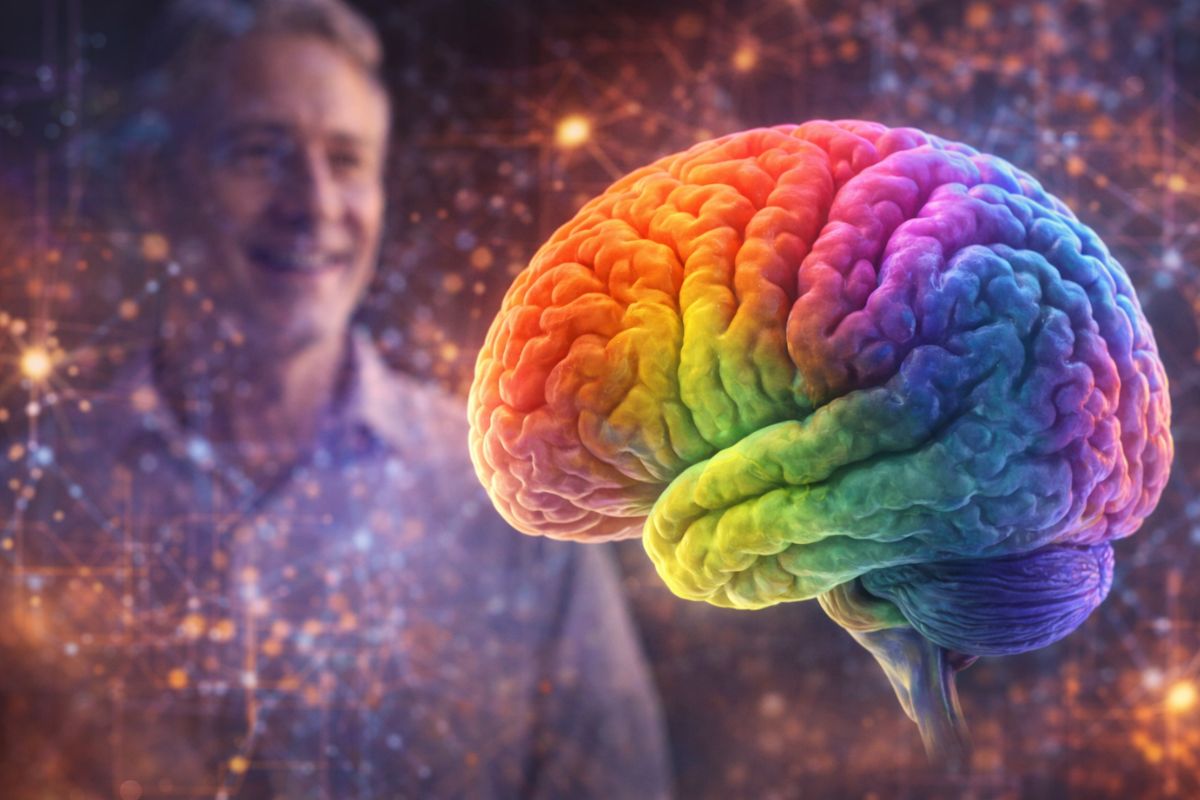
A study from the University of Cambridge with more than 4 thousand people showed that the brain does not stop developing at 25, but continues to remodel until 32, going through five distinct phases throughout life, from birth to old age.
If you believed that the brain was fully developed by 25 and that after that it was all downhill, science has just proven that this story is more complicated. A study led by Alexa Mousley from the University of Cambridge analyzed MRI scans of 4,216 volunteers ranging in age from newborns to 90-year-olds and found that the structure of the brain continues to remodel through five distinct phases, with a particularly active period of connection building extending until 32 years of age.
The research, published in the journal Nature Communications, tracked the movement of water along the fibers of white matter, the long nerve cables that connect different regions of the brain. Instead of analyzing one area at a time, the scientists treated the brain as a complete network and used metrics from graph theory to measure the efficiency with which information flows, the degree of specialization of different regions, and which centers are the most important. The result debunks one of the most repeated myths in popular neuroscience.
The five phases the brain goes through from birth to old age
The study identified four clear turning points, around ages 9, 32, 66, and 83, that mark the boundaries of five major epochs of brain development. The researchers describe these phases as childhood, adolescence, adulthood, early aging, and old age.
-
Researchers from USP have discovered how to use Brazilian arnica to produce silver nanoparticles without generating toxic waste, and the innovation already has a patent application and practical application underway in the market.

-
A study published in one of the world’s most respected medical journals shows that just two tablespoons of olive oil per day can reduce the risk of heart attack by up to 30% and also silently protect the liver.

-
China surprises the world again with a human research program at the Tiangong station, which aims to create an unprecedented space atlas, with 387 projects submitted, 53 already completed, and a mission involving an astronaut spending over 1 year in orbit.

-
With R$ 22.5 million from BNDES, J. Assy accelerates the hybrid diesel-electric autonomous planter, featuring remote monitoring and AI: it promises to plant without an operator and adjust to the terrain; the prototype will be ready in the second half of 2026.

Each transition represents a significant change in how neural networks are organized, strengthened, or simplified.
Between ages 9 and 32, the brain becomes progressively more efficient and refined. A measure called “small-world,” which captures the balance between strong local clusters and fast long-distance connections, proved to be the best overall marker of brain age during this period.
The Cambridge team classifies this age range as a prolonged adolescence in structural terms, as the overall direction of change still points to increased efficiency and reorganization. It is during this phase that the brain is busiest building shortcuts and specialized centers.
Why the 25-year myth spread and what science really said
The idea that the brain finishes developing at 25 has roots in studies from the late 1990s and early 2000s. These studies focused on gray matter and followed volunteers only until their early twenties.
Scientists observed that frontal regions were still maturing near the end of the analyzed period, and from there it was presumed that the process stopped a few years later. The 25-year mark became a popular rule without ever being proven as a real limit.
The new study on brain connectivity offers a very different picture. The formation of circuits in white matter continues to change throughout the 30s. There is no birthday when the brain suddenly becomes adult and stops changing.
Development is a process that lasts decades, made up of building, strengthening, and eliminating connections. The difference between what was believed and what the data shows is at least seven years, which changes how we understand decisions, behavior, and emotional maturation.
What happens to the brain after 32
Around age 32, the curve inverts. The integration between regions of the brain begins to slowly decline, while segregation increases, meaning that neural networks become more compartmentalized and simplified.
This process is not necessarily negative. It reflects a reorganization in which the brain trades breadth for specialization, maintaining the most useful connections and weakening the less demanded ones.
Later turning points, at ages 66 and 83, come with new reorganizations of the brain that the Cambridge team associates with natural aging, health changes, and the gradual weakening of the weakest connections.
But none of this means that people over 32 are doomed to irreversible decline. Later phases still show continuous remodeling of the brain, just with a different balance between integration and elimination of connections.
What brain neuroplasticity means for daily life
If neural connections continue to develop into adulthood, what can people do with this knowledge?
Neuroplasticity, that is, the brain’s ability to form new pathways and remodel existing ones, never disappears, but new data suggests that the age range of 9 to 32 is particularly favorable for large-scale structural changes. This explains why learning languages, developing complex skills, and forming new habits seems more natural during this phase.
Activities like high-intensity aerobic exercise can increase blood flow and growth factors that nourish the brain. Learning new languages or engaging in cognitively demanding hobbies like chess challenges multiple networks at the same time.
On the other hand, chronic stress seems to push the system in the opposite direction, interfering with the formation of new connections and accelerating age-related changes. The practical message is that taking care of the brain is a long-term investment, not a race that ends at 25 or 32.
What changes in the way we understand human maturation
The discovery that the brain continues to be actively constructed until age 32 has implications that go beyond pure neuroscience. It questions how society defines maturity and responsibility in age groups that, biologically, are still undergoing structural transformation.
If the prefrontal cortex, responsible for complex decisions and impulse control, is still being refined until this age, decisions made in the early twenties occur with hardware that has not yet reached its final configuration.
Ultimately, the message of the study published in Nature Communications is simple: the brain is not a machine that gets ready and stops changing. It is a living network that constantly reconfigures in response to what you do, how you live, and the world you move in.
Learning, movement, and social connection continue to be important for brain health in all five phases, from the first day of life to the last decade.
Did you know that the brain continues to rebuild until age 32? Do you think this discovery changes the way we view important decisions made in our twenties? Leave your opinion in the comments. This is the kind of study that makes us rethink a lot about how we become who we are.







Seja o primeiro a reagir!