






 Portuguese
  Spanish


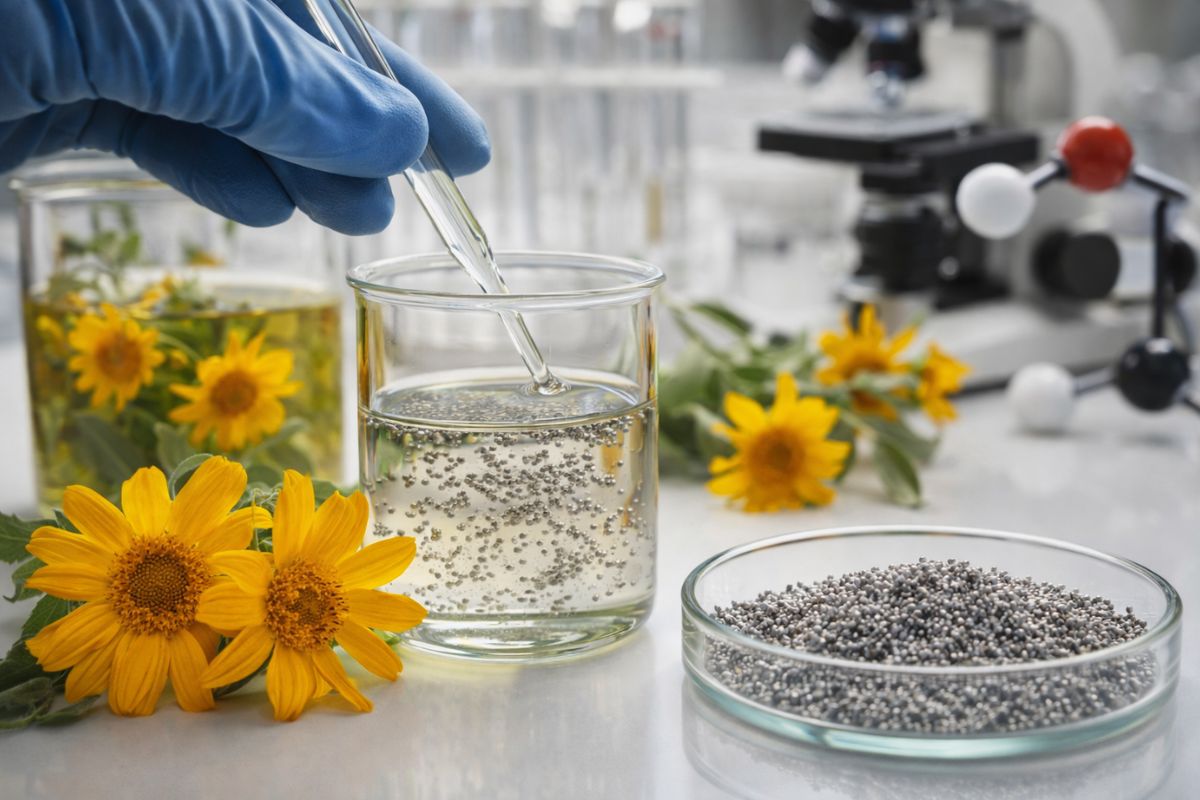

Scientists from the Faculty of Pharmaceutical Sciences of Ribeirão Preto at USP developed a method that uses the extract of Brazilian arnica to produce silver nanoparticles sustainably, without toxic reagents, and the discovery already has a patent application registered and practical application in air filtration.
Silver nanoparticles are present in more everyday products than most people imagine. Bandages, medical equipment, cosmetics, and food packaging use this substance due to its antimicrobial, antifungal, and antiviral properties. The problem is that traditional methods of producing these nanoparticles generate toxic waste that is dangerous to the environment and human health. Researchers at USP found a solution using Brazilian arnica as the basis for a process that eliminates the need for harmful chemical reagents.
The innovation was developed at the Faculty of Pharmaceutical Sciences of Ribeirão Preto and uses the aqueous extract of Brazilian arnica as a natural reducing agent. Instead of dangerous solvents, the plant transforms metal ions into silver nanoparticles through a process that science calls green synthesis. The result is nanoparticles with the same functional properties as those produced by conventional methods, but obtained sustainably and with lower energy consumption. The discovery already has a patent application registered and a practical application in development that may reach the market soon.
What are silver nanoparticles and why does Brazilian arnica change the game

Silver nanoparticles are microscopic structures with dimensions measured in nanometers, millions of times smaller than a millimeter. They have powerful antimicrobial properties that make them essential in the manufacture of bandages, medical equipment, cosmetics, and food packaging.
-
AI Radar Built with Old Camera and $20 Gains Attention After Alleged $317,000 Sale to Chinese Government, But Lack of Documentation and Official Confirmation Raises Questions

-
Amateur Detectorist Discovers 3,400-Year-Old Bronze Age Gold Treasure with 121 Pieces in Transylvania, Including a Unique Ring

-
Italian Designer Develops Solar-Powered Terracotta Water Purifier Producing Up to 5 Liters of Drinking Water Daily Without Electricity

-
New Hydrogel Made from Algae and Shrimp Shells Absorbs 60 Times Its Weight in Water to Combat Drought in Spanish Agriculture


Silver at the nanoscale can efficiently eliminate bacteria, fungi, and viruses, which explains its presence in so many products in the pharmaceutical and health sectors.
The challenge has always been how to produce them without causing environmental harm. Traditional industrial methods use toxic chemical reagents that generate dangerous waste, capable of destroying living cells and inhibiting microorganisms in the environment uncontrollably.
Brazilian arnica enters this equation as a natural alternative: its aqueous extract functions as a reducing agent, replacing chemical solvents without losing efficiency in the final result. It is the type of solution that the industry needs to meet the growing demands for sustainability.
How the green synthesis method developed with Brazilian arnica at USP works
The process is elegant in its simplicity. The aqueous extract of Brazilian arnica is brought into contact with a solution containing silver ions. The bioactive compounds present in the plant act as natural reducing agents, transforming these metal ions into stable silver nanoparticles.
Unlike conventional methods, there is no need for toxic reagents, dangerous solvents, or processes with high energy consumption.
Paulo Augusto Marques Chagas, a postdoctoral researcher at the Faculty of Pharmaceutical Sciences of Ribeirão Preto at USP and a member of the research team, explained the central objective of the work: “To reduce or eliminate the use of toxic reagents or dangerous solvents, and even to have processes with lower energy consumption.”
According to him, green synthesis with Brazilian arnica allows obtaining materials with relevant functional properties through more sustainable processes, an approach widely investigated by the scientific community for the production of metallic nanoparticles.
Where the idea to use Brazilian arnica in this research came from
The origin of the project dates back to the Environmental Control Laboratory, coordinated by Professor Mônica Lopes Aguiar at the Federal University of São Carlos (UFSCar). The group already had experience with green processes and the use of recycled materials, which created the right environment to seek an alternative method for synthesizing silver nanoparticles.
The choice of Brazilian arnica as raw material came from the internal investigation of the research group on plants with reducing potential.
Brazilian arnica proved particularly effective because its bioactive compounds act stably in reducing metal ions. The plant is known in Brazilian folk medicine for its anti-inflammatory properties, but its use in nanotechnology represents a completely new application.
The research demonstrated that the extract of Brazilian arnica not only efficiently replaces toxic reagents but also contributes to the stabilization of the formed nanoparticles, which is essential for the quality of the final product.
The patent application and the practical application that is already in development
The discovery has gone beyond the academic phase. The researchers at USP have already registered the patent application for the green synthesis method with Brazilian arnica, protecting the intellectual property of the innovation. But the advancement did not stop on paper.
The team is developing a concrete practical application: the incorporation of the nanoparticles produced with Brazilian arnica into nanofibers intended for air filtration.
The result would be a filtration device with antibacterial properties, capable of eliminating microorganisms from the air that passes through the filter. Paulo Chagas confirmed that the production of a scientific article describing this application is underway.
If the results are confirmed on an industrial scale, the innovation could reach the market in areas such as hospitals, laboratories, and the food industry, where air quality is a critical safety factor.
Why green synthesis with Brazilian arnica matters for the future of industry
Many companies around the world produce silver nanoparticles using different methods, but most still rely on processes that generate toxic waste.
The USP innovation with Brazilian arnica offers a productive route that meets sustainability demands without compromising the quality or functional properties of the nanoparticles. In a global scenario where environmental regulations become stricter every year, methods like this gain strategic relevance.
The substance produced by the green method maintains the antimicrobial, antifungal, and antiviral properties that make silver nanoparticles so valuable to the industry. The difference is that the process does not leave behind waste that contaminates soil, water, and living organisms.
Brazilian arnica, a common plant in the national flora, becomes the protagonist of a technological solution that connects biodiversity, science, and the market in a way that few researchers imagined possible until recently.
What do you think about a Brazilian plant being used to solve an environmental problem of the global industry? Did you know that silver nanoparticles were present in so many everyday products? Leave your opinion in the comments. Innovations like this show that Brazilian science has much to contribute when it receives the investment and attention it deserves.


