





 Portuguese
  English
  Spanish
  4 min of reading
  0 comments


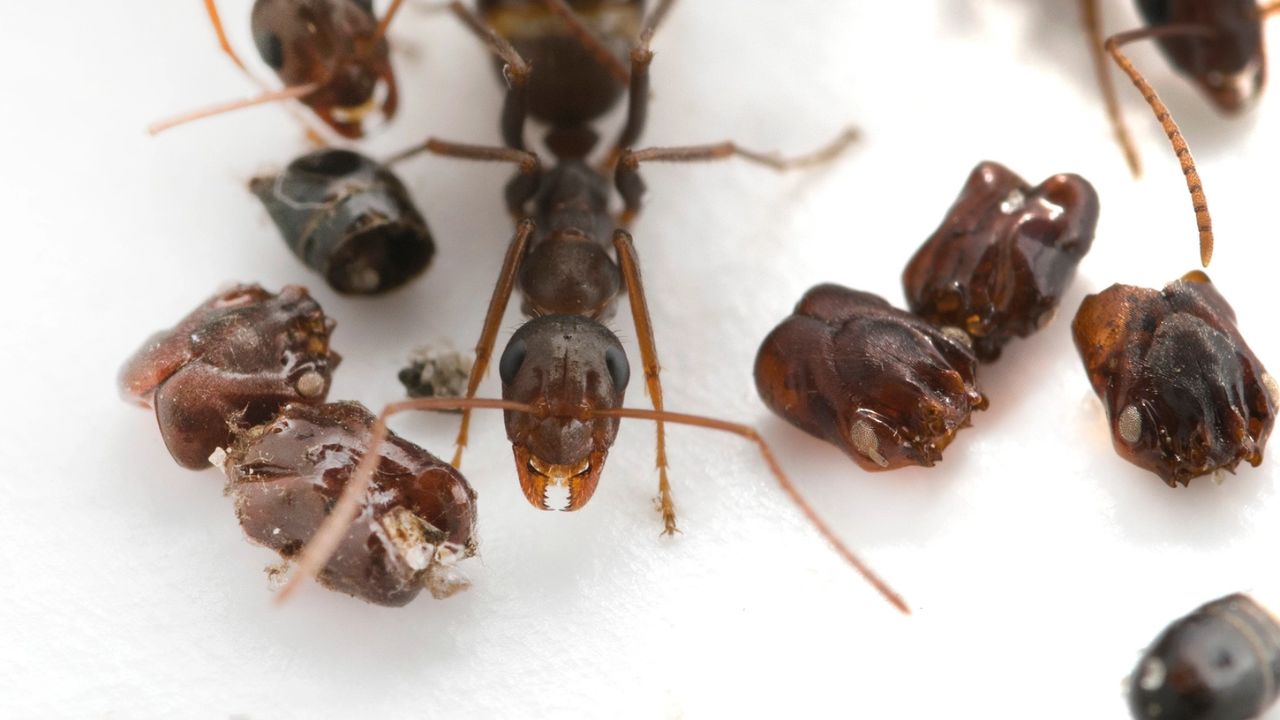
Scientists Investigate Why Ants Use Heads of Other Species as Decoration and How It Relates to Hunting, Chemistry, and Evolution.
What drives ants to collect heads of other species as decoration for their nests? This is the question that has mobilized scientists for decades and is now beginning to gain answers.
Researchers led by Adrian Smith from North Carolina State University published a recent study explaining how the species Formica archboldi manages to hunt much larger and dangerous ants.
The discovery was made from field observations and chemical analyses carried out in the southeastern United States, especially in Florida, where these ants live.
-
How an innovative city combines high technology, well-being, and sustainability to become the largest reference in clean energy on the planet.

-
Couple buys 1846 church in ruins for R$ 660,000, invests R$ 3.2 million in renovations, transforms it into a millionaire mansion, and even preserved a historic cemetery with over 300 graves.

-
He started running at 66 years old, broke records at 82, and is now a subject of study for having a metabolic age comparable to that of a 20-year-old, in a case that is intriguing scientists and inspiring the world.

-
Oldest tree on the planet reappears after 130 years of searches: Wattieza, 385 million years old, was 10 meters tall and had no leaves or seeds; Gilboa fossils in New York solved the mystery in 2007.


The study reveals how, when, and why this unusual strategy may have evolved, mixing aggressive behavior, chemical camouflage, and a curious practice of macabre decoration.
What Are the Ants That Collect Heads?
The Formica archboldi is a small species with a rusty coloration, but with very noticeable habits.
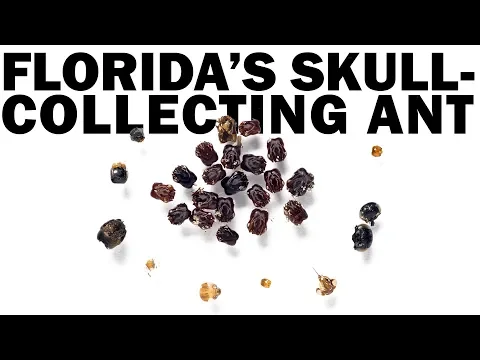
About 60 years ago, scientists already knew that their nests are often surrounded by heads or remains of stinging ants, insects known for their giant jaws and quick movements.
These heads scattered around the nest attract attention not only for their visual aspect but also for the risk involved.
Stinging ants have jaws capable of snapping shut like a trap and can even throw them away in case of danger. Still, they become frequent prey.
How Do Ants Manage to Defeat Such Dangerous Enemies?
For a long time, the central question was: how do these small ants manage to kill adversaries that are so well-armed?
The answer came with detailed experiments. According to the study, the Formica archboldi attacks using quick jets of formic acid, a toxic substance produced by many ants, but rarely used offensively.
While most species use this acid only defensively, these ants go straight for the attack.
The acid is launched precisely, immobilizing the prey in seconds. Thus, the head is separated from the body and taken back to the nest, where it becomes part of the curious decoration.
Is the Nest Decoration Just Aesthetic? Probably Not!
At first glance, spreading heads of enemies around the nest seems just a strange behavior. However, experts believe that this decoration may have practical functions.
One hypothesis is that the remains of the prey help mask the scent of the colony, confusing predators or rivals.

Additionally, the presence of these heads may act as a visual warning to other ants, indicating that the territory already has efficient defenses. Although there is still no consensus, the practice clearly goes beyond mere coincidence.
Ants heavily rely on chemical signals called cuticular hydrocarbons to communicate, recognize companions, and identify threats.
Interestingly, analyses have shown that the scent of Formica archboldi is very similar to that of the stinging ants it hunts.
This detail intrigued scientists. In theory, mimicking the scent of the prey could facilitate approach during hunting. However, tests did not confirm this direct advantage. Thus, another explanation began to gain traction.
A Third Character Enters the Story: The Kidnapping Ants
The alternative explanation involves a third type of ant known for kidnapping entire colonies. These parasitic ants invade nests of species in the genus Formica, kill the queen, and use her scent to camouflage themselves.
As a result, they go unnoticed and create workers that further kidnap more ants. Faced with this threat, changing the scent pattern may be a survival strategy.
By mimicking the odor of stinging ants—which are not targets of these kidnappers—the Formica archboldi could evade parasitism.
Although this hypothesis has yet to be proven, the data points to a complex evolutionary relationship.
Decapitating ants are only found in regions where native stinging ants also exist. Furthermore, they do not mimic recently introduced species, which reinforces the idea of coevolution.
Therefore, the similarity in scent is unlikely to be a coincidence. It is possibly a strategy refined over thousands of years, involving hunting, defense, and survival.
What Do Experts Say About the Discovery?
The research has drawn attention from the scientific community. For entomologist Andy Suarez from the University of Illinois, the behavior is surprising.
He compares the acid attack to scenes from fantasy movies, highlighting the unexpected efficiency of these ants.
Corrie Moreau from the Field Museum of Natural History notes that the study raises more questions than answers.

For her, using heads as decoration may be directly linked to chemical camouflage, but this still needs to be tested.
In the end, the story of the ants, with their heads turned into decoration and chemical strategies, shows how even the smallest living beings can exhibit complex behaviors.
Each discovery reveals a little more but also reinforces that nature still holds deep mysteries.
Source: National Geographic







-

-

4 pessoas reagiram a isso.