





 Portuguese
  English
  Spanish
  4 min of reading
  0 comments


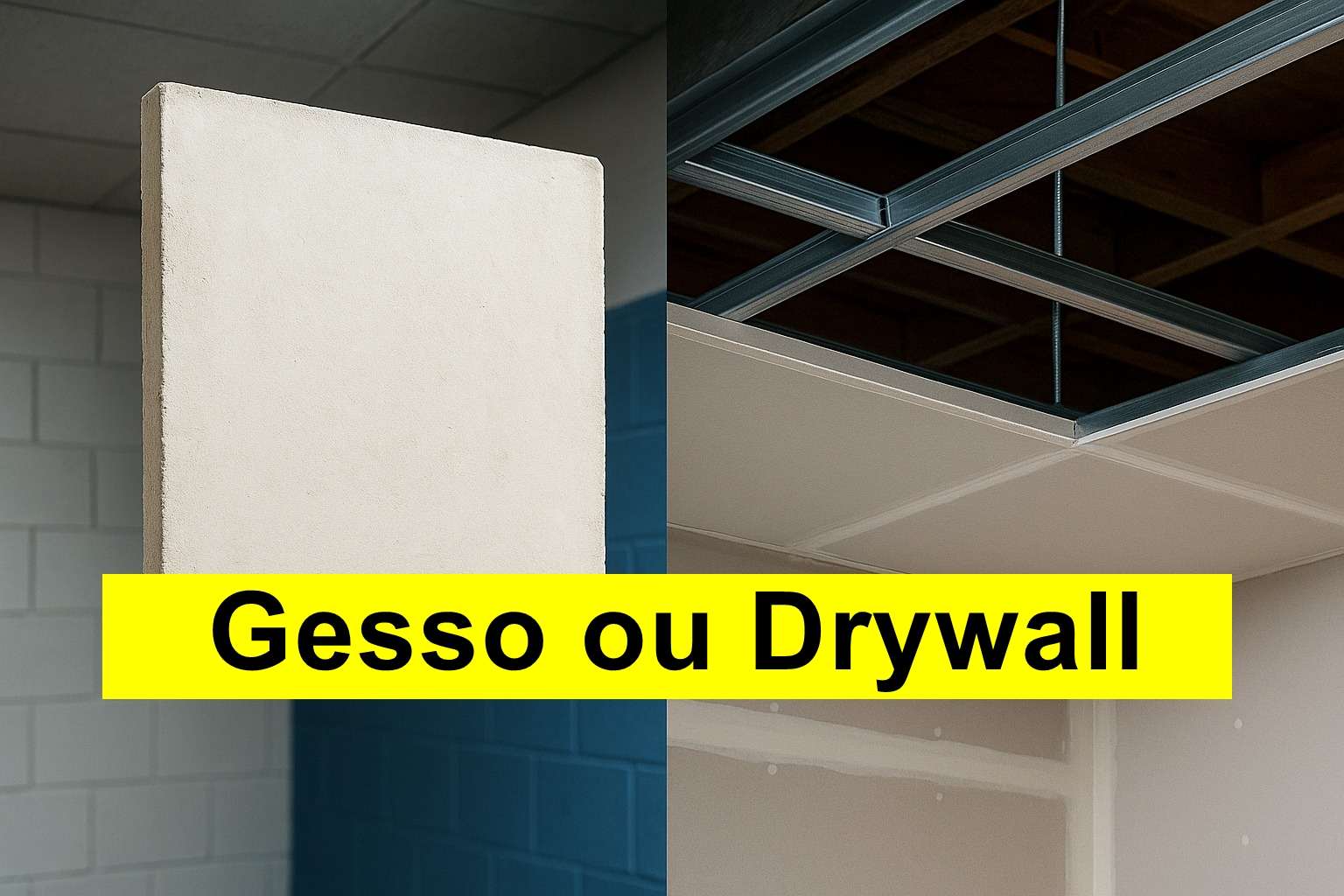
The Comparison Between Drywall and Plaster Board Highlights Differences in Installation, Cost, Mess, Maintenance, and Usage Limitations, Helping Those in Construction Choose the Most Appropriate System for Each Type of Environment.
The decision between installing drywall or plaster board ceiling often raises questions for those in the process of lowering ceilings in homes or businesses.
Understanding how each structure is assembled is essential to avoid future problems and assess the most suitable ceiling type for each situation.
How Each System Is Assembled
The common plaster ceiling, known as plaster board, uses 60 by 60 centimeter panels attached with wire, sisal, and plaster. The pieces feature a fitting system that allows for continuous ceiling assembly directly on the job site.
-
These living root bridges and ladders are over 700 years old and help indigenous people survive in one of the rainiest regions in the world.

-
From sertanejo star to international investor: Ana Castela invests millions in a mansion in the USA, creates a themed accommodation in Orlando, and shows that the “boiadeira” also wants to grow away from the stage.

-
The 10 most stunning motorhomes in the world: a $3 million trailer with a rooftop nightclub and garage for a Ferrari, “palaces on wheels” with Italian marble, private cinema, and five-star hotel luxury for billionaires.

-
Trump wanted to spend $400 million on the White House, but the courts prohibited the million-dollar construction.

Drywall follows a more modern model and has two versions: structured and wired. The structured version, considered the most common, uses larger panels of 1.20 by 1.80 meters or 1.20 by 2.40 meters.
The installation occurs with thicker wire than that used in common plaster, as well as regulators and metal profiles. The panels are screwed in and finished with tape and specific compound.
The wired drywall, on the other hand, uses wire of the same thickness as common plaster, does not employ metal profiles, and has an H-type joint to connect the panels. The joint treatment follows the same pattern as the structured version.
These technical differences influence the performance, cleaning, cost, and maintenance possibilities in each system.
Finishing and Final Appearance
In aesthetic terms, both drywall and plaster board ceilings allow for the execution of cornices, illuminated cornices, curtain rods, and other project details.
Once installed and painted, both types have a similar appearance, provided that the installer and painter correctly follow the expected steps.
Mess Generated and Execution Time
The amount of mess is one of the main distinguishing points between the systems. The plaster board ceiling generates a large amount of waste, as the attachment with sisal and plaster occurs directly at the job site.
For already occupied spaces, such as inhabited residences or businesses in operation, it is advisable to discard the traditional option and prioritize drywall, which produces less mess.
In terms of execution time, drywall also stands out. Being industrialized, it tends to be installed more quickly. However, this difference becomes significant only in large-scale projects. In small houses or apartments, the time difference between systems is considered minimal.
Costs and Usage Restrictions
In terms of cost, plaster board ceilings emerge as the more accessible option. The price can be 20% to 40% lower than that of drywall, depending on the region. Being a simpler system, it generally ends up being cheaper in most scenarios.
There is, however, an important limitation: plaster board is recommended only for locations with slabs. In constructions with roofs, such as houses and warehouses, both plaster board ceilings and wired drywall should be excluded, indicating structured drywall as the appropriate alternative.
Maintenance and Subsequent Adjustments
Regarding maintenance, drywall offers greater ease. Repairs such as repositioning lights or closing holes can be made with pieces of panel, profiles, and screws. In plaster board, the intervention is considered more complex.
Despite this advantage, the creator cautions that any alterations after the completion of the ceiling, regardless of the system, harm the structure and incur additional costs. Therefore, it is recommended to define the lighting project in detail before execution to avoid rework.
Technical Assessment and Final Recommendations
Drywall is often seen as an evolution of common plaster ceilings. Drywall stands out for being a dry system, more modern, and more resistant. The paper covering that surrounds the panels contributes to protection, reduces stains, and increases durability.
As the panels are larger, they result in fewer joints and less risk of cracking. The joint treatment, with paper tape and specific compound, also reinforces resistance to expansions.
Regarding wired ceilings, in practice, it is common to find projects where the system is not properly assembled.
In such cases, it is considered safer to opt for plaster board ceilings than for poorly executed wired drywall. For those seeking the most economical alternative, common plaster remains a valid option, provided the construction has a slab.
Finally, it is advisable for consumers to seek qualified professionals and request references before hiring the service. Many jobs are executed inadequately and require maintenance soon, leading to costs and frustrations.
The recommendation is to evaluate the type of ceiling based on the type of work, budget, and level of quality required to avoid future problems.








Seja o primeiro a reagir!