





 Portuguese
  English
  Spanish
  6 min of reading
  0 comments


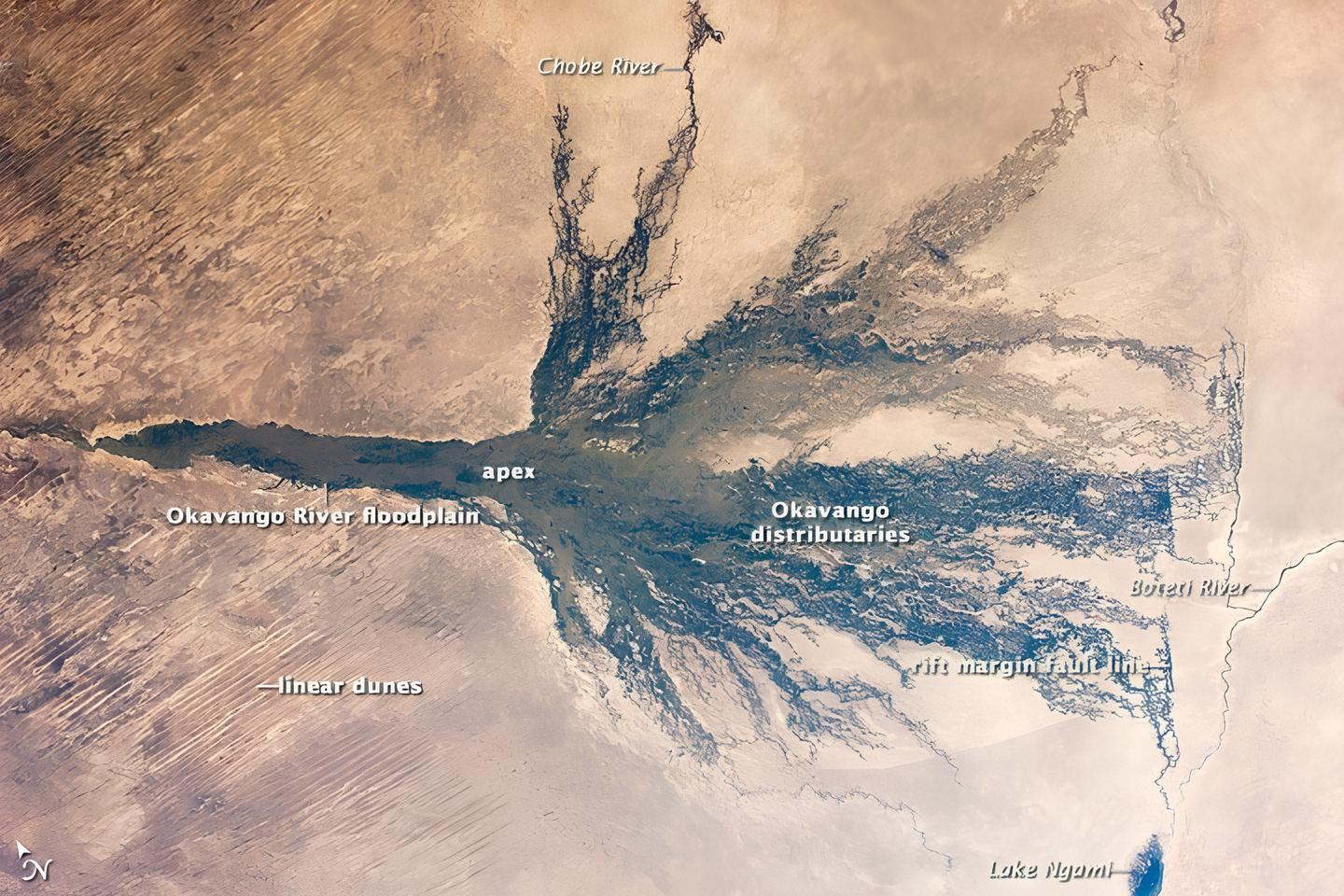
The Okavango Delta defies logic by emerging in the middle of the desert and creating one of the most dynamic and visible aquatic systems in space.
In images captured by astronauts aboard the International Space Station and released over the years by the NASA Earth Observatory, a natural formation repeatedly draws attention: a gigantic, green, and pulsating delta, spread out in the middle of one of the most arid regions on the planet. This is the Okavango Delta, located in Botswana, in southern Africa, described by NASA itself as a vast wetland that emerges almost improbably in the interior of the Kalahari Desert.
What makes this system so unique is the fact that it does not flow into the ocean, as is the case with the vast majority of the world’s large deltas. Instead, it dissipates in the interior of the continent, creating a landscape that seems to contradict the most intuitive rules of geography. According to NASA, the annual flood of the Okavango River slowly advances from the highlands of Angola, traverses about 150 kilometers of delta, feeds forests and wetlands, and instead of flowing to the sea, loses most of its water through evaporation, absorption by vegetation, and infiltration into the soil.
While most rivers on the planet flow toward the sea, the Okavango ends its journey by evaporating and infiltrating into the soil, forming one of the largest inland wetland systems in the world. NASA itself highlights that only about 2% of the river’s water actually leaves the delta, which makes the Okavango one of the most impressive examples of internal drainage on the planet and a living record of how climate, topography, and hydrology can produce a nearly unique landscape on Earth.
-
Archaeologists find giant Roman necropolis with 3,000 tombs hidden beneath the city, and the discovery could rewrite the history of Zadar.

-
Asian fruit with intense red color concentrates up to 70 times more lycopene than tomatoes and contains beta-carotene at extremely rare levels in the plant world, according to scientific studies; meet gac.
-
China drilled more than 3,400 meters of ice in Antarctica using hot water and set a world record by nearly one thousand meters, paving the way for discoveries about the limits of life in extreme environments.
-
Companies want to use satellites with mirrors to illuminate the Earth at night, and scientists around the world warn that eliminating darkness could destroy entire ecosystems and affect the health of billions of people.

The origin of the waters that feed the impossible
The functioning of the Okavango Delta begins thousands of kilometers away, in the highlands of Angola. It is there that seasonal rains feed the Cubango River, which further on becomes known as the Okavango.

This detail creates a curious temporal phenomenon. While Botswana goes through its dry season, the waters from the rains that fell months earlier in Angola begin to reach the delta, flooding the region just when the rest of the environment is most arid.
This natural delay causes the delta to reach its peak expansion between June and August, a period when the surrounding desert is practically rainless.
The result is a dynamic landscape, where water and land are in constant competition, reshaping the territory with each annual cycle.
An area that can exceed 15,000 km² during flood periods
During peak floods, the Okavango Delta can cover an area greater than 15,000 km², depending on the intensity of the rains in the river’s source regions.
This expansion does not occur uniformly. The water spreads across a complex network of channels, lagoons, and wetlands that constantly change shape and position.
Islands emerge, disappear, and shift over the years, while channels open and close as the flow of water varies. This behavior makes the delta an extremely dynamic system, both hydrologically and ecologically.
This continuous transformation is one of the reasons why the location has become one of the most studied environments on the planet.
A natural labyrinth visible from space
When viewed from space, the Okavango Delta stands out as an irregular green patch amidst the yellow and brown tones of the Kalahari Desert.
Satellite images reveal a pattern resembling an organic network of veins, with channels branching out in all directions. In some areas, water forms large reflective mirrors; in others, it appears as winding strips surrounded by vegetation.
This extreme contrast between water and desert is what makes the delta frequently cited by astronauts as one of the most striking landscapes on Earth as seen from orbit.
The absence of significant urban interference also contributes to the clarity of these images, allowing for the observation of the natural functioning of the system on a continental scale.
Soil, evaporation, and the final destination of water
Unlike rivers that flow to the ocean, the water of the Okavango has no defined outlet. About 95% of the volume that reaches the delta is lost through evaporation or infiltration into the soil.
The intense heat of the desert accelerates this process, causing the water to gradually disappear as it spreads.
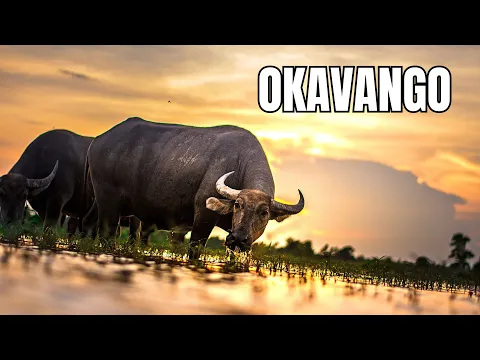
This mechanism creates a closed cycle, in which water enters, distributes, and disappears without ever reaching the sea, something extremely rare in large-scale river systems.
This delicate balance directly depends on the volume of water that reaches the delta each year, making the system highly sensitive to climate changes and hydrological variations.
Biodiversity concentrated in an unlikely spot
The constant presence of water in a predominantly arid region transforms the Okavango Delta into one of the largest wildlife refuges in Africa.
It is home to significant populations of elephants, lions, hippos, crocodiles, and numerous bird species. During the flood, the abundance of water attracts animals from drier regions, concentrating biodiversity in a relatively limited area.
This concentration makes the delta one of the richest ecosystems on the planet, despite being located in an environment that theoretically would not support such diversity.
Moreover, the alternation between dry and flooded periods creates different ecological niches, allowing for the coexistence of species with varied needs.
A system shaped by time and geology
The formation of the Okavango Delta is directly linked to geological faults that altered the course of the river over thousands of years.
Instead of flowing toward the ocean, the river encountered a tectonic depression that began to function as a dissipation basin. This geological factor is essential to understand why the delta exists exactly where it does.
Without this underground structure, the Okavango would likely follow the common pattern of rivers and flow into the sea, completely eliminating this unique phenomenon.
This aspect reinforces the idea that the delta is the result of a rare combination of geological, climatic, and hydrological factors.
One of the few inland deltas on the planet
The Okavango Delta is often classified as one of the largest inland deltas in the world, precisely because it has no connection to the ocean.
This type of formation is extremely rare, especially on such a large scale. Most known deltas occur at the mouths of rivers that flow into seas or oceans.
In the case of the Okavango, the system functions as a “delta without an outlet,” where all the water is absorbed by the environment itself, creating a closed cycle that has intrigued scientists for decades.
Environmental pressures and global importance
Despite its untouched appearance, the Okavango Delta faces increasing pressures related to climate change, upstream water use, and human expansion.
Any alteration in the river’s flow can directly impact the balance of the system. Reductions in water volume can decrease the flooded area, affecting the entire ecological chain.

For this reason, the delta has been recognized as a UNESCO World Heritage Site, highlighting its importance not only regionally but globally.
Preserving this system means maintaining one of the most extraordinary examples of interaction between water, climate, and geology on the planet.
A landscape that seems impossible, but exists
The Okavango Delta remains one of the most intriguing natural phenomena on Earth. A river that does not reach the sea, a system that grows at the height of drought, and a landscape that completely changes each year.
It is one of the few places on the planet where geographical logic seems reversed, creating a scenario that defies expectations and constantly attracts the attention of scientists, photographers, and astronauts.
What do you think of this delta that emerges in the middle of the desert and disappears without a trace?
A system that grows when it should dry up, that spreads without an outlet, and that sustains life in one of the most hostile environments on the planet raises an inevitable question: how many other phenomena still exist on Earth without the majority of people even imagining?






Seja o primeiro a reagir!