





 Portuguese
  English
  Spanish
  8 min of reading
  0 comments


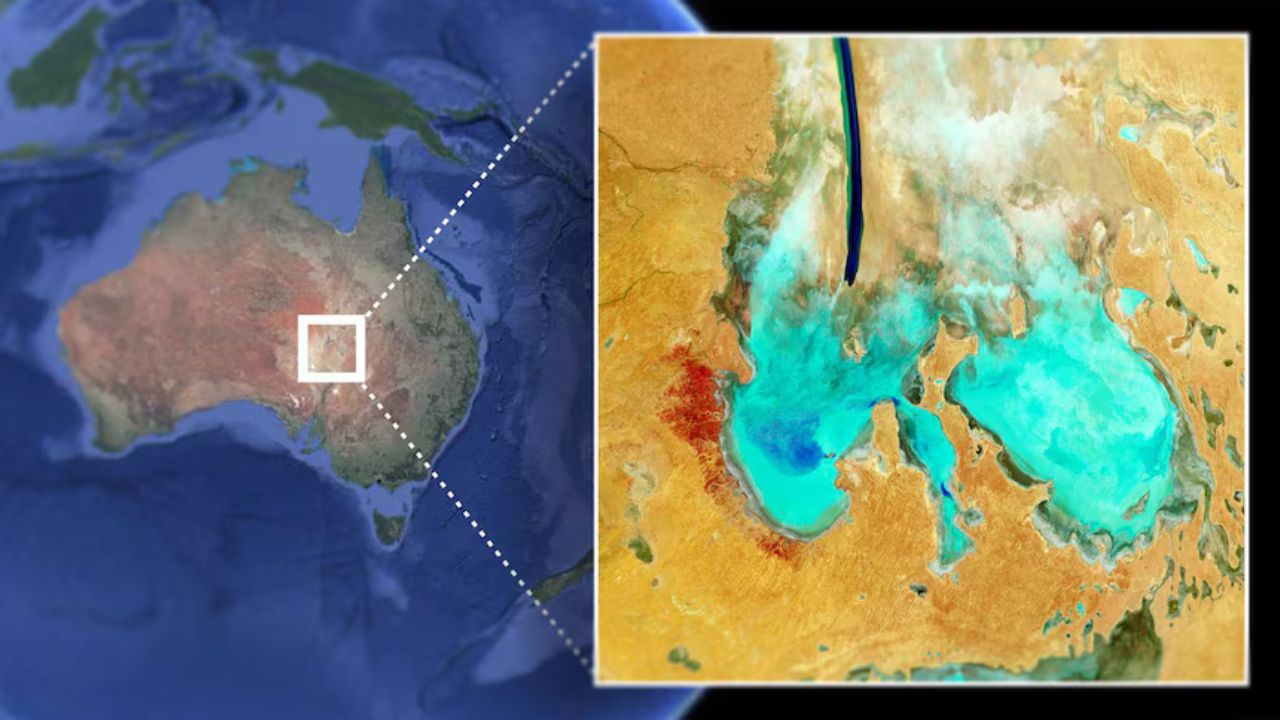
Lake Eyre, in Australia, spends years dry, is 15 meters below sea level, and in rare floods becomes an inland sea visible from space.
In 2025, the NASA Earth Observatory once again highlighted Kati Thanda–Lake Eyre, in the state of South Australia, as one of the planet’s most improbable natural phenomena. After extreme rains in Queensland, waters began to flow inland through the Outback, replenishing a vast salt flat that usually remains dry, in the heart of the continent’s driest area. NASA itself described the 2025 episode as a replenishment of water on a scale not seen in decades, reinforcing the rare and visually stunning nature of the phenomenon.
The impact of this transformation is even greater because the lake is located in a region where the average annual rainfall is extremely low. According to NASA, Lake Eyre receives about 140 millimeters of rain per year, an amount insufficient to permanently sustain such a large body of water. Still, when major floods come down from the north, the place ceases to be a white, salty desert and begins to transform into a vast temporary inland sea, in one of the most impressive hydrological cycles of the Australian interior.
The lowest point in Australia spends years dry and suddenly refills
Kati Thanda–Lake Eyre is not just a temporary lake. It occupies the lowest natural point in Australia, at 15.2 meters below sea level, and is also the largest salt lake in the country. The official national park of South Australia highlights that it has filled completely only three times in the last 160 years, which helps explain why each major flood is treated as a historical and ecological event.
-
In Antarctica, a building has just achieved a certification that only 1% of accredited buildings worldwide can attain, in an engineering feat erected in one of the most hostile environments on the planet.
-
A Meta employee is accused of downloading over 30,000 private photos of Facebook users, and one of them could be you.

-
A diver found a 900-year-old sword at the bottom of the Mediterranean Sea, and its state of preservation impressed scientists so much that it could rewrite what is known about the Crusades.

-
The city has 33 islands, urban beaches, and the highest education rating among all the capitals of Brazil, but almost no one remembers it when thinking about living or traveling in the Southeast.
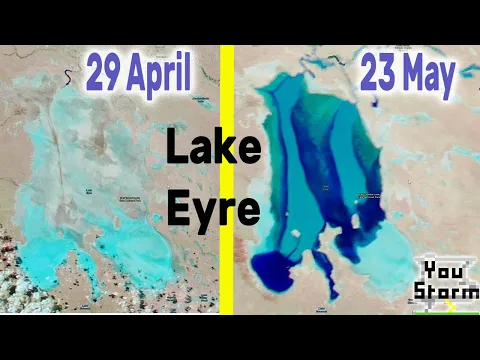

The Encyclopaedia Britannica reinforces this exceptional character by recording that the lake normally remains dry and that its documented complete fillings occurred in 1950, 1974, and 1984.
When this happens, the body of water takes about two years to disappear again, in a slow process dominated by intense evaporation. This means that Lake Eyre is, at the same time, a real lake and an absence of lake most of the time, a geographical contradiction that makes it one of the most unusual landscapes on Earth.
The lake exists because a huge part of Australia drains into the continent, and not to the sea
One of the reasons that makes Lake Eyre so fascinating is the fact that it is at the center of one of the largest endorheic basins in the world, meaning an internal drainage system where water does not reach the ocean. The official management plan of the park states that the Lake Eyre Basin covers about 1.2 million square kilometers, while NASA notes that approximately one-sixth of Australian territory drains towards this internal system, instead of flowing to the sea.

This configuration completely changes the logic of the place. Instead of flowing into a coast, intermittent rivers traverse arid areas and lead water to the center of the continent.
However, most of this flow is lost before reaching its final destination because heat and evaporation are relentless. What remains, when it remains, feeds Lake Eyre. It is precisely this combination of continental drainage, extreme heat, and sporadic floods that creates the “impossible lake” of the Australian desert.
Instead of being fed by local rains, the lake depends on floods that travel hundreds of kilometers through the Outback
The mechanism that makes the lake reappear is neither simple nor immediate. The waters that reach Kati Thanda–Lake Eyre often originate far away, especially after intense rainfall events in Queensland.
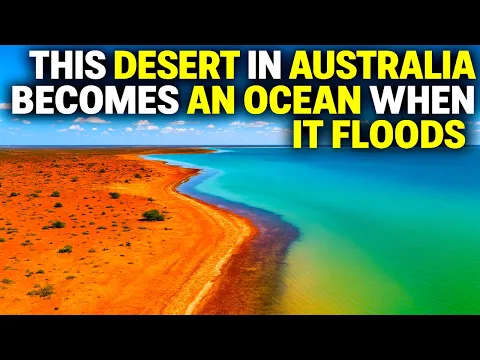
In 2025, NASA recorded that extreme rainfall in the Australian autumn flooded several rivers flowing inland and, since the end of March, these floods spent months traversing hundreds of kilometers of desert to reach the lake.
This detail is crucial for understanding the landscape. The lake may be in a dry region, but its eventual survival depends on hydrological events occurring far away. That is why the system seems so counterintuitive: while the immediate surrounding area remains arid, the lake can begin to fill due to rains that occurred in other parts of the basin months earlier.
The “inland sea” of the Outback does not arise from local rain, but from the slow and persistent journey of water through a vast and hostile territory.
When the flood arrives, the white desert changes color and the lake may look like another landscape seen from space
The year 2025 was particularly remarkable because the filling not only returned water to the lake but also significantly altered its visual appearance.
In January 2026, NASA published that 2025 was an extraordinary year for Lake Eyre, with levels rarely seen and a change in appearance after the water began to recede. The report shows that, after the tributaries slowed down and evaporation began to exceed the inflow of water, the lake started to transform again.
These changes are not just quantitative. They also affect the color of the lake. As the water evaporates and salinity concentrates, the surface can take on hues that go beyond the classic white of the salt crust.
It is precisely this visual mutation that reinforces the fascination of the place in orbital images. Lake Eyre is not just a lake that fills and dries; it is a system that changes shape, texture, and color, as if the entire desert were being repainted with each rare flood.
The size of the phenomenon helps explain why it draws so much attention when it appears
The scale of Kati Thanda–Lake Eyre is also decisive for the impact of the phenomenon. Britannica records that the lake, considered as a whole between its Northern and Southern sections, occupies a total area of 11,088 km², and also states that the system extends about 144 km in length and 77 km in width overall.
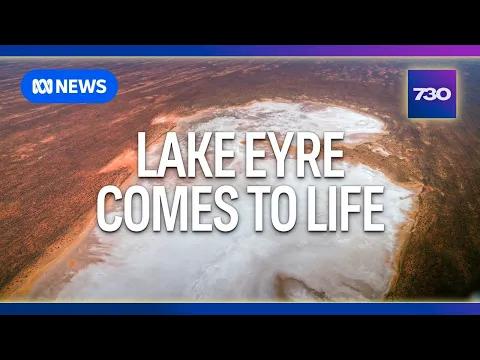
The park’s management plan highlights 950,000 hectares for the lake area, confirming that it is a gigantic landscape, even when empty.
This size completely changes the perception of the event. It is not a pond that occasionally reappears, but a vast continental depression that can transform into a seasonal inland sea.
When water spreads over this extremely flat surface, the result is such a large territorial alteration that satellites can clearly track the advance of the phenomenon. It is this meeting of continental scale and hydrological rarity that makes Lake Eyre so hypnotic in NASA’s images.
Water lasts little because heat and evaporation almost always win
If the emergence of the lake is impressive, its disappearance also helps to understand why it is so rare. Britannica explains that the water that reaches Lake Eyre evaporates very quickly and that the surface of the bed becomes covered by a salt crust deposited precisely by this process. In other words, the lake is doomed to lose the battle against the climate as soon as the inflow weakens.
NASA showed exactly this process at the end of 2025. After the floods slowed down, evaporation began to dominate, and levels started to drop rapidly with the arrival of the Australian summer.
The result is that the same body of water that months earlier looked like an inland sea gradually returns to being a salty plain. The cycle of Lake Eyre is a brutal contest between flooding and evaporation, and it is almost always the heat that wins in the end.
Even ephemeral, the lake triggers an outburst of life in an arid environment
The official park of South Australia describes Kati Thanda–Lake Eyre as a landscape of dramatic contrasts, capable of shifting from a salty plain to a vast wetland system with an abundance of birds after heavy rains.
The management plan reinforces that flooding events stimulate large cycles of reproduction of fish, invertebrates, and waterfowl, including rare or threatened species that depend precisely on these moments.
This shows that the importance of the lake goes far beyond visual impact. When it fills, it is not just creating a stunning landscape. It is reactivating an entire ecological system. In an environment where life absolutely depends on water, each major flood of Lake Eyre functions as a kind of biological pulse that reignites the region.
The place is also central to the cultural heritage of the Arabana and Dieri peoples
Another essential point is that Kati Thanda–Lake Eyre cannot be reduced to a geographical curiosity. The official park states that the area is managed in partnership with the Arabana and Dieri peoples, and the management plan explicitly records the cultural importance of water, lakes, temporary waterways, and the traditional stories associated with the region.
This aspect changes the reading of the place. What may seem to external observers as just a rare desert phenomenon is, for the indigenous peoples, part of a living, spiritual, and historical landscape.
The official document also preserves statements from Arabana elders about the connection between water, survival, and responsibility for the territory. This means that Lake Eyre is at once extreme geology, pulsating ecology, and deeply significant cultural territory.
The lake shows that the Outback is not an immobile vacuum, but a system in transformation
One of the greatest lessons of Kati Thanda–Lake Eyre is that the arid interior of Australia is not a stagnant space. The classic image of the Outback as a dry, unchanging void does not withstand the scale of transformation caused by these flooding events.
NASA recorded, in 2025, that waters advanced for months and replenished an inland sea on a scale rarely seen, while the government of South Australia highlighted that the filling of 2025 was only the fourth major event of this kind in 160 years.
These data show that the system moves at very different rhythms from urban or agricultural environments. Sometimes, it appears dead for years.
Suddenly, it reacts. Fills. Changes color. Attracts life. Then it dries up again. Lake Eyre is a powerful reminder that some of the most impressive landscapes on Earth are not permanent, but cyclical, unstable, and dependent on a delicate balance between rain, distance, salt, and heat.
Did you know about the lake that disappears and reappears in the heart of the Outback?
Kati Thanda–Lake Eyre brings together everything that makes a landscape memorable: it is 15.2 meters below sea level, spends years dry, only fills completely on rare occasions, depends on floods that traverse the interior of Australia, and when it receives water, it changes the ecology and appearance of a vast area in the middle of the desert. That is why it remains one of the most extraordinary scenes ever recorded in NASA images on the planet.
Now I want to know your opinion: is this kind of impossible landscape, which disappears and returns in one of the driest areas on Earth, one of the most impressive natural phenomena on the planet, or do you know of another place that is even more surprising?





Seja o primeiro a reagir!