






 Portuguese
  Spanish
  4 min of reading
  0 comments


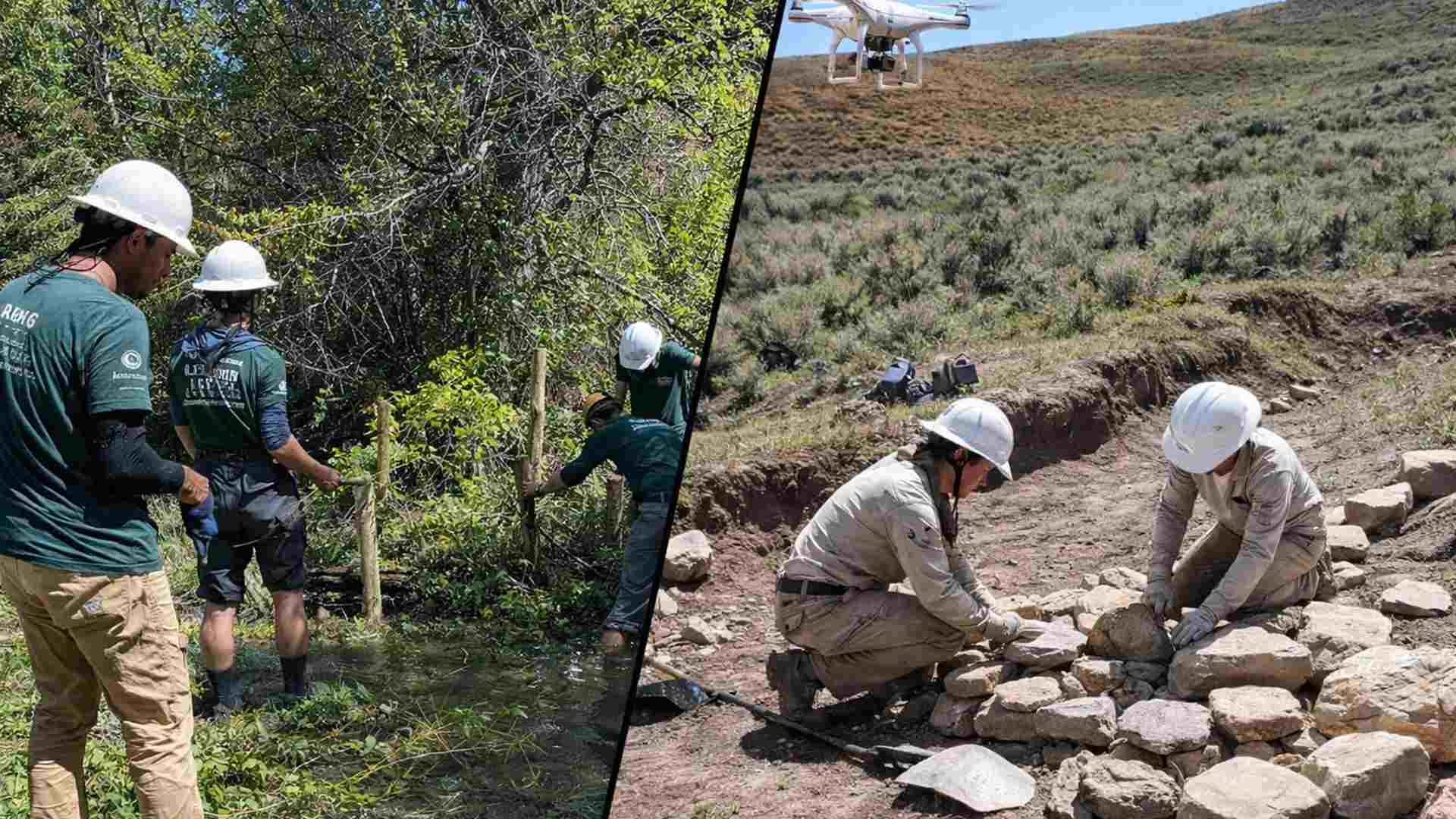
Drones are monitoring an unusual restoration in Wyoming, where youth built 74 artificial dams inspired by beavers and 100 stone structures to contain erosion, retain water in streams, and attempt to recover degraded areas near Big Piney and LaBarge
In a landscape marked by erosion, degradation, and habitat loss in the southwestern state of Wyoming, USA, teams of youth have taken on an unusual task: building, by hand, structures that mimic beaver dams to try to restore streams and wetlands in the LaBarge watershed, near the communities of Big Piney and LaBarge.
The initiative was led by the Bureau of Land Management, the BLM, in partnership with the Rocky Mountain Youth Corps, Montana Conservation Corps, and American Conservation Experience.
Structures mimicked beaver dams, but without beavers
The intervention actually occurred without the direct participation of beavers. Instead of relying on the animals to initiate the natural recovery of the environment, the project used structures known as Beaver Dam Analogs, or BDAs, made by people to replicate the function of natural dams.
-
Survivor of 1966 SS Daniel J. Morrell Shipwreck in Lake Huron Recounts 38-Hour Ordeal in Extreme Cold

-
The Greatest Hoax in World Cup History? The Film That Denied Brazil’s 1958 Victory and Exposed How Fake Evidence Can Seem Convincing on TV
-
Fake South Korean Online Stores Offer Shopping Thrill Without Spending Money or Receiving Products
-
The War of Jenkins’ Ear: How a Severed Ear Sparked One of the 18th Century’s Most Unusual Conflicts


The goal is to slow down water flow, increase water retention in the landscape, reduce erosion, and promote the regeneration of riparian vegetation. The BLM describes these works as human-designed dams based on the model created by beavers in nature.

Project raised 74 BDAs and 100 stone structures
The BDAs are assembled with wooden posts fixed in the streambed and with interwoven branches between these stakes.
In the case of LaBarge, 74 structures of this type were erected along Pine Grove Creek. In addition to them, the teams also built 100 Zeedyk rock structures in the basins of Birch Creek and Dry Piney Creek.
These stone formations are used to contain the advance of erosion in ravines and side channels, disperse surface runoff, and stimulate the growth of vegetation in fragile areas.
Goal is to slow erosion and recover moisture in the landscape
The central proposal of the project is to prevent the streams from continuing to deepen and losing connection with their banks, a process that compromises soil moisture, bank stability, and the presence of vegetation.
By spreading and retaining water for longer, the structures can improve water quality, contribute to groundwater recharge, enhance riparian habitat for fish and other wildlife, and reduce sediment transport.
Idea is also to attract beavers in the future
One of BLM’s hopes is that this type of restoration will also serve as a natural push: by creating more favorable conditions, the artificial dams may make the area more attractive to beavers in the future.
The official video released by the agency in February 2024 stated that the expectation was precisely to encourage the arrival of these animals, in addition to addressing erosion and the effects of drought in a region pressured by low water availability.
Drone monitoring entered the case updates
The most concrete public updates about the case appeared in August 2024. On August 6, the BLM officially announced the initial balance of the action in LaBarge, detailing the teams involved and the number of structures completed.
Two days later, the agency announced that it would start using drones, referred to as UAS, to collect images and document the conditions of the habitat and natural resources in the restoration landscapes of LaBarge and Muddy Creek.
The technology was presented as a tool to measure results with high-resolution digital images and to monitor the evolution of the treated areas.
Larger project integrates government-funded restoration plan
In the same environmental recovery effort, the BLM announced in August 2024 an investment of about $500,000 to remove an old and non-functional dam in Wildcat Canyon and rebuild smaller channels, in a project linked to erosion control and reducing sediment delivery to the Upper Green River. The agency stated that this intervention complemented ongoing efforts in the Greater LaBarge Restoration Landscape.
The work is part of a larger program funded by resources from the Inflation Reduction Act.
The case of Big Piney and LaBarge, therefore, was not an isolated experience, but an example of how low-impact manual engineering has been used to try to reactivate natural processes in degraded streams of the American West.
More information at blm.





Be the first to react!