





 Portuguese
  English
  Spanish
  5 min of reading
  0 comments


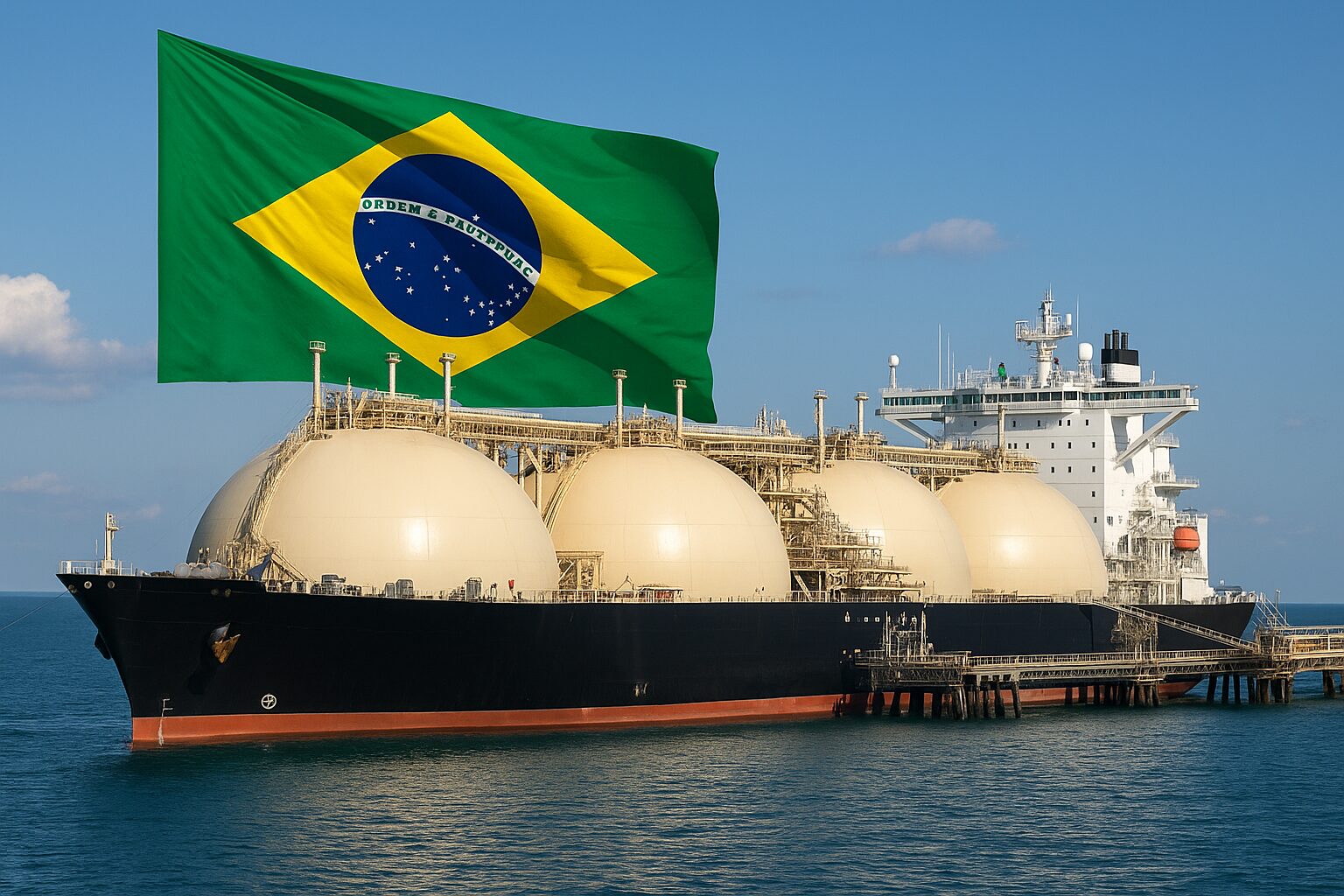
Discover How Liquefied Natural Gas Revolutionized Energy Transportation, Boosts Energy Security, and Becomes a Key Element in the Transition to a More Sustainable Future.
The Birth of Liquefied Natural Gas
The liquefied natural gas (LNG) has a history that began more than a hundred years ago. Researchers in the United States successfully liquefied natural gas for the first time in 1917, according to information from the American Gas Association.
However, only in 1964, did Algeria carry out the first commercial exports to the United Kingdom, according to the International Gas Union (IGU), marking a watershed moment in the energy industry.
Before this advancement, natural gas, primarily composed of methane, needed to be consumed close to extraction sites, as long-distance pipeline transportation was impractical, especially when crossing oceans.
-
Offshore industrial demand in Macaé skyrockets with the recovery of oil and gas and could grow by up to 396% by 2026 in the Campos Basin.
-
Offshore industrial demand in Macaé surges with the recovery of oil and gas and could grow by up to 396% by 2026 in the Campos Basin.
-
Brazilian giant expands borders in the Southeast: Petrobras confirms new oil discovery in ultra-deep waters in the pre-salt of the Campos Basin.

-
Alert in the global energy market: Severe tropical cyclone hits the coast and disrupts gas production at major plants in Australia, threatening global supply.


When scientists discovered how to cool it to around -162°C to turn it into dense and compact liquid, the energy market gained a new dimension, thus allowing its shipment on specialized vessels.
Over time, countries such as Japan, South Korea, and China became major consumers of liquefied natural gas, thus driving a true global expansion.
The LNG quickly established itself as a strategic alternative for ensuring energy security in regions with few natural resources.
The Transformation of the Global Energy Matrix
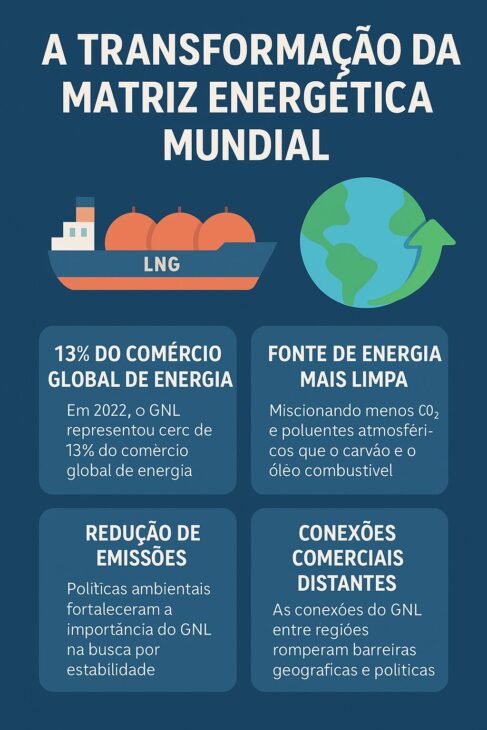
Since the beginning of its commercial use, liquefied natural gas has gained fundamental space in the global energy matrix.
According to a report by the International Energy Agency (IEA) published in 2022, LNG accounted for about 13% of global energy trade.
Governments and companies began to value it mainly for offering a cleaner energy source than coal and fuel oil, thus emitting less carbon dioxide (CO₂) and air pollutants.
Furthermore, with the strengthening of environmental policies and the pursuit of more sustainable energy transitions, many countries have adopted LNG as a key element to reduce emissions and ensure stability in supply.
As the transportation of LNG does not depend on land pipelines, it allows for commercial connections between distant regions, thus breaking geographical and political barriers.
During the European energy crisis of 2022, caused by the reduction in Russian gas supply, liquefied natural gas stood out as an emergency solution.
According to data from the International Energy Agency published in December 2022, Europe imported record volumes of LNG to avoid blackouts.
The Liquefaction and Transportation Process of LNG
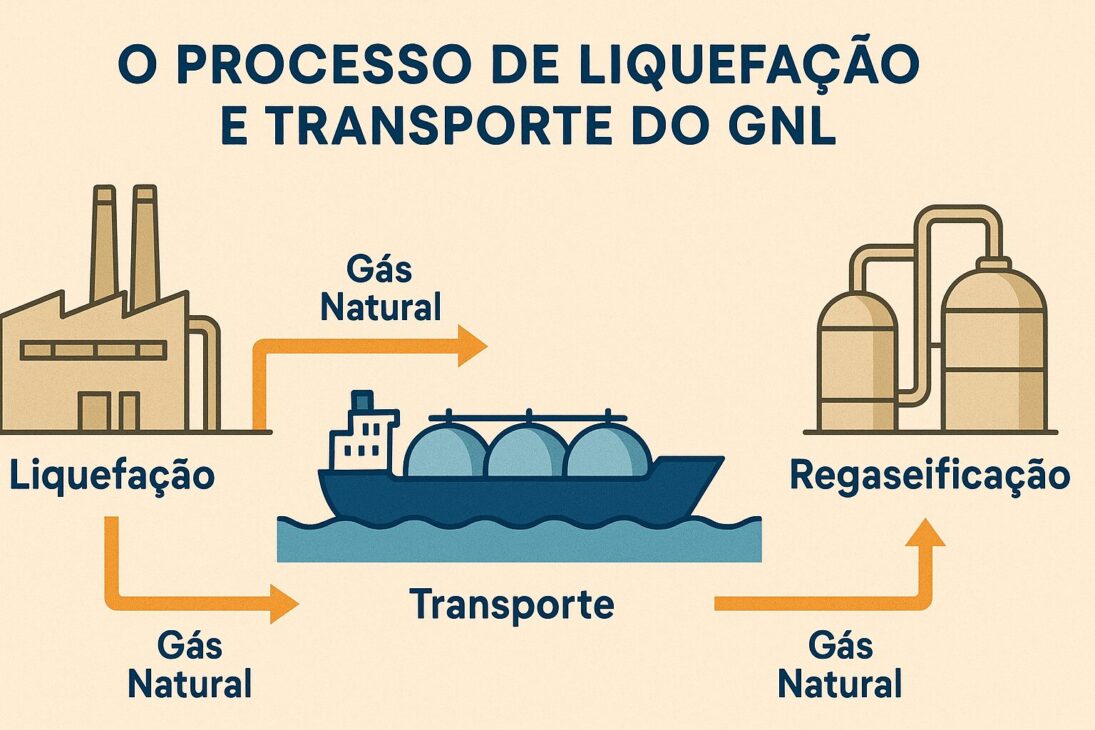
Transforming natural gas into liquid involves a sophisticated and crucial process.
First, operators purify the gas, removing water, carbon dioxide, and sulfur compounds.
Next, they cool the gas to cryogenic temperatures, which reduces its volume by approximately 600 times, as explained in a technical report from Shell Global.
This high density, therefore, makes transportation viable on ships called methane carriers, equipped with special tanks to keep the LNG at extremely low temperatures.
After arriving at its destination, LNG goes through regasification plants, where operators reheat the liquid and transform it back into gas.
Thus, it can be distributed to industries, thermal power plants, and residential consumption networks.
This entire chain — liquefaction, transportation, and regasification — requires robust infrastructure and billion-dollar investments.
However, it ensures flexibility and security in global energy supply, reinforcing the strategic role of LNG.
The Impact of Liquefied Natural Gas in Brazil
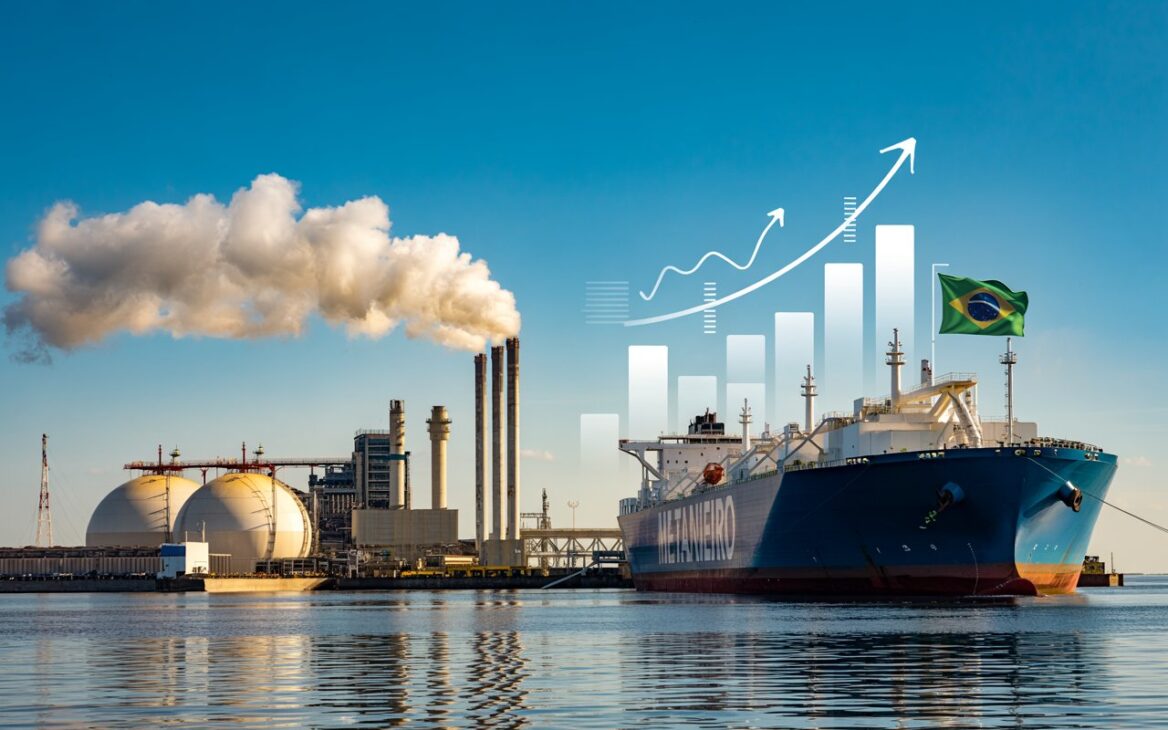
Brazil, despite its vast natural gas reserves, is heavily investing in liquefied natural gas to diversify its energy matrix.
According to data from the Energy Research Company (EPE) in 2023, the number of operational and planned regasification terminals has grown by 45% in the last five years.
In recent years, the country has expanded the installation of regasification terminals in strategic locations such as Pecém (CE), Bahia (BA), and Rio de Janeiro (RJ).
These terminals thus enable the import of LNG from various parts of the world, strengthening Brazilian energy security, especially during drought periods that impact hydropower generation.
Furthermore, LNG allows for the rapid expansion of thermal power generation, increasing the energy supply and thus reducing the risks of blackouts.
The growing use of liquefied natural gas also contributes to reducing greenhouse gas emissions, as it replaces more polluting fuels, such as diesel fuel in thermal plants.
In this way, LNG serves as a crucial pillar in Brazil’s energy transition, while renewable sources such as solar and wind gain ground every year.
New Trends and Challenges for Liquefied Natural Gas
The future of liquefied natural gas promises to be even more dynamic and innovative.
According to the World LNG Report 2023 from the International Gas Union, global LNG liquefaction capacity is expected to grow by about 20% by 2030.
Global demand is expected to rise, driven by the development of technologies such as small-scale LNG, aimed at supplying small regions, road and maritime transport, and decentralized industrial applications.
Despite the optimistic outlook, the sector faces some challenges.
International price volatility, increasingly stringent environmental demands, and high infrastructure costs hinder LNG expansion in certain markets.
Moreover, environmentalists, as pointed out by the Environmental Defense Fund, question whether LNG can truly be a long-term solution, as it remains a fossil fuel.
To maintain its competitiveness and relevance, companies and governments are heavily investing in carbon capture and storage technologies.
These solutions, as emphasized by the IEA, are essential to reduce emissions and ensure a sustainable future for the LNG sector.
Liquefied natural gas has established itself as a vital vector for energy security and the transition towards cleaner energy matrices.
Its historical development, from the first experiments to its current presence on all continents, proves, above all, the energy industry’s ability to reinvent itself.
In Brazil, LNG already plays a strategic role, reinforcing energy security and serving as a bridge to a low-carbon future.
Even facing challenges, liquefied natural gas remains a key component in building the global energy future.
Understanding the importance of LNG today is undoubtedly recognizing the foundations upon which the entire world intends to build a new era of safer, more accessible, and cleaner energy.









Seja o primeiro a reagir!