





 Portuguese
  English
  Spanish
  5 min of reading
  0 comments


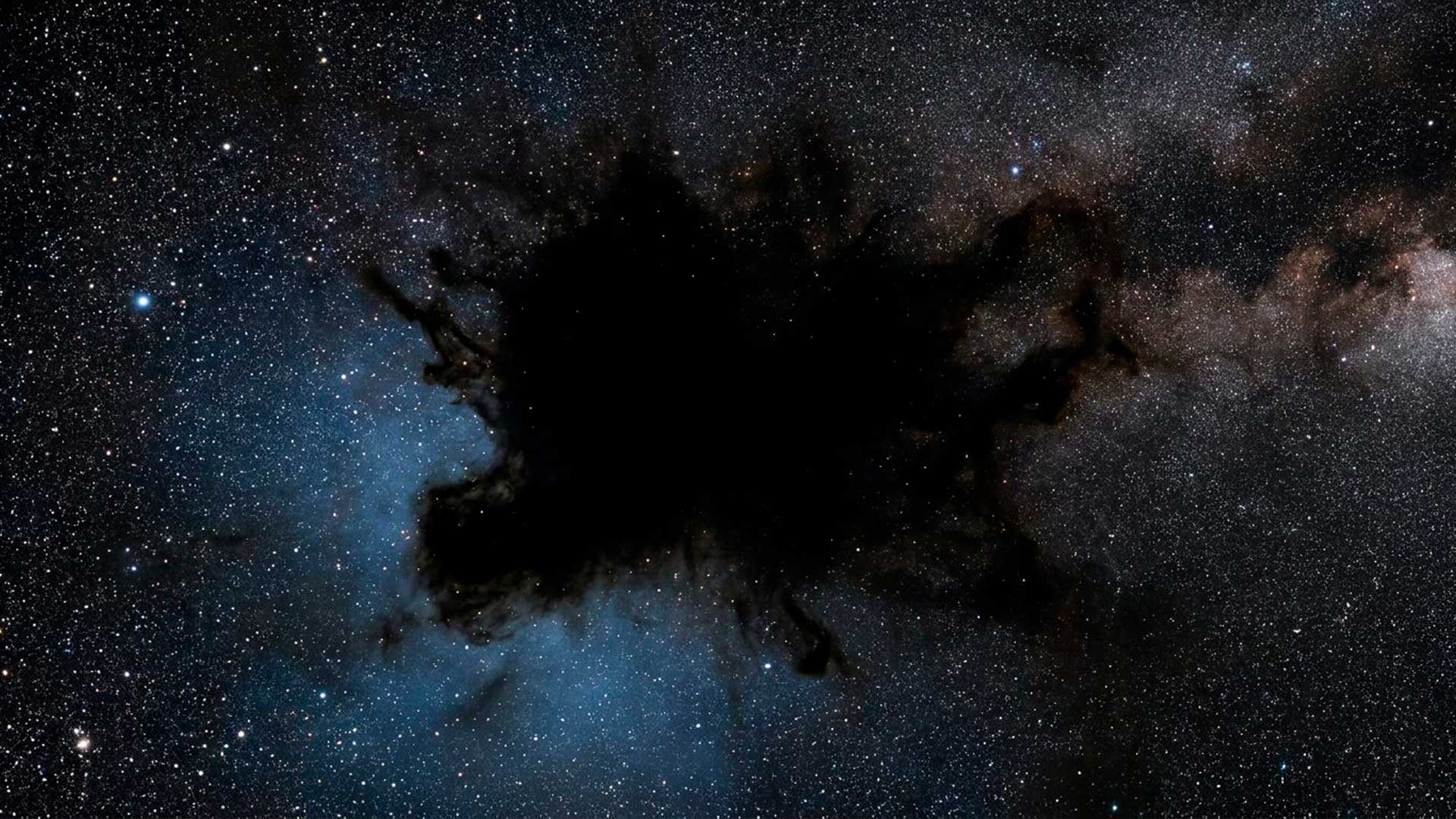
A colossal cloud of molecular hydrogen, hidden about 300 light-years away, appeared on the radar of astronomers with a technique that could rewrite the map of cold gas in the Milky Way.
The discovery of the Eos hydrogen cloud has caught the attention of astronomy for a direct and powerful reason. It is an immense gas structure, relatively close to the Solar System, that remained virtually invisible for decades despite being in the galactic neighborhood of the Sun.
Eos is about 300 light-years from Earth and is positioned at the edge of the Local Bubble, a region of hot, rarefied gas around the Sun, shaped by ancient supernova explosions. Its estimated mass is approximately 3,400 times the mass of the Sun, placing it among the largest and closest molecular clouds ever observed.
The finding gained significance because the structure was detected in a novel way for this type of object. Instead of relying on traditional signals used to locate molecular clouds, researchers observed the emission in far ultraviolet, directly revealing the molecular hydrogen present there.
-
Bahia becomes a key player in the new BRICS plan for a sovereign data center and brings Brazil closer to the competition for the future of cloud computing and AI.

-
Research gives new weight to the quipu and suggests that the Inca Empire developed an advanced method for organizing and processing data, with a structure of knots and strings that now brings the artifact closer to logics used in computing.

-
Scientists use artificial intelligence to create nearly indestructible steel that does not rust and could change the way industrial energy and oil parts are produced.

-
Instead of buying new electric trucks, India is removing the diesel engines from old vehicles and installing electric propulsion for 40% of the price, and this simple idea could be the solution that polluted megacities around the world have been waiting for.

In practice, the discovery opens a new window to study how stars and planets form and how the interstellar medium evolves around our region of the Milky Way. It also raises the possibility of other similar, cold, and massive clouds still hidden from classical observation methods.
What is the Eos cloud and why is its location near the Solar System so relevant to science

The Eos cloud is primarily composed of molecular hydrogen H₂, the essential component of the large regions where stars can be born. Since hydrogen is the most abundant element in the universe, structures of this kind serve as central pieces for understanding the construction and recycling of matter in the galaxy.
The fact that Eos is so close to our cosmic surroundings makes the discovery even more important. A cloud this large, just 300 light-years away, offers a rare chance to more accurately track the processes that transform interstellar gas into dense regions capable of giving rise to new stellar systems.
Its position at the edge of the Local Bubble also helps scientists investigate how ancient supernovae influenced the distribution of gas around the Sun. This detail connects the history of the solar neighborhood to much broader phenomena of galactic evolution.
How the detection in far ultraviolet revealed a cloud that traditional methods could not see
Eos was identified through far ultraviolet fluorescence. The process occurs when light from nearby stars excites the hydrogen molecules in the cloud, which then reemit this energy at specific wavelengths, difficult to capture by conventional techniques.
For this, scientists used the FIMS SPEAR spectrograph, installed on the Korean satellite STSAT 1. The equipment allowed them to break down the ultraviolet light and locate the characteristic lines of molecular hydrogen, a decisive factor in confirming the presence of the structure.
This point gives the discovery historical weight. It was the first time that a molecular cloud was found directly through this emission, without relying on carbon monoxide as an indirect marker.
This technical advancement has practical consequences for observational astronomy. By detecting cold gas that goes unnoticed in radio and infrared, the technique can reveal an entire population of hidden clouds in the interstellar medium.
Why Eos is a dark CO cloud and how this could change estimates about the gas available for star formation
One of the most surprising points is that Eos is classified as a dark CO cloud. This means that it has almost no carbon monoxide, a substance normally used to locate molecular clouds through radio and infrared observations.
As traditional surveys often look for this tracer, Eos managed to remain hidden despite its proximity to Earth. In other words, there was a gigantic structure near the Solar System that simply did not appear clearly on the maps most used by astronomy.
This finding shakes a central point in the field. If other cold clouds are also poor in carbon monoxide, there may be more molecular gas in the galaxy than previously thought, which affects the calculations regarding star formation and galactic evolution.
Among the most relevant impacts are the possibility of revealing a previously invisible fraction of cold gas, improving star formation models, and complementing observations made by advanced instruments, such as the James Webb. The result also helps refine the map of the galactic neighborhood of the Solar System.
What the Eos cloud can show about star birth, matter disks, and the recycling of the interstellar medium over billions of years
Stars are born in dense molecular clouds that collapse under their own gravity. By directly measuring the amount of molecular hydrogen in Eos, astronomers can indicate where the gas is more concentrated and which regions may, in the future, give rise to new stellar systems.
This type of observation goes beyond a static picture. It helps reconstruct the trajectory of gas from its remote origin to the moment it organizes into structures capable of forming stars, planets, and matter disks.
The hydrogen atoms present in Eos date back to the early chapters of the universe, linked to the very Big Bang. After wandering for billions of years, they ended up accumulating in a region near the Sun, forming a cloud that can now be studied with much greater precision.
With this, Eos becomes a kind of natural laboratory to track the accumulation of primordial gas, its transformation into dense clouds, the beginning of new stellar structures, and the recycling of the interstellar medium. It is a direct connection between the chemical history of our cosmic neighborhood and the broader evolution of the Milky Way.
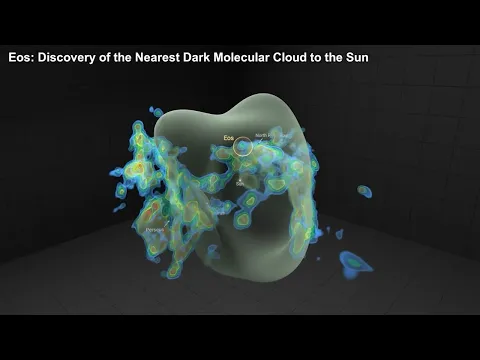
A 3D animation released by the SciTechDaily channel helps visualize the scale and position of this structure in relation to the Solar System. The resource emphasizes the size of the finding and shows why the discovery has generated so much interest in the global scientific community.
A nearby, silent, and enormous discovery that could force astronomy to look again at the space around the Sun
The Eos cloud combines three rare elements in the same object: proximity, large mass, and invisibility to the most common methods. When these factors combine, the discovery ceases to be merely curious and begins to have the potential to correct part of what is known about interstellar gas in our region of the galaxy.
If new observations confirm that Eos is not an isolated case, astronomy may be facing a hidden stock of raw material for star formation. This would change not only the maps of the space around the Sun but also the models used to explain the evolution of the Milky Way.
And you, do you think there is still much of the “nearby” universe hidden from telescopes because of traditional techniques? Leave your comment and let us know if this discovery seems like a real revolution or just the beginning of a larger revision in astronomy.








Seja o primeiro a reagir!