





 Portuguese
  English
  Spanish
  5 min of reading
  1 comment


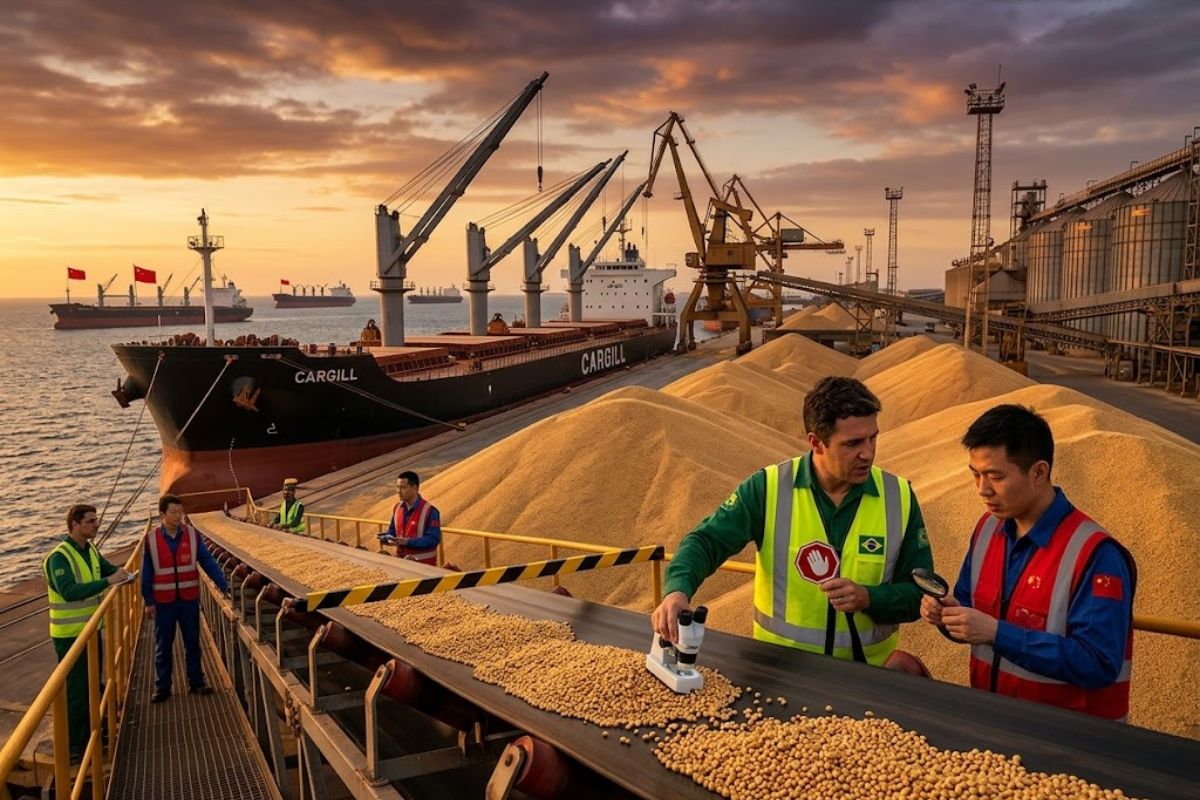

Agribusiness Giant Cargill Halted Operations to Buy and Export Soy to China After Brazil Implemented Stricter Phytosanitary Inspections, With Its Own Sampling by the Ministry, Creating Discrepancies in Certificates, Risks to Vessels, and Immediate Pressure on the Country’s Peak Shipments at This Time.
The agribusiness giant Cargill has entered the center of a new trade impasse by suspending export operations for soybeans from Brazil to China and also halting purchases in the domestic market. The reason was not a crop failure or decline in demand, but a sudden change in the phytosanitary inspection adopted by the Ministry of Agriculture at the request of the Chinese government.
The issue strikes a sensitive chord because it involves the world’s largest buyer of the grain and the largest global supplier of the oilseed. Without a phytosanitary certificate, the ship cannot unload in China, and any failure in this link ceases to be a bureaucratic detail and becomes a direct risk to the flow of shipments, price formation, and the purchase routine in the Brazilian market.
What Changed in the Phytosanitary Inspection and Why Soybean Shipments Stalled
The break began when the Ministry of Agriculture started using a stricter form of phytosanitary inspection for soybeans destined for China. Instead of relying on the standard sample normally used by the grain market, the ministry began conducting its own sampling. It was precisely here that the discrepancies pointed out by Cargill arose.
-
Larger than entire cities in Brazil: BYD is building a 4.6 km² complex in Bahia with a capacity for 600,000 vehicles per year, but the discovery of 163 workers in conditions analogous to slavery has shaken the entire project.

-
With an investment of R$ 612 million, a capacity to process 1.2 million liters of milk per day, Piracanjuba inaugurates a mega cheese factory that increases national production, reduces dependence on imports, and repositions Brazil on the global dairy map.

-
Brazilian city gains industrial hub for 85 companies that is equivalent to 55 football fields.

-
Peugeot and Citroën factory in Argentina cuts production by half and opens a layoff program for more than 2,000 employees after Brazil drastically reduced purchases of Argentine vehicles.


These differences in collection and classification have started to hinder the issuance of the certificates that accompany the cargo. Without this document, the shipment may leave, but unloading at the destination becomes unfeasible. The critical point is not just the tougher inspection, but the mismatch between the official method and the method the market is accustomed to operating.
According to the report presented, the new system began at the start of last week and has already altered the trading dynamics. The president of Cargill in Brazil and the Agricultural Business unit in Latin America classified the model as unusual in the grain market, precisely because it disrupts an operational standard built to provide predictability to shipments.
The immediate consequence was practical and severe. Some ships that had China as their destination have already been rerouted to other places. When the phytosanitary inspection fails to unblock the shipment and instead blocks the certificate, the entire export logistics system goes into a state of alert.
Why Cargill Stopped Buying and What This Reveals About the Market
The reaction of the agribusiness giant went beyond exportation. Cargill also suspended the purchase of soybeans in the Brazilian market, because the difficulty in shipping to the world’s main importer disrupts the business’s commercial logic. The company halted operations last Friday, according to reports made behind the scenes at Argentina Week 2026 in New York.
This move carries weight because Cargill is one of the largest exporters of the grain from Brazil. When a company of this size withdraws from purchasing, even temporarily, the effect is quickly felt in the countryside, among brokers, and in the formation of bids. Some posts on social media have already mentioned a near absence of local buying offers for soybeans from trading companies.
The problem gains even more scale because China purchases about 80% of all soybeans exported by Brazil. In other words, this is not just a relevant client among many, but the dominant axis of external demand. If this channel gets stuck, the potential impact is not limited to Cargill; it touches the heart of Brazilian soybean exports.
For this reason, the episode goes beyond a mere operational adjustment. The purchase stoppage indicates that the company does not currently see sufficient security to keep moving product normally. When the agribusiness giant stalls, it signals to the market that the problem lies not at the margin, but at the core of the distribution system.
What the Ministry Is Trying to Negotiate as the Risk of Stoppage Grows
In light of the tension, Agriculture Minister Carlos Fávaro has started to assess the situation with two central entities in the sector: Anec and Abiove. The discussion revolves around the correct way to sample and classify soybeans so that the phytosanitary inspection can again produce certificates without generating discrepancies that impede commercial flow.
So far, however, no solution has been found. Anec itself stated that the main concern remains the soybeans and the capacity of the supply chain to adapt to the new requirements in the medium term, especially during a peak moment for Brazilian exports. The sector is not only discussing sanitary rules, but the short-term operational viability.
The lack of immediate response from the ministry to the request for comment increases the sense of uncertainty. Meanwhile, the scenario described by Cargill is clear: if the situation is not resolved soon, the risk is a stoppage of shipments to China. This changes the dimension of the case, as it ceases to be a technical noise and becomes a concrete threat to the most important corridor for Brazilian grain exports.
The market is now watching two clocks at the same time. One is the institutional negotiation between government and entities. The other is the harvest and the ships, which do not wait for political timing. When the phytosanitary inspection collides with the shipment schedule, each day without an agreement increases the size of the problem.
The agribusiness giant Cargill has unveiled an impasse that may seem technical, but affects the most sensitive point in the relationship between Brazil and China in the soybean trade. The change in the phytosanitary inspection has already stalled purchases, complicated certificates, and raised the risk of a stoppage during the strong shipping season.
In your view, is this likely to be resolved as a procedural adjustment or could it become a larger crisis in Brazilian export flows?









Texto parece escrito em IA