





 Portuguese
  English
  Spanish
  4 min of reading
  0 comments


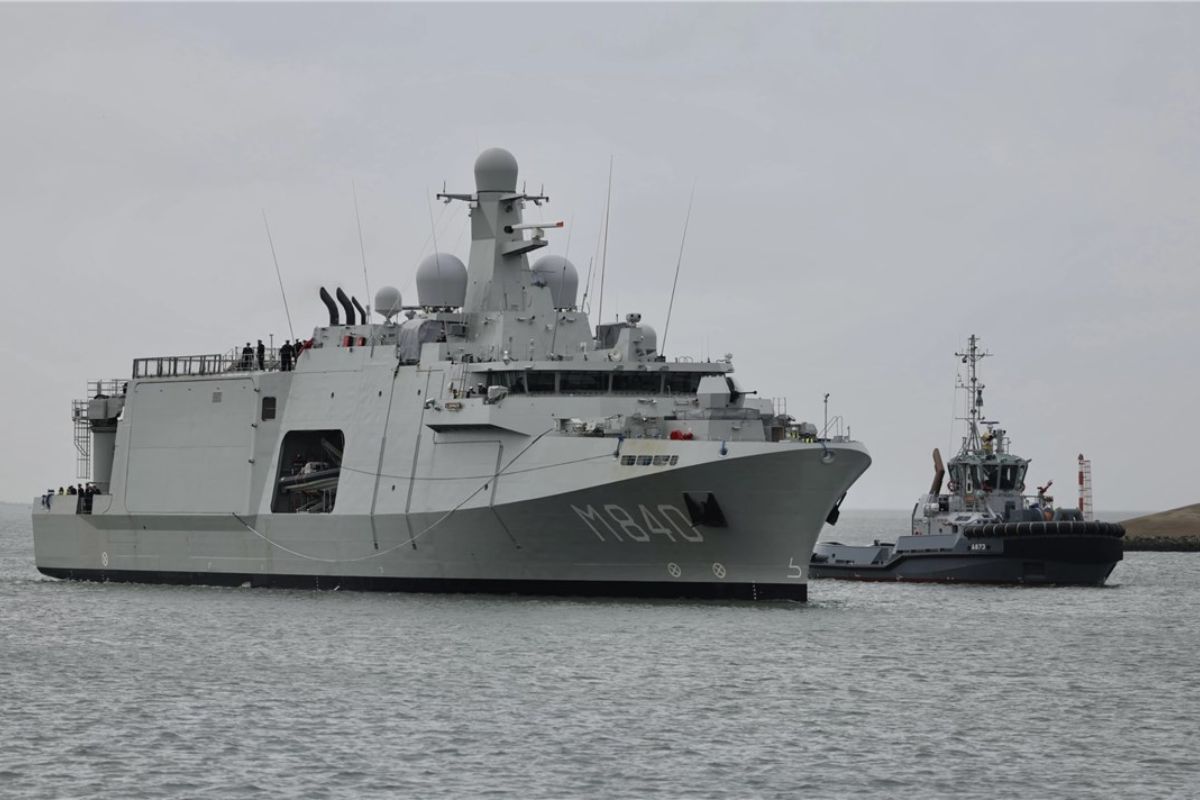
The Arrival of the Naval Giant Vlissingen at the Port of Den Helder Marks a Strategic Advance for the Royal Netherlands Navy by Introducing a New Generation of Anti-Mine Countermeasures with Drones Capable of Detecting and Neutralizing Explosives While Keeping the Ship at a Safe Distance
Last Friday, the port of Den Helder received a visitor that represents much more than just a new warship. The naval giant Vlissingen, the first of a new class of vessels dedicated to anti-mine warfare, arrived at its home port inaugurating a decisive phase in the modernization of the Royal Netherlands Navy.
The moment was internally regarded as a strategic milestone, as it symbolizes the transition to a completely different operational model from the traditional one. Instead of navigating directly through mined areas, the naval giant Vlissingen operates unmanned systems that take on the most dangerous tasks of the mission.
This concept drastically reduces risk to the crew and allows the ship to stay out of the explosion range while drones carry out mine searching and neutralization operations.
-
Something is happening around the Earth: Inside the huge explosion of fireballs in 2026

-
A hot air bubble coming from Argentina expands over Brazil, causing thermometers to exceed 38 degrees with a thermal sensation of 40 degrees in late March, affecting 6 states at once.

-
The radish leaf that almost everyone throws away has more polyphenols, flavonoids, and fiber than the consumed root, and a 2025 study showed that the leaf contains compounds that protect the intestine, combat inflammation, and may inhibit the growth of cancer cells.

-
A planet that seemed to defy the laws of physics has intrigued scientists for decades, until the James Webb revealed what is really affecting Saturn’s rotation.


International Construction and Cooperation Between Countries

The naval giant Vlissingen is not just a national project. It was born from a joint program between two European countries that share strategic interests in maritime security: the Netherlands and Belgium.
The vessel was built in France by the naval group responsible for the project and subsequently began its journey northwards to Europe.
During its journey to the Netherlands, the ship made a stop in Belgium before finally arriving at the port of Den Helder.
This route symbolizes the multinational nature of the program, which anticipates the delivery of twelve ships of this class. Six will be allocated to the Dutch Navy and six to the Belgian Navy.
In addition to the shared construction, teams from both navies have also been trained together, creating a model of military cooperation that aims to standardize operational procedures and enhance joint operational capabilities.
The Technology That Changes the Logic of Mine Warfare
Historically, mine countermeasure ships needed to enter directly into areas potentially contaminated by underwater explosives.
This method required great precision and represented a significant risk for the vessels and crews.
The naval giant Vlissingen introduces a different concept, based on a broad set of unmanned systems.
These systems include floating drones and aerial drones capable of patrolling maritime areas and identifying underwater mines.
After detection, other robotic systems can neutralize the explosives, eliminating danger without requiring the main ship to approach the risky area.
This model transforms the way operations of this kind are conducted.
The ship functions as a command center, while the most dangerous part of the mission is executed by remote platforms.
Protection of Maritime Routes and Submarine Infrastructure
The role of the naval giant Vlissingen is not limited to military operations in times of war.
It also plays a crucial role in securing strategic maritime routes.
In the North Sea, for example, large volumes of international trade circulate daily.
The presence of maritime mines could block trade routes, straits, or port access areas, causing immediate economic impacts.
Additionally, the seabed hosts critical infrastructures such as communication cables and energy systems.
The protection of these structures has become a central theme in modern naval security strategies.
In this context, the naval giant Vlissingen is designed to act quickly in any region where it is necessary to ensure navigational safety or remove explosive threats from the seabed.
A Decisive Step in the Modernization of the Navy

The arrival of the naval giant Vlissingen represents a concrete advance in the process of modernizing the Dutch fleet.
The ship will still undergo final phases before officially entering service.
In the coming months, additional systems and the drones that make up the operational package will be delivered and integrated into the ship’s system.
After this phase, the ship will be formally named and incorporated into active service, operating as a warship of the Royal Netherlands Navy.
Behind the scenes, the process of acquisition and technological integration involves the work of the Navy’s Material and Information Technology Command, responsible for ensuring that the new systems are fully operational.
The goal is clear: to prepare the fleet for the maritime challenges of today and the coming decades.
A New Era in Naval Warfare
The naval giant Vlissingen symbolizes a profound transformation in the way naval warfare operations are conducted.
The replacement of direct human missions with unmanned systems marks a strategic shift that is expected to become increasingly common in modern navies.
Less human exposure, more technology, and greater operational reach.
With the arrival of this ship and the future delivery of the other eleven vessels of the same class, cooperation between the Netherlands and Belgium reaches a new level in European maritime defense.
Now an inevitable question arises for those following the advancement of military technologies at sea: Do you believe that ships controlling fleets of drones will be the standard for naval warfare in the future, or will we still see large traditional vessels dominating the oceans?







Seja o primeiro a reagir!