





 Portuguese
  English
  Spanish
  4 min of reading
  10 comments


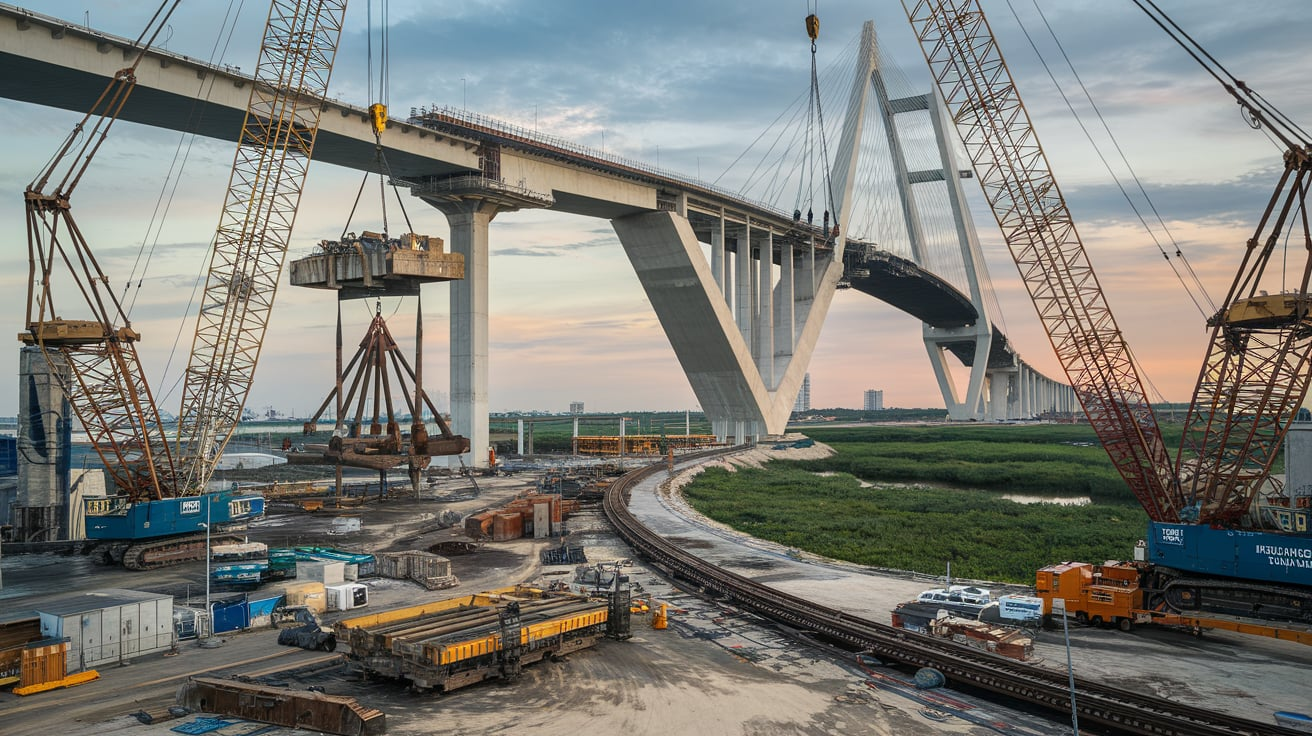


A Super Construction Is Happening in Joinville with Two Monsters of 170 Tons. The Construction of the Joinville Bridge of US$ 310 Million Uses Heavy Technologies to Transform the City. Discover How Giant Machines Are Making This Bridge an Engineering Landmark. Don’t Miss the Details of This Super Construction!
If you think you have seen it all in the world of construction, get ready to be surprised.
Machines with impressive power, weighing up to 170 tons, are playing a crucial role in the construction of one of the largest works of infrastructure in Joinville, the bridge between the neighborhoods of Adhemar Garcia and Boa Vista.
With an investment of US$ 310 million, the project promises to transform the city and speed up traffic between the regions. But what is behind this high-level engineering project?
-
China alone accounts for 70% of trade within the BRICS, while Brazil establishes itself as an essential supplier of food and minerals: understand how the group, which already represents nearly 40% of the world’s GDP, is changing the game.

-
Starting in May, those who do not have registered biometrics will not be able to apply for Bolsa Família, sickness benefits, or unemployment insurance: understand the new rule that changes access to benefits for millions of Brazilians.

-
The government opens the vault and deposits R$ 2.6 billion for the construction of Brazil’s first underwater tunnel, with a length of 1.5 km, 870 m under the sea, a total project cost of R$ 6.8 billion, and a 30-year concession.
-
A new law being voted on in Brazil proposes a minimum fare of R$ 10 per trip and R$ 2.50 per kilometer for Uber and 99 drivers, and promises to ensure they earn as well as taxi drivers did during the golden age of taxis in the country.


The giant machines, called cantitravelers, have a robust design and are installing the support piles of the bridge without the need to clear the local vegetation.
According to NSCTotal portal, they have been fundamental in minimizing environmental impacts, respecting the mangrove around the construction site.
Equipped with tracks and 50-meter cranes, the cantitravelers are in action at both ends of the structure, advancing precisely toward the Cachoeira River.
The expectation is that the bridge, with a length of 980 meters, will be completed by the end of the first half of 2026, connecting the two regions with more fluidity and speed.
The project was authorized in May 2024 by the Joinville City Hall, with the intention of improving urban mobility and attracting more investments to the city.
Cantitraveler: The Secret Behind the Construction
These 170-ton machines, better known as cantitravelers, are true engineering marvels.
Their main function is to install the piles, essential for the bridge’s support, at depths ranging between 22 and 36 meters, depending on soil conditions.
To achieve this, they use a mobile base on tracks and are equipped with cranes that facilitate the movement and placement of the piles with precision.
The construction process with the cantitravelers begins with driving metal casings into the ground, which are large metal tubes.
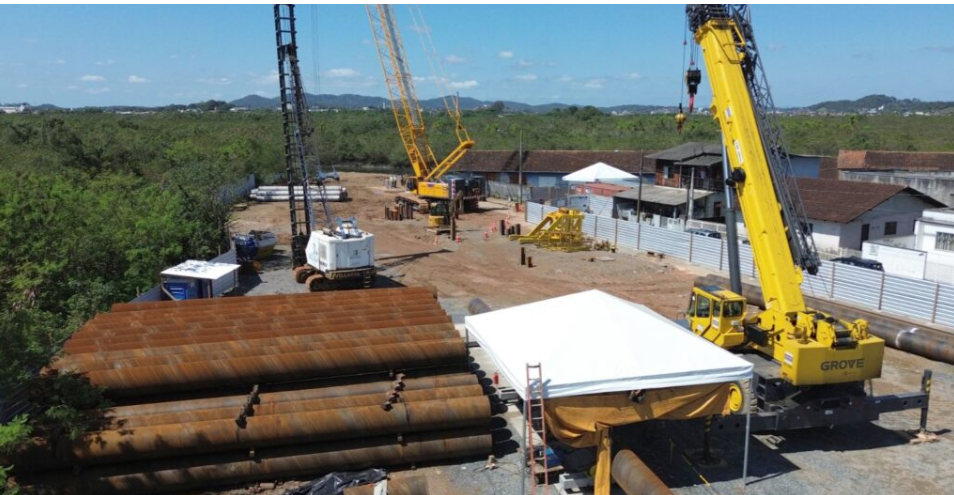
Next, drilling is performed inside the casings, with excavation removing the necessary material for the installation of metal reinforcements. This process is crucial to ensure the solidity of the piles, which receive concrete after the reinforcement installation is completed.
The crane attached to the cantitraveler assists in all these stages, ensuring that the piles are positioned correctly.
After this phase, the installation of blocks and mats will take place. These blocks help support the structure of the bridge, ensuring that the project continues to progress toward the final phases.
The Construction of the Central Span
In the central section of the bridge, which will be traversed by vessels, the process will be different.
The construction of the 160-meter span will be carried out using the successive cantilever method, which involves the installation of concrete pieces called segments.
This method does not require shoring, making the work even more efficient, while also speeding up the installation of the concrete pieces.
The segments will be placed by cranes, which will move the pieces to the installation site with the help of trusses, which are support structures.
This stage of the process is crucial for completing the work within the stipulated timeline.
With cutting-edge technology used in the cantitravelers and the successive cantilever method, the Joinville Bridge project is becoming an example of how modern engineering can effectively solve structural challenges.
Final Phase: The Last Stages
As construction progresses, other phases of the project begin to take shape.
The installation of pre-cast beams, manufactured directly at the construction site, will mark the end of the bridge’s support stage, giving way to the paving and signaling of the structure.
Although the road is still far from completion, the use of imposing machines like the cantitravelers has been crucial in ensuring that the work proceeds with precision and on schedule.
At the end of the entire process, the Joinville Bridge will be ready to become one of the largest and most modern constructions in the city, facilitating urban mobility and providing a new era of development for the region.
With an investment of US$ 310 million, this project stands out not only for its cost but also for its innovation and respect for the environment.
The use of cantitravelers and advanced construction techniques reflects how Brazilian engineering is keeping up with global trends and preparing for major challenges.








Esqueceram de falar que a grana e parceria com o governo federal ,no governo do genovidax qual foi o projeto para o sul ? Zeroooo
Moro em Itapema, SC. Na verdade o Governo de SC não conseguiu fazer obra nenhuma, até agora. Todas as grandes obras daqui foram feitas, tocadas e ou realizadas pelo Governo Federal. É a verdade. Kkkk
Pessoas que não sabem o que dizem, não se informam , da nisso.Oa obras mais impactantes foram e estão sendo feitas pelos governos do PT.Ponte Anita Garibaldi, BR 470, 280, que o **** deixou paradas, sendo que a 280 nem projeto finalizado tinha.Vão se informar antes de falar o que não sabem.