





 Portuguese
  English
  Spanish
  5 min of reading
  0 comments


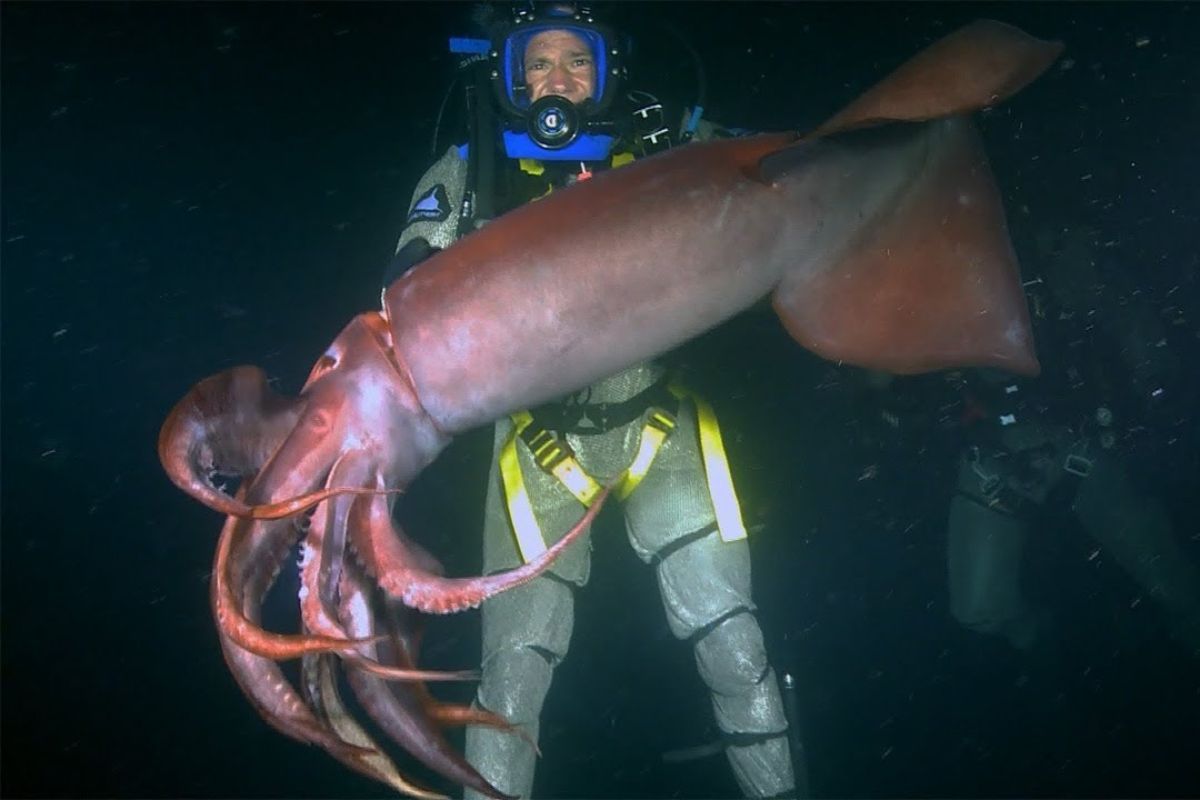
Gigantism of the Deep Sea Shows How the Ocean Floor Creates Huge Monsters by Combining Food Scarcity, Extreme Pressure, Near-Freezing Temperatures, and Total Dependence on Marine Snow, Favoring Giant Squids, Centenarian Sharks, and Colossal Amphipods Adapted to Absolute Darkness
The ocean floor is a vast, dark, cold environment subjected to extreme pressures, where life persists under conditions that would be lethal on the surface. In this hostile scenario, huge monsters emerge as a direct result of evolutionary adaptations favoring giant bodies, slow metabolism, and opportunistic survival strategies.
As depth increases and light fades, food scarcity redefines the entire food chain. It is in this context that huge monsters like giant squids, Greenland sharks, and colossal amphipods become extreme examples of how the ocean floor shapes life on a colossal scale.
The Layers of the Ocean and the Beginning of Gigantism

Descending from the surface, the first region encountered is the epipelagic zone, where sunlight sustains nearly all marine life through photosynthesis. In this range, the abundance of energy allows for smaller, colorful, and numerous organisms without the need for extreme growth.
-
With a cost per shot close to zero, the DragonFire laser could change naval warfare in 2027 and provide British ships with nearly unlimited defense against drones.

-
A British startup creates tires that generate electricity in electric vehicles when passing over potholes, speed bumps, and cracks.

-
Scientists have created robots made with living cells that have their own nervous system, swim on their own, explore the environment, and self-organize without any genetic engineering, and now they want to do the same with human cells.

-
Students create a solar-powered ambulance that operates without a plug, without fuel, and still keeps medical equipment running in remote areas.


Below it lies the mesopelagic zone, known as the twilight zone, where light is too weak for photosynthesis. From approximately 1,000 meters, in the bathypelagic zone or midnight zone, darkness is total, and the only light comes from bioluminescence. It is in this environment that huge monsters begin to stand out, favored by selective pressures radically different from shallow waters.
At greater depths, pressure increases dramatically, reaching hundreds of times the pressure at the surface, while temperatures remain surprisingly low. The abyssopelagic zone reaches down to 6,000 meters, covering about 60% of the planet’s surface and being the largest continuous ecosystem on Earth.
Even further down, the hadopelagic zone extends between 6,000 and 11,000 meters, in narrow deep trenches. In this environment, where food barely reaches and pressure can exceed a thousand times that of the surface, huge monsters survive against any intuitive expectations about life’s limits.
Marine Snow as a Currency of Survival

From about 400 meters deep, food becomes extremely scarce. Without light, algae and plankton disappear, breaking the traditional base of the food chain. Deep life now depends almost exclusively on what is called marine snow, consisting of dead plankton, feces, and fragments of decomposing organisms that slowly descend from the surface.
This marine snow sustains the entire deep ecosystem, but not in large quantities. As the available biomass is limited, the number of organisms is also reduced, intensifying predatory pressure. In this context, becoming one of the huge monsters in the environment becomes an evolutionary advantage, reducing the number of predators and expanding feeding opportunities.
The giant squid has become one of the greatest icons of marine gigantism. For centuries, it was known only by remains found on the coast until, in 2004, it was finally recorded alive in its natural habitat, in the twilight zone, about 1,000 meters deep. Some individuals reach 13 meters in length and around 275 kg.
Even more impressive is the colossal squid, the largest invertebrate on the planet. Although shorter in length, it can weigh between 500 and 700 kg, living at over 2,000 meters. Despite the appearance of a dominant predator, these huge monsters have an extremely slow metabolism, burning very little energy per day and surviving long periods on minimal amounts of food.
Slow Metabolism and Extreme Efficiency
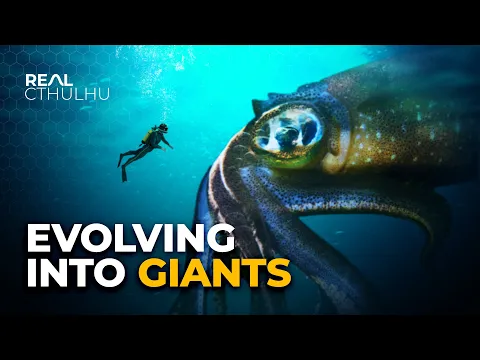

Gigantism in the depths is directly linked to metabolic efficiency. As body size increases, metabolism does not grow proportionally. Larger bodies become energetically more efficient, requiring relatively less food to stay alive.
In the case of the colossal squid, estimates indicate a minimal daily consumption, allowing a single feeding event to sustain the animal for months. This strategy is crucial in an environment where food is unpredictable. Being large, in the depths, does not mean spending more, but spending better, a logic that supports the existence of huge monsters in the deep ocean.
Cold waters carry more dissolved oxygen, which favors larger bodies in aquatic environments. Although this relationship is traditionally associated with warm-blooded animals, there is evidence that marine ectotherms also follow this trend in extreme environments.
Deep and polar regions combine intense cold, relatively high oxygen availability, and low competition, creating ideal conditions for the emergence of huge monsters, including among invertebrates and fish.
Greenland Shark and Extreme Longevity
The Greenland shark is another emblematic example. Living at more than 2,000 meters deep, in waters between -2°C and 7°C, it can reach 7 meters in length and up to 1,400 kg. More than size, its most impressive characteristic is its longevity.
Scientific estimates indicate that these sharks can live more than 400 years, with some individuals possibly surpassing half a millennium. Slow growth, late maturity, and extremely reduced metabolism place this animal among the largest and oldest monsters ever known, surviving at a pace almost indifferent to human time.
In the deepest regions of the planet, between 6,000 and 11,000 meters, some of the most extreme examples of gigantism emerge. Amphipods that measure only a few millimeters in shallow waters can reach up to 34 cm in the hadal trenches. The species Alicella gigantea is the largest amphipod ever recorded.
These organisms are scavengers and detritivores, capable of storing large amounts of energy when they find food. The great size allows them to survive long periods of hunger, as well as cover greater distances in search of scarce resources.
Unexpected Adaptations to Survive Without Plants
Even without vegetation in the hadal depths, some species have developed enzymes capable of digesting cellulose, allowing them to convert wood that occasionally sinks into energy. This adaptation reveals the extreme level of specialization necessary to sustain huge monsters in environments where almost nothing should survive.
The ability to exploit incredibly rare food sources demonstrates how gigantism is linked not only to size but also to efficiency and metabolic flexibility.
Despite seeming distant and isolated, the deep ecosystem is extremely sensitive. Changes in ocean chemistry, pollution, overfishing, and deep-sea mining represent direct threats to these highly specialized forms of life.
The huge monsters of the depths do not live in a world separate from ours. The stability of this environment depends on the global balance of the oceans, and any disruption could mean the silent disappearance of creatures that took millions of years to evolve.
In light of this extreme and fascinating scenario, do you believe that the gigantism of the depths is a definitive advantage or just the last possible adaptation before the absolute limits of life?








-

-

-

-

7 pessoas reagiram a isso.