





 Portuguese
  English
  Spanish
  5 min of reading
  0 comments


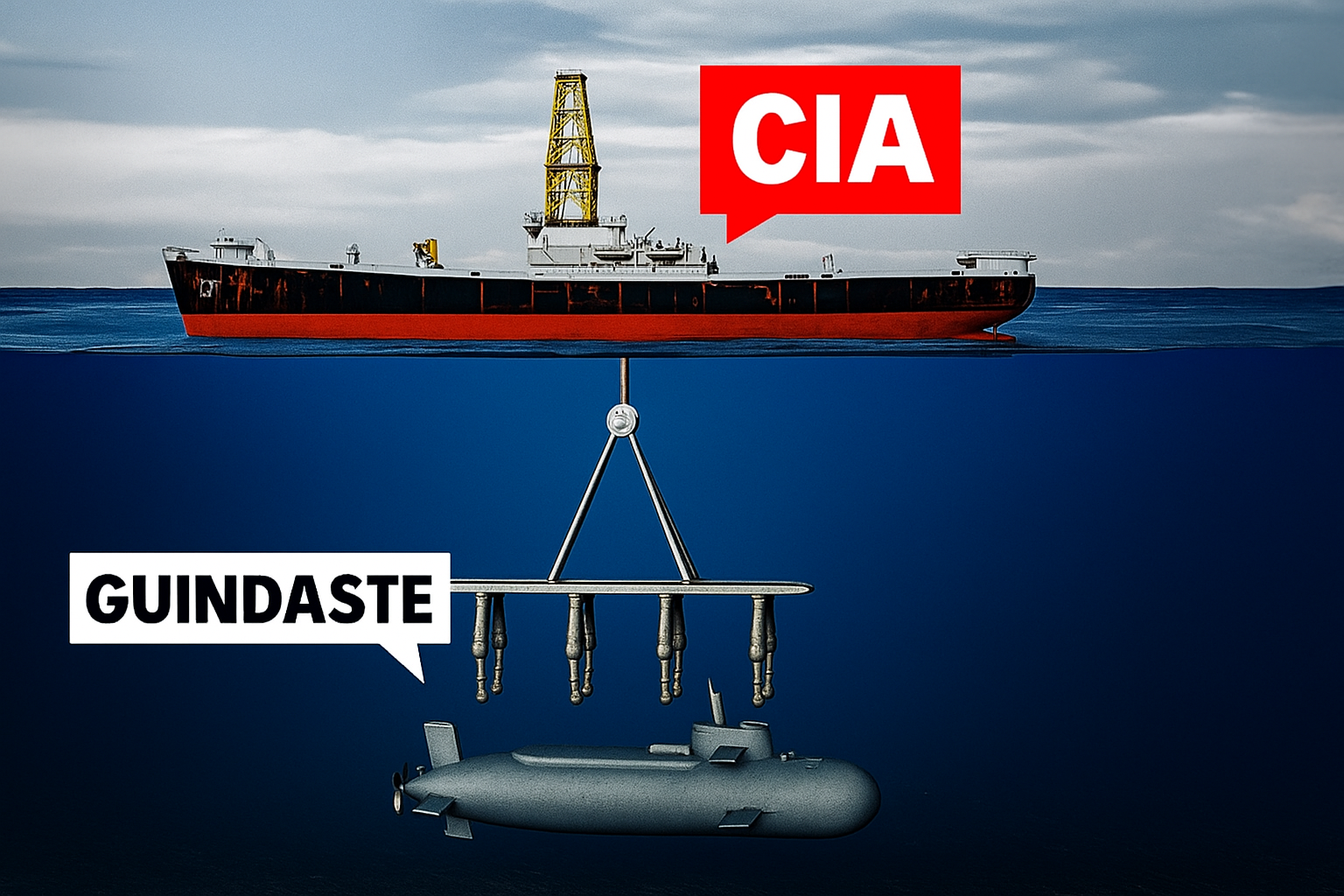
The Glomar Explorer Was The Spy Ship Created By The CIA For One Of The Most Secret Operations Of The Cold War: Trying To Recover A Sunken Soviet Submarine At 5 Thousand Meters Depth In The Pacific.
At the height of the Cold War, when the United States and the Soviet Union were competing for technological and military supremacy, one of the boldest episodes in naval history and espionage emerged: the Glomar Explorer. Officially presented as a ship for mining manganese nodules from the seabed, the vessel was, in reality, built by the CIA to carry out a covert mission: to recover the Soviet submarine K-129, which sank in the deep waters of the Pacific.
The K-129 sank in March 1968, during a patrol in the North Pacific, about 1,500 kilometers northwest of Hawaii. The vessel was carrying nuclear weapons and strategic equipment, including torpedoes and cryptographic systems. The location of the wreck was discovered by the United States with the help of underwater sensor networks. The CIA, in collaboration with the Pentagon, saw the Soviet tragedy as an unprecedented opportunity to access the rival’s secrets during the most tense period of the global dispute.
The Construction Of A Unique Ship
Between 1971 and 1973, the Glomar Explorer was built at the Sun Shipbuilding docks in Philadelphia, with secret funding from the U.S. government. Billionaire Howard Hughes was used as a front for the project, claiming that the ship would be used for deep-sea mining. The total cost of the venture was estimated at about US$ 800 million at the time — the equivalent of over US$ 4 billion in today’s values.
-
(Video): Italian pilot lands plane on moving train at 120 km/h and achieves unprecedented feat in aviation, even with a narrow runway and without direct visual contact.
-
It seems to have come out of a science fiction movie: A Brazilian city where it rains almost every day, recording over 4,000 mm per year, driven by climatic factors — a direct result of its strategic location in the Amazon.

-
The water crisis that could change everything this year has already begun; it’s not just about the climate, it affects technology, raises product prices, and can halt entire companies without warning.

-
A Japanese mason transforms raw granite into small cups and handcrafted utensils, collects giant stones, cuts with precision, and impresses with detailed manufacturing and finishing.


The ship measured about 190 meters in length and was equipped with a central moon pool from which it was possible to hoist large objects without exposing the cargo to the external environment. Equipped with robust cranes, a drilling tower, and high-precision stabilization systems, the Glomar Explorer was capable of operating offshore for months. The vessel was accompanied by a submerged barge, nicknamed Clementine, designed to capture parts of the submarine at 5 thousand meters depth.
The Execution Of Project Azorian
In 1974, after years of planning and construction, the Glomar Explorer headed to the wreck site to carry out the so-called secret operation known as Project Azorian. The goal was to lift the K-129 without alerting the Soviet Union, whose ships regularly patrolled the area.
For weeks, the vessel remained on site, positioned over the exact spot where the submarine rested. The barge Clementine descended to the seabed, equipped with a huge hydraulic claw to grasp the structure of the K-129. The operation required extreme precision, considering the ocean currents, the depth, and the risks of detection by the Soviet navy.
Despite the complexity, the claw managed to grasp the hull of the submarine and begin the raising process. However, during the ascent, the hull of the K-129 broke apart, and most of the vessel returned to the seabed. Only a smaller section was recovered, including electronic equipment, nuclear armaments, and the bodies of six Soviet sailors.
The Legacy Of The Glomar Response And The Secrecy Of The Mission
To maintain the secrecy of the operation, the CIA adopted a policy of absolute silence. When the existence of the mission was revealed by news reports in 1975, the U.S. government began responding to public inquiries with the phrase: “I neither confirm nor deny.” This practice became known as the Glomar response, adopted since then in cases of national security and requests for sensitive information.
The burial at sea of the Soviet sailors was recorded on video and, years later, shared with the Russian government as a gesture of respect. The details of what was exactly recovered remain classified to this day, fueling theories about possible strategic secrets accessed by the United States.
The Ship After The Mission And Its Transformation
After the partial failure of the operation, the Glomar Explorer was placed in reserve by the U.S. Navy for several years. In the mid-1990s, it was converted into a deep-water drilling ship by Global Marine Drilling and renamed GSF Explorer. The ship operated for another two decades in the oil and gas industry before being retired and dismantled in 2015.
The project, although it did not achieve all of its objectives, represented a remarkable feat of engineering and logistics, as well as marking the history of espionage and naval technology.
The Importance Of The Glomar Explorer In Naval History And Espionage
The Glomar Explorer became an icon of naval history and U.S. intelligence. The project highlighted how Cold War submarine operations combined technological innovation with extreme secrecy strategies. The mission underscored the lengths to which superpowers were willing to go to secure advantages on the global geopolitical chessboard.
In addition to inspiring books, documentaries, and academic studies, the story of the spy ship remains an example of how engineering, politics, and military strategy intertwined during the Cold War. Project Azorian continues to be one of the greatest mysteries of the sea, reinforcing the enigmatic aura of the Glomar Explorer and the secret operations of the period.
The Glomar Explorer symbolizes a unique chapter in the race for supremacy between the United States and the Soviet Union. Its legacy goes beyond the attempt to rescue the Soviet submarine: it has become a reference for complex naval operations, government secrecy practices, and advances in deep-sea rescue engineering. Even today, the project is studied for its audacity, costs, and the lessons it left about the limits of espionage in times of global tension.







Seja o primeiro a reagir!