





 Portuguese
  English
  Spanish
  5 min of reading
  15 comments





Struthio Embezzlement Exposes Billion-Dollar Deficit and Forces Ana Maria Braga’s Farm to Sell Elite Cattle, Bet on Eucalyptus and Organic Coffee to Escape Definitive Bankruptcy
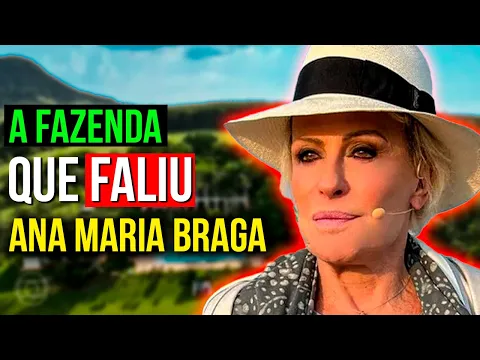
Between the early 2000s and 2005, the Struthio Master scheme became one of the largest financial pyramids in the country, accumulating over R$ 1 billion in losses and undermining rural projects of celebrities and small producers. Ana Maria Braga’s Fazenda Primavera was born directly from this downfall, after the presenter was forced to sell the old property and start over from scratch.
In 2006, already famous on television, Ana Maria bought Fazenda Primavera in Bofete, just over 370 hectares with a colonial house built in 1960, in an attempt to rebuild the lost assets. Since then, the farm has dealt with elite cattle that didn’t pay off, eucalyptus forests that don’t generate profit, and now bets on organic coffee as a last economic shot after nearly two decades of adjustments.
From Rural Dream to the Scam That Broke the First Project

Before Ana Maria Braga’s Fazenda Primavera, the presenter’s connection with the countryside began at a smaller farm, purchased with her salary from Editora Abril.
-
New 100% clean fuel produced in Brazil could retire diesel.

-
Plastered walls become a trend and end up being the perfect choice for finishing; the secret of the 2 coats that prevent waste in painting.

-
With 333 meters and equivalent to a 20-story building: China launches a supertanker that transports 2 million barrels, has 540,000 m² of area, and saves $5 million per year.

-
Brazil becomes a beacon of hope for ending plastic waste by leading a global plan that could prevent millions of tons from entering the oceans.


The goal was simple: to fulfill a childhood dream of having a piece of land, close to a waterfall, for livestock and planting.
This plan changes scale when she enters the ostrich business, alongside about 50,000 Brazilian investors attracted by promises of monthly returns above 10 percent and guaranteed buybacks of birds and eggs by the company Struthio Master.
The company sold over 600,000 ostriches but kept less than 40,000 animals in the breeding farms and never repurchased a single animal for slaughter, which exposed the financial pyramid in 2005.
To maintain the breeding, Ana Maria needed to invest in air-conditioned incubators, a 24-hour team, and feed supplied by the company, which kept getting more expensive.
When the scheme collapsed, there was no market for the birds, not even for free. She had to donate the animals and sell the property, ending her first rural experience with losses and debts.
Purchase of Fazenda Primavera by Ana Maria Braga and Turnaround to Elite Cattle
The restart comes in 2006, with the purchase of Fazenda Primavera by Ana Maria Braga in Bofete, just over 200 kilometers from the capital of São Paulo.
The farm, with a colonial style, a swimming pool surrounded by royal palms, and a main house with five bedrooms, was originally a stud farm, focused on horse business.
Convinced that elite cattle would bring more returns, the presenter reduces the number of horses and invests heavily in cattle genetics.
Her own cattle brand is born, with semen from purebred bulls imported from the United States, eggs from high-bred donor cows, and embryo transplants into surrogate cows.
The system allows forming a herd of over 500 purebred animals focused on selling genetics, not meat or milk.
When Elite Cattle Fails to Balance the Books

The sophisticated model, however, had a structural problem: very high costs in the face of a highly concentrated source of revenue.
Without large-scale milk or meat production and relying on auctions and genetic sales, Ana Maria Braga’s Fazenda Primavera could not generate enough cash to sustain the team, management, inputs, and ongoing investments in breeding.
With the move of her Mais Você show studio to Rio de Janeiro, Ana Maria began to be even further away from daily management.
The combination of the owner’s absence and the expensive elite cattle model leads to yet another rupture.
To prevent the farm’s deficit from contaminating her personal finances, the presenter is forced to sell the entire herd and end her bet on high-genetic livestock.
Large Eucalyptus Forest, Small Revenue
Without cattle, Ana Maria Braga’s Fazenda Primavera replaces the pasture with a eucalyptus forest of about 100 hectares, in partnership with a specialized company.
The partner company takes care of planting the seedlings, maintaining the internal roads, and harvesting the trees, while the farm provides the land and basic maintenance.
The problem lies in time.
The eucalyptus cutting cycle takes approximately seven years, turning the forest into a long-term savings account, unable to cover the annual operating costs of the property.
In practice, the vast green area does not produce enough cash flow and does not meet the recurring income needs for salaries, infrastructure maintenance, taxes, and daily supplies.
Organic Coffee Becomes the Farm Rescue Plan
Facing a forest that consumes land and immobilizes capital without quick returns, Ana Maria Braga’s Fazenda Primavera starts a small-scale test with coffee.
One hectare of the eucalyptus area is designated for cultivation, supervised by an agricultural technician, to evaluate productivity, grain quality, and economic viability in an organic system.
If the results are positive, the plan is to reduce or replace the forest with a large organic coffee plantation, betting on the recent appreciation of this niche in the market.
The presenter’s expectation is that organic coffee will yield higher prices, enhance her own brand, and help the farm finally escape the long-term investment cycle without compatible financial returns.
After more than 18 years, the goal is to make Ana Maria Braga’s Fazenda Primavera generate constant profit, not just assets on paper.
Between Garden, Orchard, and Faith: The Infrastructure That Remains Standing
Alongside the large eucalyptus and coffee strategy, Ana Maria Braga’s Fazenda Primavera maintains a diverse productive base. There are corn plantations, an orchard with atemoya, orange, carambola, and other fruits, and a large vegetable garden with greens and herbs such as kale, lettuce, mint, ora-pro-nobis, leeks, and peppers.
The production supplies the presenter’s house, the farm, and the families of employees.
The chicken coop provides sufficient eggs for internal consumption and distribution to neighbors, reinforcing a logic of shared abundance on a small scale.
In the center of the property, a chapel built after the presenter’s successive victories against cancer houses over 400 religious images and hosts masses and Saint John’s parties, blending personal devotion and the farm’s identity.
What the Story of Ana Maria Braga’s Fazenda Primavera Reveals About Risk in the Field
The trajectory of Ana Maria Braga’s Fazenda Primavera summarizes, in one case, the combination of financial risk, rural investment fads, and the difficulty of building recurring income outside the consolidated chains of meat, milk, and grains.
The Struthio embezzlement showed how promises of returns far above the market hide high operational costs and unsustainable structures.
Meanwhile, the failure of elite cattle and the low profitability of eucalyptus in the long cycle illustrate that scale, return time, and diversification are decisive variables in any agricultural project.
Organic coffee now emerges as an attempt to combine better prices per sack, brand identity, and a more intelligent use of land, but still depends on technical execution and a consistent market to become real profit.
After the Struthio embezzlement, elite cattle that did not pay off, and an eucalyptus forest without quick profit, do you think betting the future of Ana Maria Braga’s Fazenda Primavera on organic coffee is a wise decision or another high risk in a history already marked by large bets in the field?





Isso é pra quem conhece tem que ser caipira da roça se não quebra a cara mesmo
Abateu todo o prejuízo no imposto de renda. Ou seja imposto que pagaria nos merchans e salario serviram para pagar as brincadeiras no campo.
Ela não entende e não está à frente do negócio. Fazenda, terra, ****, café… exige experiência, administração, tecnologia, isso tudo custa. Vende tudo e compra um sitio para pouca produção, e para seus finais de semana no campo. Se bem que com tanto dinheiro, não é fácil quebrar kkkk