





 Portuguese
  English
  Spanish
  3 min of reading


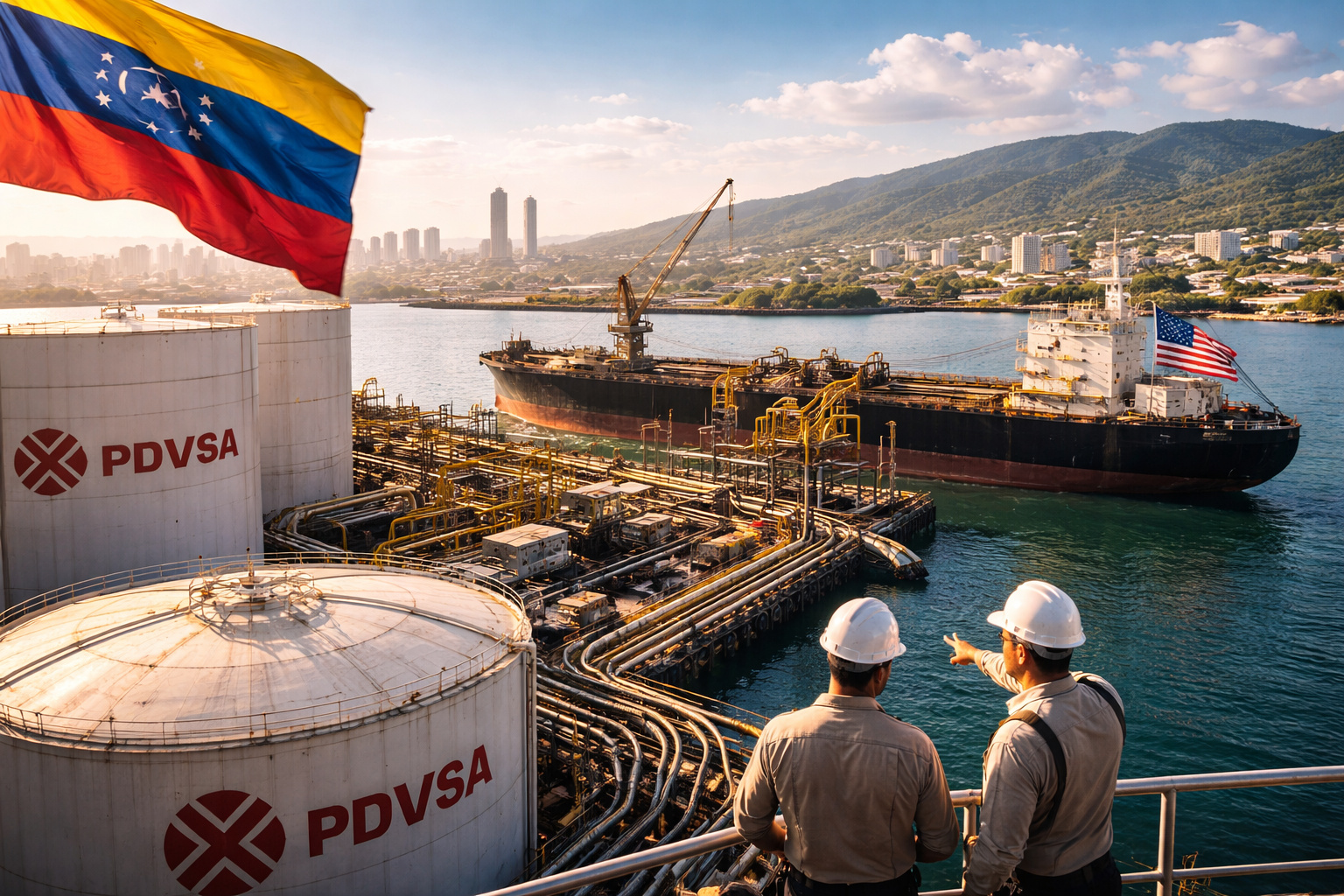
Venezuela has initiated negotiations with the United States to sell crude oil, according to an official statement from the state-owned company PDVSA, made on January 7, 2026. The announcement came shortly after American President Donald Trump stated that the country could receive up to 50 million barrels of Venezuelan oil. Thus, Caracas is trying to regain ground in the world’s largest consumer market and open a new commercial cycle.
Although talks are still ongoing, the move already marks a significant shift in the relationship between the two countries.
PDVSA Confirms Direct Negotiations with Washington
PDVSA announced that, in light of the new political scenario, it has decided to seek formal commercial agreements with the United States. Additionally, the state-owned company stated that it operates with principles of transparency and aims to ensure mutual economic benefits.
-
Lula reveals a masterstroke by Petrobras to undo a deal made by Bolsonaro, which involves the return of an important refinery that currently produces less than half of what was expected and makes Brazil dependent on international diesel.
-
A study confirms that the natural gas sector will reduce greenhouse gas emissions in Brazil by 0.5% and accelerate the energy transition by 2026.

-
Petrobras implements a severe adjustment and confirms a 55% increase in the price of aviation kerosene with a proposal for installment payments for the companies.

-
The rise in oil prices could ensure an extra revenue of R$ 100 billion for the Federal Government, indicates a recent economic study.


At the same time, the U.S. government began evaluating logistics, transportation routes, and refining capacity. Thus, both countries are entering a phase of rapprochement after years of distancing, sanctions, and diplomatic tensions.
A Repositioning of Venezuelan Oil
For over a decade, Venezuela directed a large portion of its exports to China and other Asian countries. However, with the internal political change, the interim government began prioritizing traditional markets.
Therefore, the trade reopening with the U.S. represents not just a one-time sale, but an attempt to reposition Venezuelan oil in the international arena.
Trump stated that the generated resources should fund domestic programs both in the U.S. and Venezuela. Furthermore, he said he prefers stable trade agreements over prolonged sanctions.
Reasons for Venezuela to Move in This Direction
The motivation is clear. After years of declining production, deteriorating infrastructure, and fleeing investments, Venezuela needs to quickly recover revenue.
Therefore, selling oil to a market with high purchasing power could strengthen PDVSA and reactivate plants, mature fields, and refineries.
On the other hand, the United States seeks to increase its energy security. This is because the international market faces frequent uncertainties, and Washington wants to reduce dependence on other producing regions.
Thus, buying oil from Venezuela could offer predictability to the country.
Immediate and Future Economic Impacts
If the agreement is finalized, the effects could appear quickly. For the United States, increased international supply tends to moderate prices and reduce shortages.
At the same time, Venezuela will receive essential resources to balance its accounts and finance the reconstruction of its oil industry.
Additionally, new exports could attract foreign companies and stimulate technical partnerships. Consequently, PDVSA will have more chances to modernize processes and qualify teams.
However, experts warn that Venezuela will need to prove its real production and delivery capacity. Otherwise, potential logistical failures could undermine buyers’ confidence.
A Political Milestone After Years of Breakage
The negotiations occur shortly after the government change in Caracas. Following the capture of Nicolás Maduro, the new leadership decided to adopt a more open agenda.
Therefore, the conversation with Washington is not isolated but part of a larger diplomatic effort.
Trump stated that he wants to “turn the page” and build a more pragmatic relationship with Venezuela. Consequently, oil exports function as a gateway to broader agreements.
If this rapprochement advances, the two countries could rebuild an energy partnership interrupted for almost a decade.
Recent Timeline on Venezuelan Oil
On January 6, 2026, Trump announced that he intends to import up to 50 million barrels from Venezuela.
The following day, January 7, PDVSA confirmed that it is already negotiating commercial terms with the American government.
Since then, technical teams have been discussing schedules and shipping routes.
Therefore, oil returns to the center of the bilateral relationship, now with prospects of commercial exchange rather than conflict.
Oil as the Axis of the New Phase
Finally, the event confirms an essential point: oil continues to determine the future of Venezuela.
At the same time, it influences decisions in the United States, reorganizes alliances on the continent, and moves global markets.
Thus, the negotiations represent much more than an export contract. They symbolize a possible economic reconstruction for Venezuela and a hemispheric geopolitical realignment.






Seja o primeiro a reagir!