





 Portuguese
  English
  Spanish
  5 min of reading
  0 comments


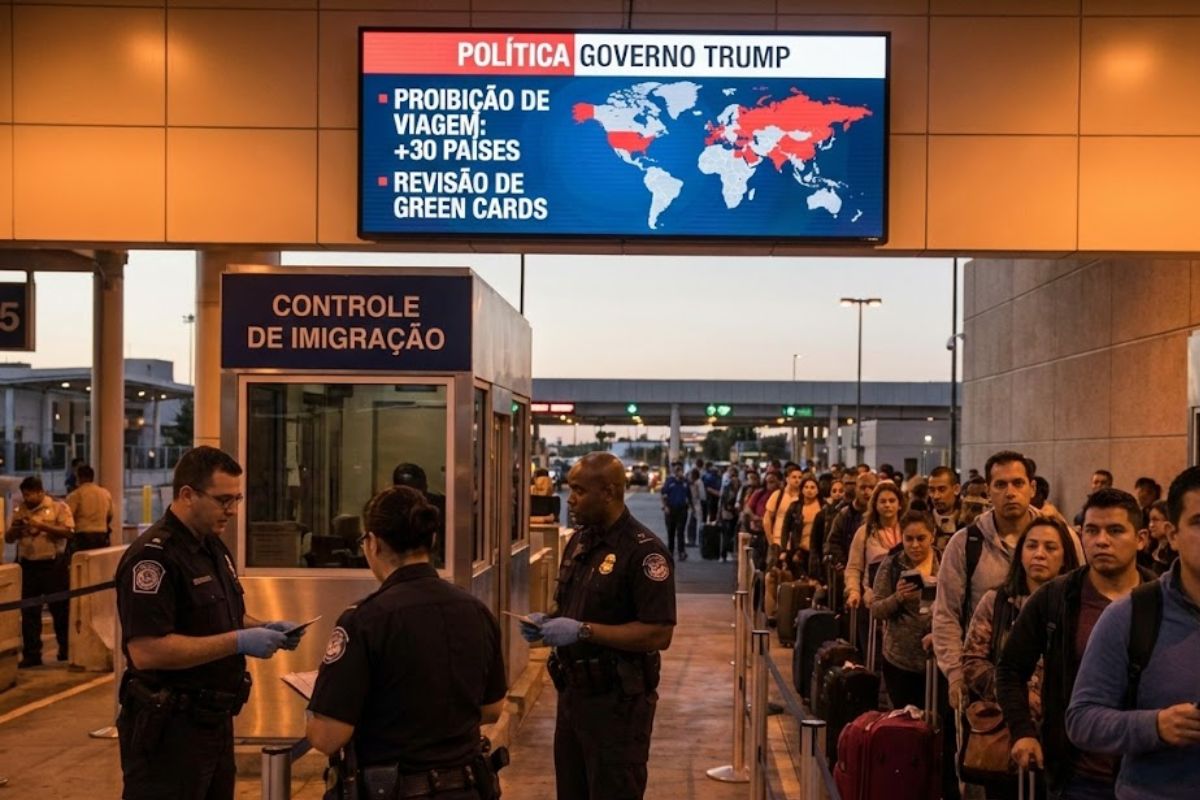
Secretary of Homeland Security, Kristi Noem, confirmed on December 4 that Trump is considering expanding the list of countries with travel bans to the US, focusing on nations with unstable governments, reviewing green cards for foreigners, and hardening the speech, calling immigrants leeches and addicts to privileges in recent political speeches.
On the night of Thursday, December 4, 2025, the United States Secretary of Homeland Security, Kristi Noem, stated in an interview with Fox News that the Donald Trump administration intends to increase the number of countries whose citizens will be banned from traveling to the US to more than 30. She did not disclose which nations may be included but said that the president is still evaluating the list and that the decision is part of a new phase of migration policy for the second term.
According to the CNN Brazil website, Noem’s statements add to measures already taken throughout 2025. In June, Trump signed a decree that banned entry into the US for people coming from 12 countries, mostly from Africa and the Middle East, and imposed additional restrictions on visitors from seven other nationalities. On Monday, December 1, the secretary herself had already advocated for a “total travel ban” for certain countries, raising the temperature of the migration debate in Washington.
List of Banned Countries May Exceed 30 and Continue to Grow
During the interview on the Ingraham Angle program on Fox News, Kristi Noem was asked if the list of countries with travel bans to the US could reach 32. She avoided committing to a number but reiterated that it would be “more than 30” and that the assessment is ongoing.
-
The institute that trained the greatest aerospace engineers in Brazil has just opened its first campus outside São Paulo after 75 years: ITA Ceará will have R$ 445 million, new courses in energy and systems, and classes are expected to start in 2027.

-
Luciano Hang, owner of Havan, goes to Juiz de Fora after the tragedy in February, brings R$ 1 million, hands out R$ 2,000 cards, and donates up to R$ 15,000 to victims in the region.

-
The Brazilian passport allows legal residence in dozens of countries without the need for a prior visa, and most Brazilians are unaware that they can apply for residency directly upon arriving in nations in South America, Africa, and even Europe.
-
Petrobras sends a message to Brazilian truck drivers after fuel collapse and reveals plan to have 100% domestic diesel.


According to Noem, the central criterion is the ability of the countries of origin to cooperate with the US in background checks and the identification of travelers.
“If they don’t have a stable government, if they don’t have a country that can sustain itself and tell us who these individuals are and help us verify them, why should we allow people from that country to come to the United States?” she argued.
In practice, this statement opens the door for new gradual expansions of the list, with no defined deadline and no transparency regarding which countries are being evaluated. The lack of details feeds uncertainty among foreigners planning to travel to the US and among immigrant communities already established in the country.
Targets Nations With Unstable Governments and Speech of “Invaders”
The secretary made it clear that the priority target is nations considered unstable, unable to guarantee secure information about their citizens. The message is that, without this minimum cooperation, access to US territory will be closed or severely restricted.
At the same time, the government has hardened its public rhetoric. In previous statements, on Monday, December 1, Noem said she had advised Trump of a “total travel ban” for citizens of countries that, according to her, “have flooded our nation with leeches and addicts to privileges.”
The rhetoric reinforces the idea that part of the foreigners would be responsible for violence, abuse of public benefits, and strain on services funded by American taxpayers.
In a post on platform X, Trump stated that “our ancestors built this nation with blood, sweat, and an unwavering love for liberty” and that this would not have happened for “foreign invaders” to massacre heroes, consume taxes, or steal benefits from citizens. The message concludes with a direct warning: “We don’t want them. None.”
June Decree Had Already Blocked 12 Countries and Tightened Rules for 7 Others
The new round of restrictions announced by Kristi Noem does not come out of nowhere. In June, Trump had already signed a decree that banned entry into the US for people coming from 12 countries, mostly located in Africa and the Middle East. The official justification was “to protect national security and the national interest of the United States and its people.”
In addition to the total ban for these 12 countries, the same measure established tighter rules for visitors from seven other nationalities, creating different layers of migration barriers. This includes additional documentation requirements, deeper security checks, and expanded possibilities for denying visas even before travel.
Together, these actions have already transformed the landscape of who can or cannot enter the US, even before the list is expanded to more than 30 countries as now mentioned by the Secretary of Homeland Security.
For experts and migrant advocacy organizations, the result is an increasingly complex and difficult-to-challenge architecture of restrictions.
Review of Green Cards for Foreigners from 19 Nations Raises Alert
The offensive does not only affect those who are still outside the US. In the week prior to Noem’s statements, Trump ordered the review of green cards for foreigners from 19 nations already living in the country. The green card is the document that guarantees immigrants the right to reside and work permanently in American territory.
This review can have profound effects on families that have built lives in the US over the years. Although the government argues that the measure reinforces national security, civil rights groups warn of the risk of administrative hunts for immigrants based on unclear criteria, especially if the list of countries considered problematic continues to expand.
Noem also mentioned sending Immigration and Customs Enforcement (ICE) teams to different regions of the country, as part of a larger package of actions to reinforce immigration laws. In practice, this signals an increase in enforcement operations, detentions, and possible deportations, with a significant impact on immigrant communities.
New Phase of US Migration Policy Under Trump
The set of measures described by Kristi Noem indicates that the US is moving toward a new phase of migration policy, based on three main fronts: banning travel from certain countries, tightening conditions for visa grants, and reviewing already granted permanent authorizations.
The language adopted by the president and his team, calling foreigners “murderers,” “leeches,” and “addicts to privileges,” helps to solidify a narrative that immigrants are, above all, a risk.
For critics, this framing reinforces stigmas, encourages prejudices, and can legitimize increasingly harsh policies, with little room for debate on humanitarian and economic impacts.
While the government avoids revealing which countries are in the sights of the new round of prohibitions, millions of people around the world watch each new statement coming from Washington with concern and try to understand if, and when, they will be directly affected by the entry barriers into the US.
In your opinion, does this US migration offensive really increase security or merely deepen fear and insecurity among foreigners and immigrant communities?










-

-

-

4 pessoas reagiram a isso.