





 Portuguese
  English
  Spanish
  6 min of reading
  0 comments


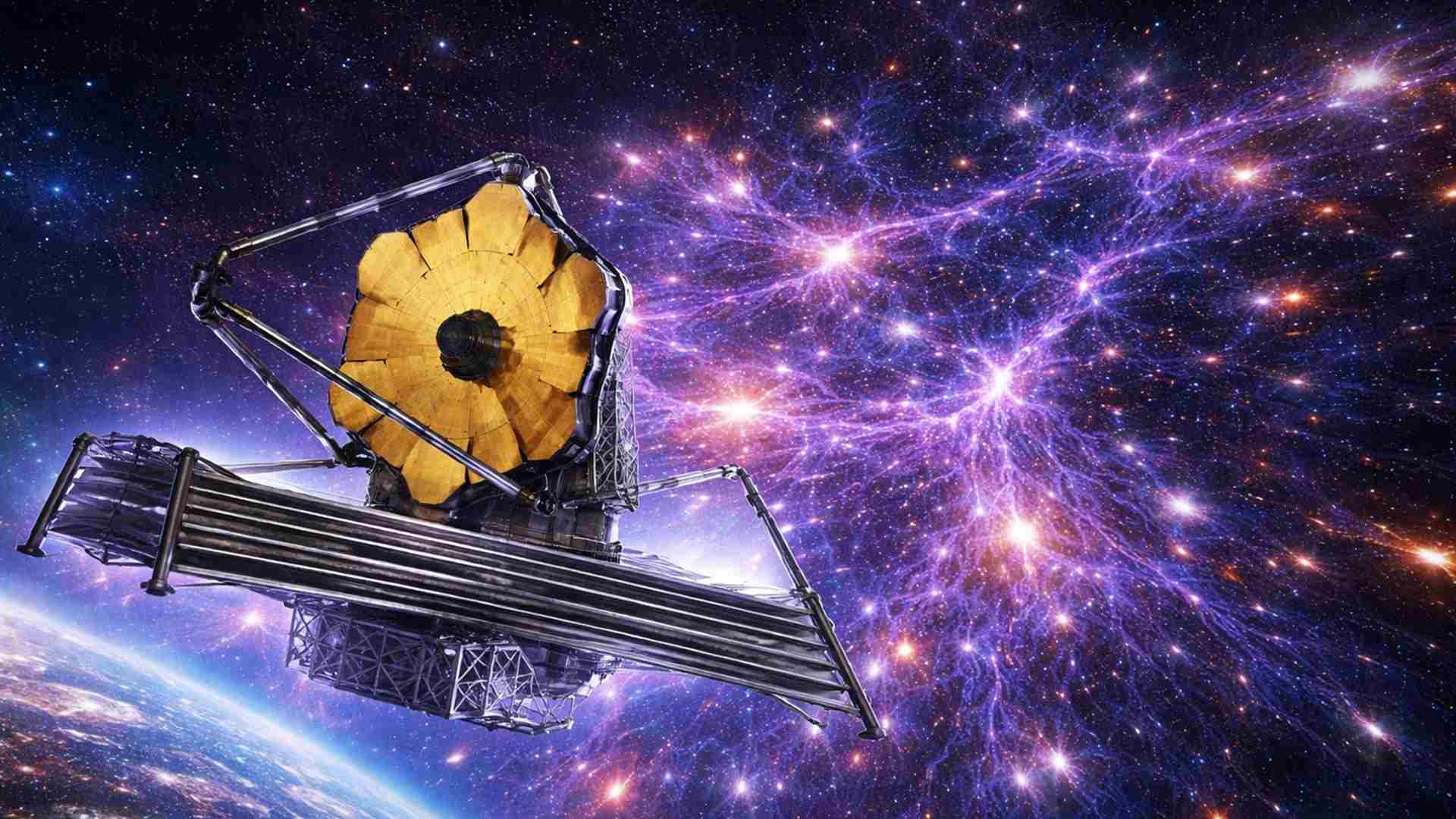
Based on 255 Hours of Observation from the James Webb Space Telescope, Study Published on January 26 in Nature Astronomy Presents the Most Detailed Dark Matter Map Ever Obtained, Covering Nearly 800 Thousand Galaxies in the COSMOS Field and Reinforcing Models About the Formation of the First Structures of the Universe
Dark matter, an invisible component that accounts for about five times more mass than ordinary matter in the universe, has returned to the center of scientific research with the release of the most detailed map ever produced, published on January 26 in Nature Astronomy, with data from the James Webb Space Telescope.
The study shows where dark matter is distributed in part of the cosmos and how its gravity shaped the formation of galaxies, offering direct evidence that these invisible structures acted as a foundation for the emergence of the first clusters of ordinary matter in the early universe.
According to researchers, without the presence of dark matter, there would not be enough mass to keep galaxies gravitationally bound, meaning that structures like the Milky Way and the billions of planets it hosts would not exist in their current form.
-
With a cost per shot close to zero, the DragonFire laser could change naval warfare in 2027 and provide British ships with nearly unlimited defense against drones.

-
A British startup creates tires that generate electricity in electric vehicles when passing over potholes, speed bumps, and cracks.

-
Scientists have created robots made with living cells that have their own nervous system, swim on their own, explore the environment, and self-organize without any genetic engineering, and now they want to do the same with human cells.

-
Students create a solar-powered ambulance that operates without a plug, without fuel, and still keeps medical equipment running in remote areas.


“It is the gravitational structure in which everything else fits and that forms galaxies,” says Richard Massey, co-author of the study and physicist at Durham University, explaining the relevance of the new map.
The COSMOS Field and the Area Mapped by Webb
The new map covers a region of the sky known as the COSMOS field, an area widely studied by previous observatories, including the Hubble Space Telescope, but now observed with significantly higher detail thanks to Webb.
Despite containing images of nearly 800,000 galaxies, many of them identified for the first time, the map covers a relatively small area of the sky, equivalent to about 2.5 times the apparent size of the full moon as seen from Earth.
About 20 years ago, Hubble provided pioneering images of the COSMOS field, allowing scientists to visualize the large-scale structure of the universe with unprecedented accuracy for the time.
With the new infrared data from Webb, researchers were able to overlay current observations onto previous ones, confirming past analyses and revealing new details of the distribution of invisible mass supporting these galaxies.
“We can see that the structures coincide, but now we can observe them with much more detail and precision,” says Diana Scognamiglio, a cosmology researcher at NASA’s Jet Propulsion Laboratory, who led the new study.
The Cosmic Web and the Formation of the First Galaxies
As Webb primarily observes in infrared, it is capable of recording galaxies formed billions of years ago, when the universe was still in its early stages of evolution.
These observations allowed scientists to identify structures known as dark matter filaments, which make up the so-called cosmic web, an invisible network along which galaxies align.
“There are galaxies lined up like beads wherever we see dark matter,” explains Massey, pointing out that these structures appear at different distances and times since the Big Bang.
According to scientists, shortly after the birth of the universe, dark matter began to clump together, forming a kind of gravitational skeleton that subsequently attracted ordinary matter.
The new map reinforces this idea by showing that regions with a higher density of dark matter correspond to areas with a greater concentration of galaxies, stars, and, later, planets.
“Wherever there is dark matter, it attracts ordinary matter and starts accumulating enough mass to form stars and planets,” adds Massey, reinforcing the central role of this invisible substance.
Weak Gravitational Lensing and the Construction of the Map
Since dark matter neither emits, reflects, nor absorbs light, scientists had to use indirect methods to map its presence in the COSMOS field.
The main technique employed was gravitational lensing, an effect predicted by general relativity, in which the gravity of massive objects bends the path of light coming from more distant sources.
In this new study, researchers focused on weak gravitational lensing, a subtle effect that causes small distortions in the apparent shapes of the observed galaxies.
These distortions are caused by the gravitational influence of dark matter along the path traveled by light to reach the telescopes.
To measure this effect accurately, it was necessary to analyze the shapes of hundreds of thousands of galaxies, comparing small statistical variations in their orientations and shapes.
“Galaxies become distorted into characteristic shapes, like a funhouse mirror,” explains Massey, highlighting the complexity of the calculations involved in this type of analysis.
The researchers observed the same region of the sky for 255 hours using Webb, which represents the largest survey conducted in the first year of the telescope’s scientific operations, which began in 2022.
Comparison with Previous Maps and Scientific Collaboration
The study also presents a direct comparison between previously obtained dark matter maps with Hubble and the new maps produced with Webb.
The overlaid contour lines indicate regions of equivalent dark matter density, allowing for the consistency between the two datasets to be verified and highlighting the resolution gain.
The research was conducted in collaboration between scientists from the COSMOS-Webb project, including Dr. Gavin Leroy and Professor Richard Massey, both from Durham University.
According to the authors, measuring dark matter in this way is comparable to observing the movement of leaves to infer the presence of wind, an indirect process, but highly informative.
This approach demands extreme precision, as the analyzed distortions are minimal and spread across vast cosmic scales, involving galaxies billions of light-years away.
The final result is a map that not only confirms existing theories but also provides a robust basis for future analyses about the structure of the universe.
Future Prospects and New Observatories
For experts who did not participate in the study, such as Rachel Mandelbaum, a physicist at Carnegie Mellon University, the new map paves the way for a series of additional scientific investigations.
Among them are analyses of how different types of galaxies relate to the amount of dark matter present and more detailed studies of so-called galactic voids.
These regions, with lower galaxy density than average, may provide important clues about the distribution of matter in the universe on a large scale.
The Webb map comes at a moment described by scientists as a golden age in the exploration of dark universe, with various observatories coming online.
The Euclid telescope from the European Space Agency, launched in 2023, and NASA’s Nancy Grace Roman Space Telescope, scheduled to launch this fall, will conduct surveys in much larger areas of the sky.
The Vera C. Rubin Observatory in Chile, which released its first images in June 2025, will also contribute detailed maps of galaxies and dark matter.
According to Gavin Leroy, the new Webb map represents “a fundamental first step” for all future knowledge that will be produced about dark matter.
From the Two-Dimensional Map to Understanding Dark Matter
Scientists are now working on constructing a three-dimensional version of the dark matter map obtained by Webb, combining these data with observations from other telescopes.
This approach will allow for the study not only of the spatial distribution of dark matter but also of its fundamental physical properties.
One of the central questions is to determine whether dark matter is composed of massive, slow-moving particles known as cold or lighter, faster particles referred to as hot.
The answer to this question has direct implications for cosmological models that describe the evolution of the universe since the Big Bang.
“I hope people see this as a foundation for other studies,” says Scognamiglio, highlighting the potential of combining different datasets to advance cosmology.
With this, the new map does not close the mystery of dark matter, but consolidates a technical and scientific milestone that will allow for gradual advancement in understanding one of the greatest enigmas of modern physics, even with small discrepancies and details still to be explored.
Source: Nature Astronomy








-

-

-

-

-

30 pessoas reagiram a isso.