





 Portuguese
  English
  Spanish
  3 min of reading
  1 comment


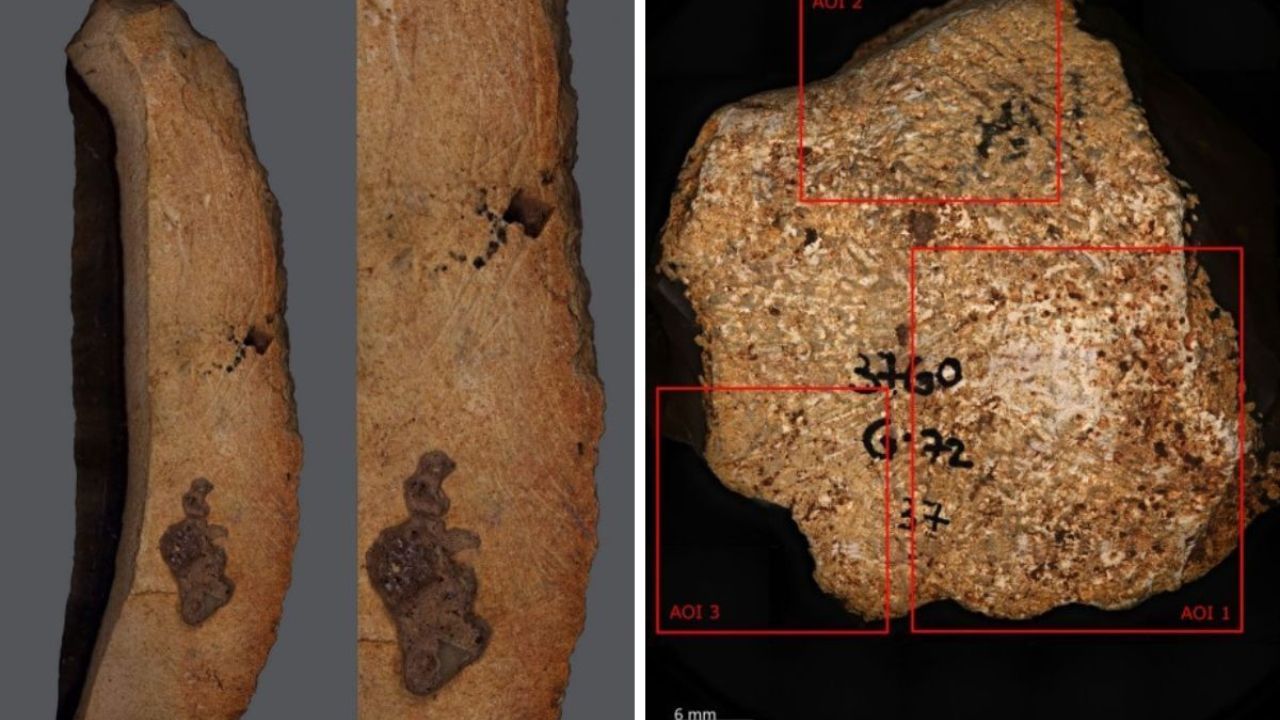


New Archaeological Evidence Shows That Early Humans Already Had Symbolic Thinking More Than 200 Thousand Years Ago! Geometric Engravings Found in Caves in the Levant Suggest That Our Ancestors Had Advanced Cognition, Challenging Everything We Knew About Human Evolution.
Check this out: a recent discovery could completely change the way we understand human evolution. A study published in Archaeological and Anthropological Sciences revealed that early humans already had symbolic and abstract thinking more than 200 thousand years ago!
You know those mysterious engravings in caves? Well, they were not made by chance. Researchers found geometrical patterns intentionally engraved in stones, indicating that our ancestors already had a level of cognition much more sophisticated than we imagined. Were they trying to communicate? Creating art? Or perhaps even developing a rudimentary writing system?
The Evolution of Symbolic Thinking in Early Humans

It was always believed that symbolic thinking was exclusive to modern humans, emerging about 40 thousand years ago. But it seems that this idea is falling apart.
-
Haiti’s capital is experiencing an energy and construction crisis, facing blackouts, a blocked port, and buildings at risk after years of instability and a significant earthquake.

-
Government unlocks R$ 554 million for a highway that has been requested for decades and accelerates the duplication of BR.

-
Without bricks, without cement, and without endless construction: the cardboard house that is assembled in modules and can be moved.

-
Billions of barrels on the equatorial margin could lead Amapá to double its oil production in Brazil — the state aims to enter the route of companies in the Campos Basin, attract investments, and boost jobs and businesses in the oil and gas sector.


The new evidence shows that hominids from the Middle Paleolithic period (250,000 to 45,000 years ago) were already producing symbols, which means that culture and communication began much earlier than we thought.
If they were already able to engrave symbols in stone, did they already have rituals, language, or even a primitive form of art? This could rewrite the entire timeline of human evolution.
Intentional Engravings: The Secret Code of Early Humans?
Archaeologists analyzed stone artifacts found in archaeological sites in the Levant, such as Manot Cave, Qafzeh Cave, and the Quneitra site, and discovered something surprising.
Using 3D analysis technology, they realized that the cuts were not random marks — they were intentional engravings. But what did early humans mean by this?
Here are some possibilities:
A form of art? Like the most famous rock paintings, but much older.
A communication system? Something like a visual code between tribes.
Rituals and beliefs? Perhaps a first step towards the emergence of religiosity.
Whatever the answer, one thing is certain: our ancestors were thinking far beyond simple survival.
How Did Scientists Manage to Prove This?
To leave no doubt, researchers used advanced 3D surface analysis. The goal? To differentiate intentional engravings from functional marks made by the daily use of stone tools.
And the results were very clear:
The engravings in the caves of Manot, Qafzeh, and Quneitra were made with symbolic intent.
The ones in the Amud Cave appeared to be just normal wear from tool use.
In other words, not all hominid groups had this ability, which may indicate that symbolic thinking emerged in certain regions before spreading.
Now, imagine the work it took to carve these symbols in stone? They needed sharp tools and a good level of motor coordination. This shows that, in addition to abstract thinking, they also had impressive technical skills.









É muito difícil interpretarmos comportamentos de tempos tão distantes. O que nos parece simbólico, pode apenas ser uma leitura direta de coisas do dia a dia.