





 Portuguese
  English
  Spanish
  6 min of reading
  0 comments


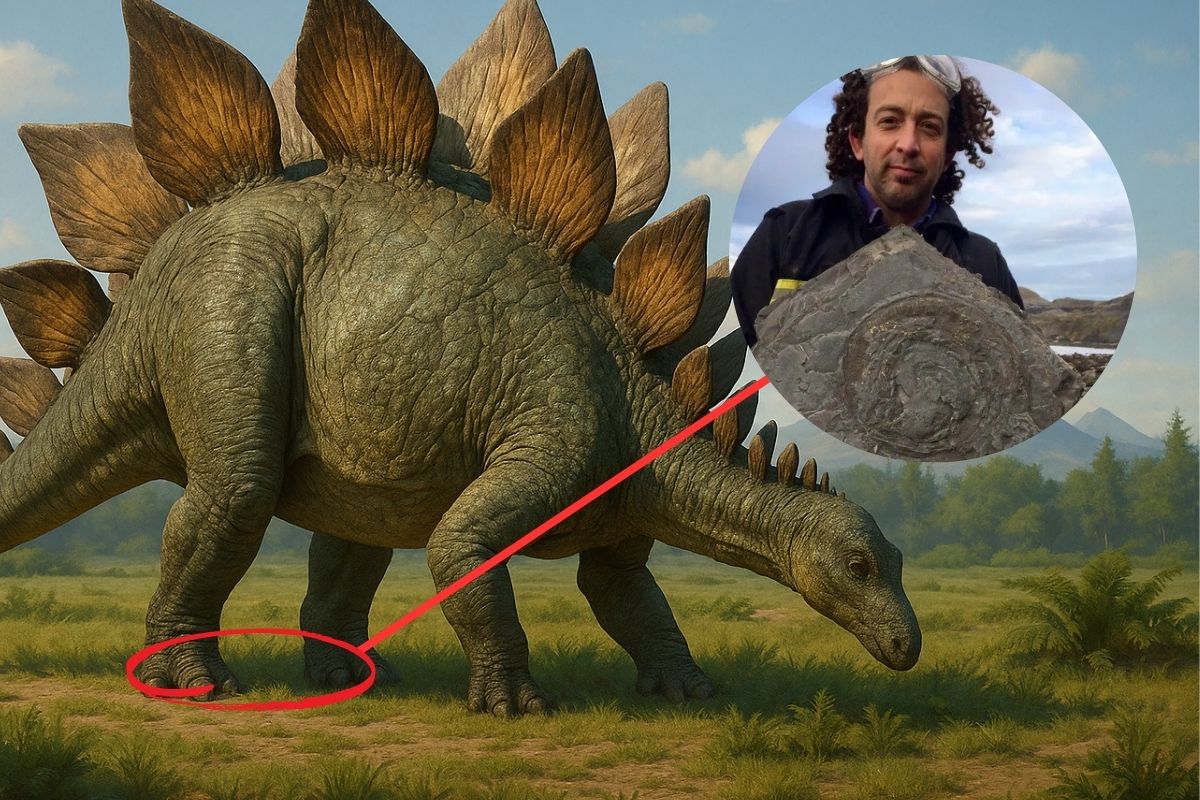
During a guided walk for students in Saltwick Bay, near Whitby, geologist and showman Steve Cousins, known as the “Rock Showman,” discovered an impressive fossilized dinosaur footprint in sandstone that is believed to be about 170 million years old.
The impression, attributed to a stegosaurus, was buried under sand until Cousins, attentive to the rock’s relief, revealed it to the light. To confirm the discovery, paleontologist Dr. Liam Herringshaw conducted a 3D scan of the block, demonstrating that the geological conditions of Saltwick Bay continue to expose traces from the Middle Jurassic, the information was published by the BBC.
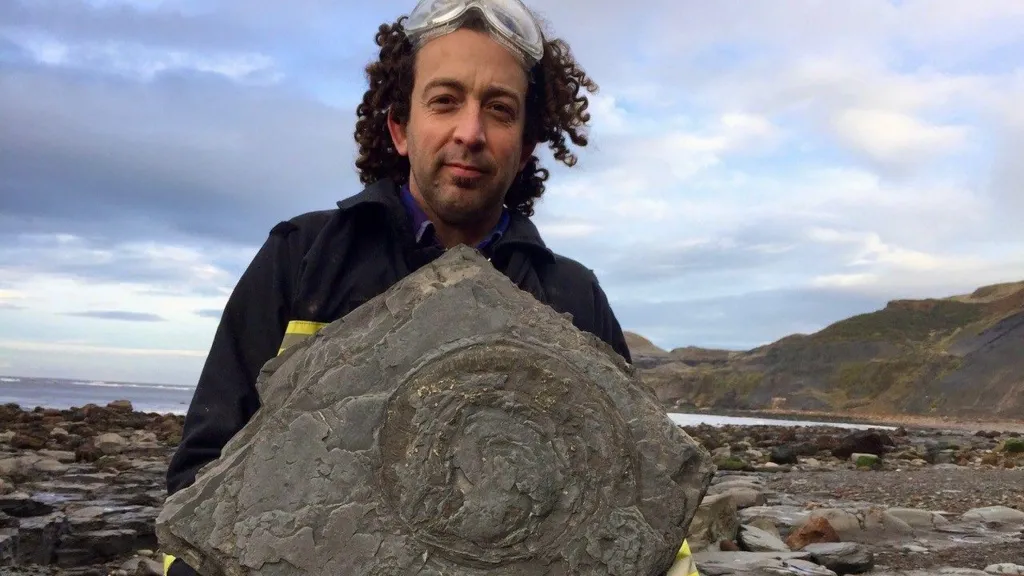
Saltwick Bay: An Open-Air Natural Museum
Saltwick Bay is located approximately 1.6 km east of Whitby, on the east coast of North Yorkshire, England. This stretch of coastline is part of the Saltwick Formation, sedimentary rocks deposited during the Early and Middle Jurassic. The area is famous for its abundance of ammonite fossils (such as Dactylioceras and Hildoceras), fossilized plants, and marine reptiles (such as thalattosuchians and ichthyosaurs). The sandy layers here formed about 174 to 164 million years ago, in shallow coastal environments that allowed for the recording of footprints of animals walking over still soft sediments.
-
With a cost per shot close to zero, the DragonFire laser could change naval warfare in 2027 and provide British ships with nearly unlimited defense against drones.

-
A British startup creates tires that generate electricity in electric vehicles when passing over potholes, speed bumps, and cracks.

-
Scientists have created robots made with living cells that have their own nervous system, swim on their own, explore the environment, and self-organize without any genetic engineering, and now they want to do the same with human cells.

-
Students create a solar-powered ambulance that operates without a plug, without fuel, and still keeps medical equipment running in remote areas.


Since the 18th century, alum extraction activities have opened deep cuts in the cliff, exposing horse bones, skeletons of crocodilians (Steneosaurus bollensis and S. brevior), and marine reptiles. In 1824, the discovery of a nearly complete skeleton of Steneosaurus bollensis was considered one of the most notable in the region. Later, specimens of ichthyosaurs and plesiosaurs were also recovered, consolidating Saltwick Bay as one of the classic sites of English paleontology.
Steve Cousins: The “Rock Showman” and His Passion for Fossils
Steve Cousins, with a background in geology and performing arts, founded the Earth Science Outreach UK organization alongside Dr. Liam Herringshaw. In his presentations as the “Rock Showman,” he combines educational demonstrations with theater to engage the public at science fairs, museums, and festivals. Along the northern coast of Yorkshire, Cousins leads educational trails for students and enthusiasts to learn how to identify fossils exposed by the tides.
Wearing plastic glasses on his head and always with brightly colored gloves, Cousins takes groups along rocky ledges and coves. His effort focuses on making science accessible: “For me, the entire coast of North Yorkshire is an open-air museum. One of the greatest pleasures is to take people to this coastline and help them understand what they are looking for,” he often says.
The Discovery of the Stegosaurus Fossil
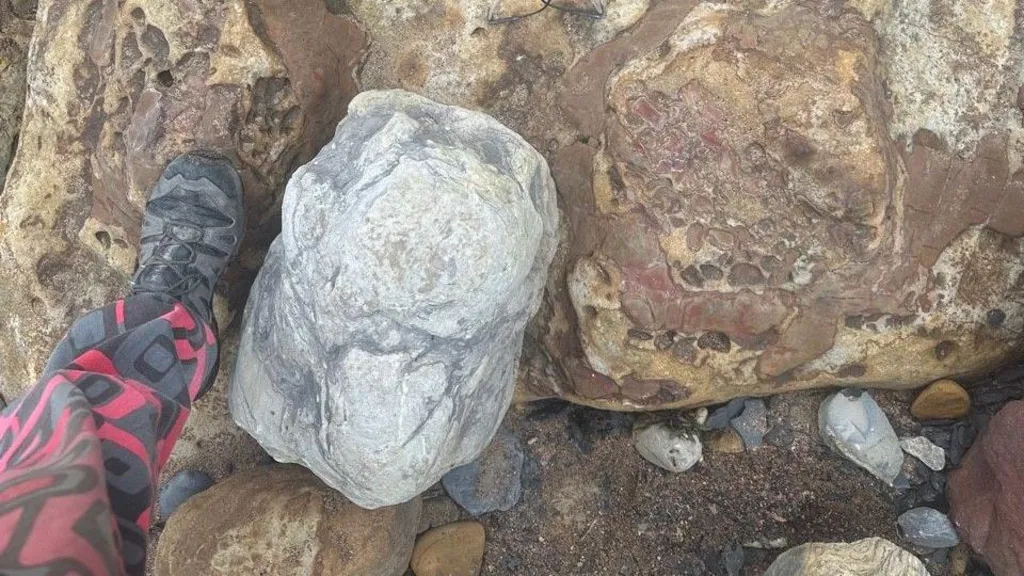
On a recent school trip, while guiding students in Saltwick Bay, Cousins noticed an irregular shape on the surface of a sandstone block partially covered by sand. It was a well-defined tridactyl footprint, impressed when the sediment was still soft, in the Middle Jurassic. “The kids were very excited. It was amazing to share this discovery with them,” the geologist reported to the BBC.
The block displayed a large groove, with approximately three arched toes and sufficient depth to characterize a firm support moment of a stegosaurus’ hind foot. To confirm his suspicions, Cousins contacted Dr. Liam Herringshaw, who conducted a 3D scan of the fossil using a specific application. The three-dimensional map revealed the exact contours of the footprint, allowing for size estimation—almost three times the length of a hiking boot—and the typical morphology of Stegosaurus.
The Stegosaurus: Characteristics of the Genus
The stegosaurus (genus Stegosaurus), as described by paleontological literature, lived during the Kimmeridgian to Tithonian (approximately 155–148 Ma) in the Late Jurassic. It was a large quadrupedal herbivore, with posterior limbs more robust than the anterior ones, an arched back, and an elevated tail. Its most striking feature was the rows of tall bony plates along its back and the sharp tips (spikes) at the tail end, suggesting possible functions for thermoregulation, display, or defense.
Fossils of Stegosaurus have been found mainly in the western United States (Morrison Formation) and in Portugal. Three species — S. stenops, S. ungulatus, and S. sulcatus — are the most recognized. They inhabited forested and shallow swamp environments, co-existing with giant sauropods, such as Apatosaurus and Brachiosaurus, and theropod predators, such as Allosaurus and Ceratosaurus.
Geological Formation and Reasons for Preserving the Footprints
The rocks of Saltwick Bay belong to the Early and Middle Jurassic, deposited in river delta and shallow coastal plains. In more recent times, during the Tertiary, tectonic movements resulting from the collision between Africa and Europe uplifted the crust again, eroding deeper layers and bringing these phosphatic layers to the surface. In Saltwick Bay, the cliffs drop directly into the sea, and the waves remove sediments, exposing consolidated sands where dinosaur tracks have become visible.
Many footprints formed in fine sandstones, where the dinosaur left significant impressions while walking over wet sediments. As the tides recede and continuous erosion occurs, these footprints temporarily emerge before becoming covered by sand or water. Thus, fossil impressions can appear on low tide days, especially after storms or particularly low tides, when the cliff is “cleaned” by the force of the waves.
Scientific and Educational Importance of the Discovery
Each new footprint helps to understand the locomotor behavior of the stegosaurus: stride width, support depth, and sometimes indicates whether the individual was running or walking slowly. Furthermore, the coastal location demonstrates that these dinosaurs traversed flooded coastal plains, possibly migrating between safer areas during high tide.
The discovered fossil has been taken for display at Jet Bistro, in Whitby Holiday Park, where visitors can observe it for free. The goal of Cousins and Herringshaw, founders of Earth Science Outreach UK, is exactly this: “any finding should be within the public’s reach to convey knowledge about the prehistoric era,” they affirm. The exhibit is located just steps from the beach, creating a direct experience between the original landscape and the fossil record.
Continuity of Finds Along the North Yorkshire Coast
According to Dr. Herringshaw, dinosaur footprints are quite common along the entire North Yorkshire coast. Sedimentary rocks of the right age frequently re-emerge in Whitby, Scarborough, and other locations. Although rare on a global scale, these Middle Jurassic sandstones in this region preserve dinosaur tracks in large quantities.
With the low tide, anyone interested in paleontology can explore the beaches and look for fossilized footprints. Minimal equipment—a camera, gloves, and a notebook—can already allow for recording any impressions found. However, it is essential to respect National Park regulations and avoid removing specimens: the best practice is to photograph and inform qualified researchers.
The discovery of the stegosaurus footprint in Saltwick Bay reinforces the importance of scientific outreach initiatives that connect schools, communities, and researchers to the local geological heritage. By revealing this 170 million-year-old record, Steve Cousins—the “Rock Showman”—demonstrates that “the entire coast of North Yorkshire is an open-air museum.” Ongoing collaboration with experts like Dr. Liam Herringshaw accelerates the process of 3D scanning and scientific validation, contributing to a deeper understanding of the habitat and behavior of Jurassic dinosaurs.








Seja o primeiro a reagir!