





 Portuguese
  English
  Spanish
  6 min of reading
  0 comments


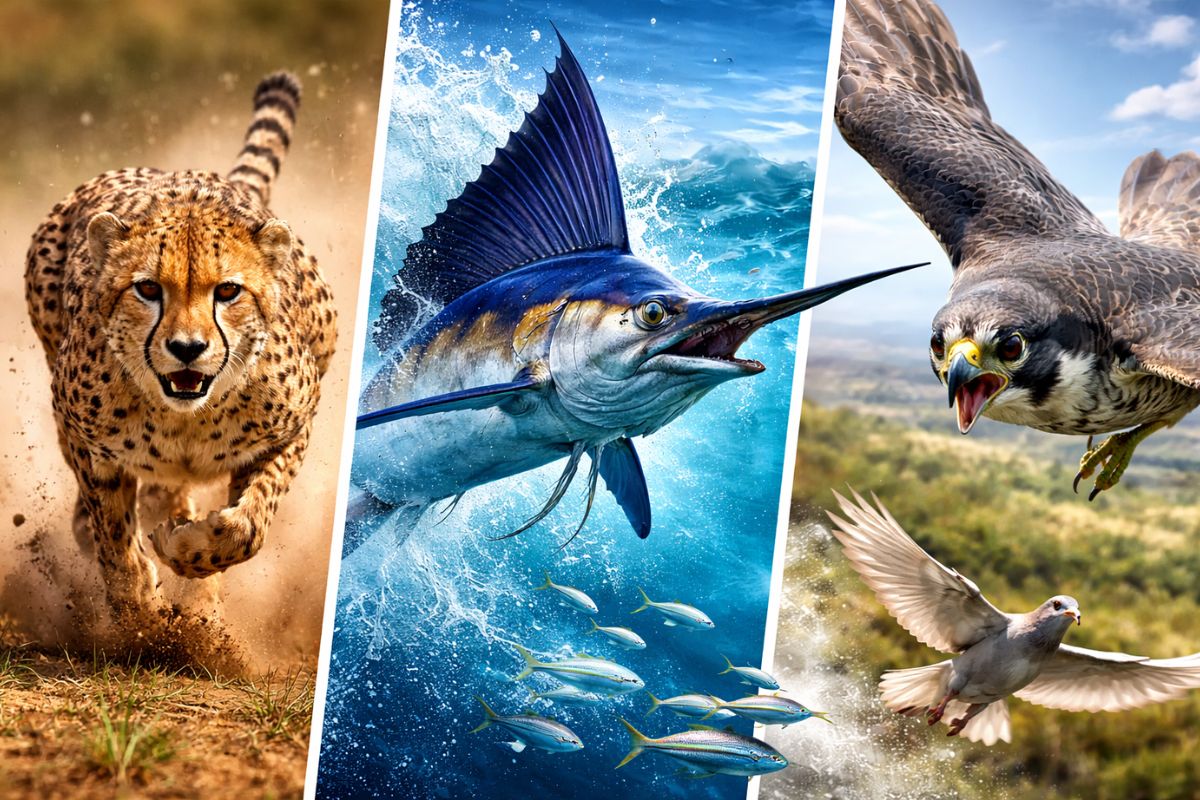
Cheetah, Sailfish, and Peregrine Falcon, Fastest Animals on Earth, Form the Podium of the Fastest Animals on Land, Water, and Air in High-Speed Hunts.
When we talk about fastest animals on land, many people only remember the cheetah running on the savanna, but the planet holds other discreet champions. In the warm oceans, the sailfish darts like a torpedo at 110 km/h. In the sky, the peregrine falcon dives on its prey at an impressive 320 km/h. Together, they show how far evolution can push body, muscles, and aerodynamics to the limit of speed.
Why These Are the Fastest Animals on Land, Water, and Air

In common, these three champions share one thing: every detail of the body has been shaped to overcome the resistance of the environment. The sailfish cuts through the water with its pointed snout and dorsal fin that acts like a rudder.
The cheetah uses semi-retractable claws like soccer cleats, gripping the ground in turns and sprints.
-
With a cost per shot close to zero, the DragonFire laser could change naval warfare in 2027 and provide British ships with nearly unlimited defense against drones.

-
A British startup creates tires that generate electricity in electric vehicles when passing over potholes, speed bumps, and cracks.

-
Scientists have created robots made with living cells that have their own nervous system, swim on their own, explore the environment, and self-organize without any genetic engineering, and now they want to do the same with human cells.

-
Students create a solar-powered ambulance that operates without a plug, without fuel, and still keeps medical equipment running in remote areas.


The peregrine falcon turns its own body into a missile, closing its wings to dive freely onto its prey.
When we talk about fastest animals on land, we are looking at a group of record holders that dominate completely different environments, but follow the same basic rules: reduce drag, increase thrust, and maintain control at high speeds.
In all cases, speed is not just spectacle. It’s the difference between eating and running out of energy, between escaping and becoming a meal.
Sailfish: The Champion of the Warm Waters

In the warm waters of the tropical oceans, the sailfish, also called the billfish or swordfish, is the true king of speed in water.
In videotaped hunts, it reaches approximately 110 km/h, a mark that appears in the Guinness Book of Records.
Its body has clear adaptations for this. The end of the snout is long and pointed, helping to cut through water resistance and maintain speed during swimming.
This sharp form allows the sailfish to approach schools of small fish, its main food, and also helps it escape from predators like sharks.
The large dorsal fin, the “sail” that gives the animal its name, acts as a high-speed steering control system.
It helps direct the body, stabilize the trajectory, and make quick turns when the school disperses. At high speeds, any poorly controlled deviation can mean a loss of energy or even a collision, so this “sail” is crucial.
Another important point is its relation to fishing. Many people enjoy catching sailfish precisely because they “play” a lot after being hooked, jumping and fighting on the surface.
This same energy that makes the fish valuable to sport fishermen is a direct consequence of the engine that places it among the fastest animals on land in the aquatic category.
Cheetah: The Sprinter of the African Savannas

On solid ground, the title of land speed champion goes to the cheetah, also known as the chita.
It is one of the most beautiful felines in the world and can reach speeds of about 115 km/h over short distances. Among the fastest animals on land, it is the perfect sprinter, capable of accelerating faster than many cars at low speeds.
Its body is entirely built for running. The pads on its feet have grooves that improve traction on the ground, and its claws, unlike those of other felines, do not fully retract.
They function like soccer cleats or track spikes, ensuring the cheetah doesn’t slip in turns and sprints.
The long, flexible tail acts as a counterbalance in turns, helping the animal stabilize its body when changing direction quickly to follow fleeing gazelles and antelopes.
The head is small and aerodynamic, and the extremely flexible spine works almost like a spring, allowing for very long and elastic strides.
Another striking detail is the two black stripes that run down from its eyes, as if they were tears. They help reduce light glare, improving vision on very bright days, something essential for a daytime hunter.
While many felines prefer the night, the cheetah uses the clarity of day to locate its prey and go all in on a short, explosive chase.
This combination of specialized anatomy and unique behavior places the cheetah at the top of the list of fastest animals on land in a terrestrial environment, with a strategy based on a few seconds of explosion rather than long-distance endurance chases.
Peregrine Falcon: Dives at 320 km/h in the Sky

In the air, no other vertebrate comes close to the peregrine falcon when it comes to speed. In hunting dives, it can reach speeds of about 320 km/h, earning the title of fastest animal on the planet.
If the cheetah dominates the land and the sailfish dominates the water, the peregrine falcon is the living missile of the sky, a predator that transforms gravity, aerodynamic shape, and acute vision into a lethal weapon.
Its hunting technique is as impressive as it is simple to describe. First, the falcon rises high and flies in circles, observing everything below.
Upon spotting prey in flight, it closes its wings against its body and enters free fall, like a torpedo aimed at the target.
It is in this dive, known as a “stoop,” that the speed surges. The impact on the prey is so strong that, in most cases, it dies instantly while still in the air.
Immediately after the strike, the falcon makes a quick maneuver and grabs the bird before it falls. In the midst of all this, it still needs to protect its eyes.
For this, it has a third eyelid, the nictitating membrane, which lubricates and cleans the ocular surface during the descent, functioning like a kind of high-performance biological goggles.
The peregrine falcon is also extremely versatile in terms of habitat. It can be found in mountains, savannas, coastal regions, oceanic islands, and even urban areas with many buildings.
In Brazil, for example, it uses tall buildings and towers as hunting and resting perches, taking advantage of the abundance of pigeons and bats in urban centers.
It is a solitary predator or seen in pairs, spending a large part of the day on its perches, coming out to hunt in the early morning and late afternoon.
With this combination of dives at 320 km/h, adapted vision, and bold behavior, the peregrine falcon completes the trio of fastest animals on land, dominating the aerial category with ease.
What Speed Champions Have in Common
Despite living in completely different environments, sailfish, cheetah, and peregrine falcon share some basic principles.
All have elongated bodies, relatively small heads, and structures that reduce drag, whether in water, air, or on land.
They also have “extra tools”:
- the sailfish uses the dorsal fin as a rudder and the snout as a knife in the water
- the cheetah uses semi-retractable claws and tail for stability in turns
- the peregrine falcon uses narrow wings, nictitating membrane, and precise dives
In all cases, speed is directly linked to survival. These fastest animals on land change the balance of food chains.
They capture prey that many other predators could not reach, and at the same time need to be efficient, because explosive energy like this takes a heavy toll on the body.
In the end, observing these three champions is looking at the limit of biomechanics in nature: every muscle, every bone, and every structure has been fine-tuned by natural selection to compete for fractions of a second in hunts that determine the day.
And you, which of these fastest animals on land impresses you the most: the savanna cheetah, the sailfish of the warm seas, or the peregrine falcon that falls from the sky like a missile?







-

-

-

6 pessoas reagiram a isso.