





 Portuguese
  English
  Spanish
  6 min of reading
  0 comments


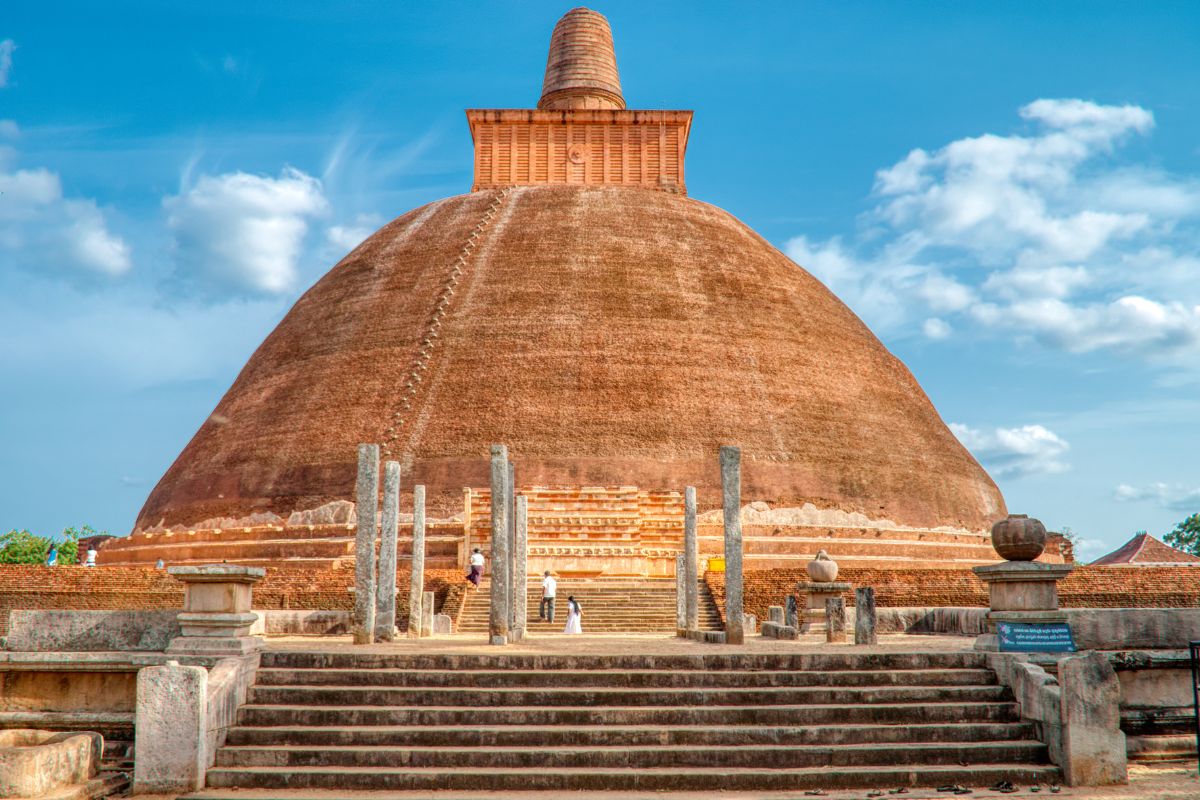
In Anuradhapura, The Jetavanaramaya Emerged As A Religious Center And Unprecedented Logistical Challenge: A Stupa That Once Measured 122 Meters Was Built With About 93.3 Million Bricks And Even After Being Reduced To 71 Meters After Centuries Of Erosion, Remains The Largest Known Brick Structure In Historical Scale.
The Jetavanaramaya is not just a monumental work of ancient Sri Lanka. It synthesizes, within the same architectural volume, Buddhist faith, the capacity for collective coordination, and technical mastery at a level that still surprises. Completed around 301 AD, its scale placed Anuradhapura among the great construction centers of the ancient world.
Today, the stupa continues to impose a physical and symbolic presence. Even with a loss of height over time, its volume maintains its position as the largest brick structure ever built. What it reveals goes beyond dimension: it shows how a premodern society articulated belief, labor, and infrastructure to materialize a long-lasting project.
Anuradhapura, The Scenario Where Religion And Urbanism Converged

In the center-north of Sri Lanka, Anuradhapura established itself as the first major capital of the island and as one of the most sacred spaces of Buddhism. The persistence of rituals at the site, spanning centuries, helps to understand why the Jetavanaramaya was not conceived as an isolated element, but as the nucleus of a living spiritual landscape. The monumentality, in this context, functioned as both a religious and political language.
-
A Mercado Livre customer opened their package and found 32 resumes of people looking for jobs crumpled as protective paper inside the box, exposing names, addresses, documents, and phone numbers of dozens of candidates.

-
Iceberg A23a, one of the largest in the world, is undergoing accelerated collapse and may disappear: what explains the end of the ice giant?

-
The simplest swap at home can reduce energy consumption by up to 90% without changing habits, using a technology that lasts up to 25 times longer and consumes only a fraction of the electricity.

-
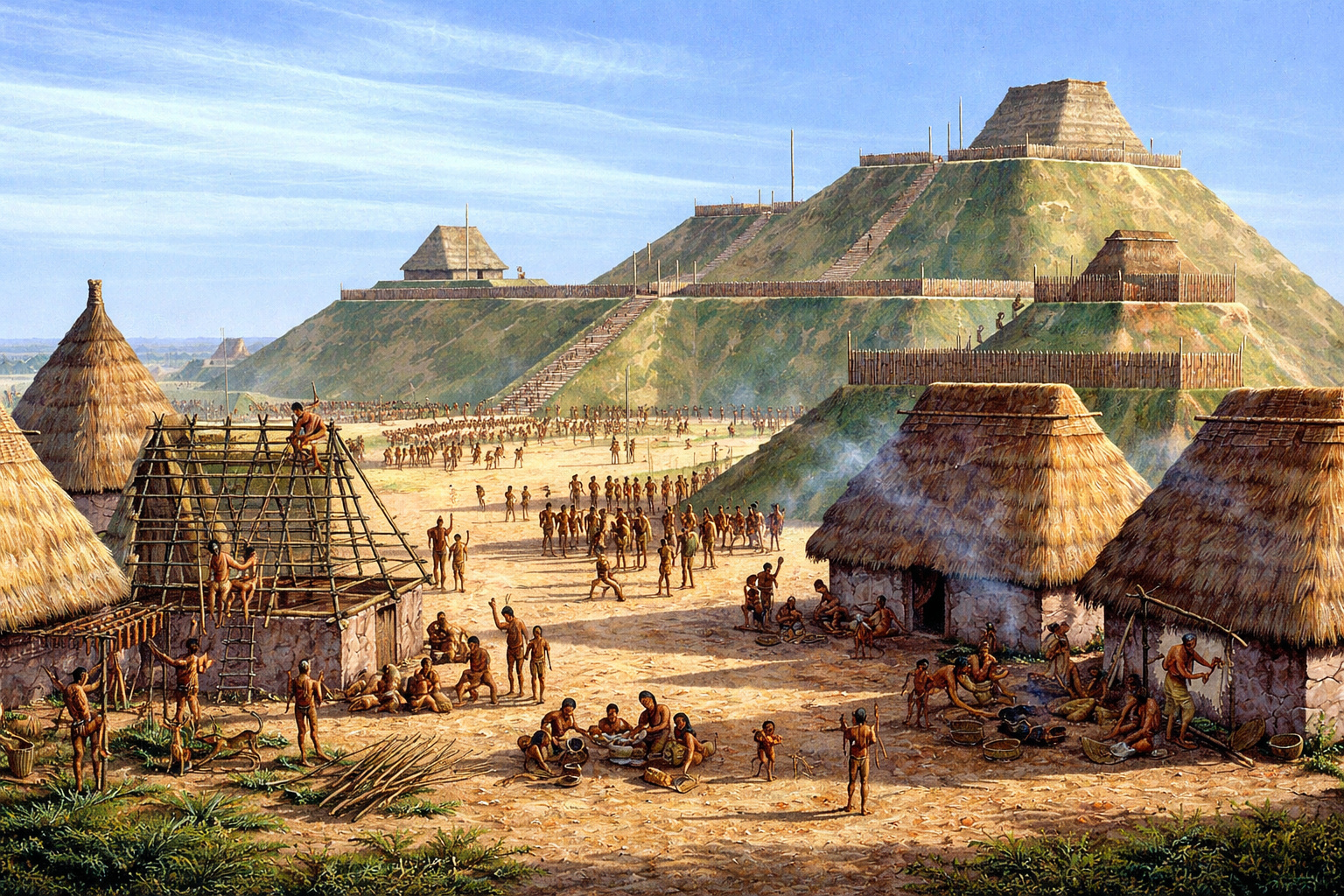
With over 14 million baskets of earth moved, an ancient North American metropolis built a monumental pyramid of 30 meters and established a city with 20,000 inhabitants nearly a thousand years ago.

On full moon days, the dynamics of the place reinforce this historical continuity: pilgrims dressed in white, monks chanting, and foreign visitors circulating on ancient paths. The stupa remains visually dominant and organizes the reading of the surrounding space. Rather than being just a “marker of the past,” the Jetavanaramaya continues to be integrated into the ritual daily life, connecting historical memory and present practice.
This permanence helps to explain why the structure has survived so many cycles without losing its symbolic centrality. In ancient societies, works of this magnitude were not just demonstrations of technique. They were instruments of social cohesion, territorial reference, and concrete proof of a collective project intended to last beyond individual generations.
The Engineering Of 93.3 Million Bricks And The Challenge Of Scale

When observing the Jetavanaramaya through numbers, the leap in complexity becomes evident. The stupa was completed with about 93.3 million baked clay bricks, reaching approximately 122 meters in height in its original phase. In the ancient world, this placed it among the largest human constructions, second only to the Pyramids of Giza.
The choice of brick was decisive for the level of difficulty. Unlike stone construction, the method required a continuous operational chain: producing, drying, firing, transporting, and laying millions of units with structural stability in a large curved shape. It was not just about stacking material but maintaining technical coherence throughout a work of enormous volume.
Remnants of ancient kilns in the region reinforce the idea of large-scale production, although without conclusive attribution and closed dating for each stage. This raises an important point: part of the logistics remains opaque in the historical record. What is known with greater certainty is the final result, which presupposes coordination of labor, resource management, and temporal planning far beyond usual projects of the time.
This operational dimension also allows for a broader reading. The Jetavanaramaya demonstrates that ancient societies could organize complex processes systematically, with task division and maintenance of construction rhythm for long periods. The work proves administrative capacity, not just craft skill.
From 122 To 71 Meters: Deterioration, Abandonment, And Permanence
The current image of the Jetavanaramaya is the result of prolonged transformations. Over the centuries, progressive collapses and phases of abandonment reduced its height to about 71 meters. This difference, compared to its original peak, shows how even extraordinary constructions depend on continuous maintenance to preserve form and proportion.
Nonetheless, the most striking aspect is the permanence of the overall volume. The vertical loss did not nullify the scale of the set, and the stupa continues to be recognized as the largest known brick structure. The partial durability, in this case, is already a technical feat, especially considering the prolonged exposure to erosion and tropical climate.
For a long time, coverage by vegetation helped the monument remain relatively discreet outside the region, despite its magnitude. This period of lesser public visibility contrasts with the real size of the construction and helps to explain why, compared to other more widely known ancient works, the Jetavanaramaya still appears little in the global repertoire.
There is also a recurring historical comparison that dimensions its material scale: the bricks of the stupa would be enough to raise a wall about 30 centimeters thick and nearly 3 meters high between London and Edinburgh. While it is a comparative image, it concretely communicates the order of magnitude involved in the project.
Jetavana Vihara: Religious Function, Monastic Life And Symbolic Authority
The Jetavanaramaya was part of a larger complex, the Jetavana Vihara, designed to house a large monastic community and structure the spiritual practice around the central presence of the stupa. In urban and religious terms, this means that the construction operated as an axis of orientation for space, circulation, and daily life.
In this configuration, the architectural dimension had practical and doctrinal purposes. The visibility of the stupa from different points of the precinct reinforced belonging and symbolic hierarchy. The architecture was not a passive backdrop but an active component of religious organization. The main building served as a continuous reference for rituals, movements, and community rhythms.
This arrangement helps to answer why a work of this size was necessary: in addition to hosting a spiritual function, it materialized institutional stability. In periods of ideological dispute and affirmation of religious currents, monumental constructions could communicate permanence, legitimacy, and capacity for collective mobilization without relying on written discourse.
The very continuity of practices in the territory reinforces this reading. By surviving long-term political and social changes, the complex maintains the original message in a new historical layer: the sacred space remains functional, even in a contemporary context.
What Was Found Inside The Stupa And What It Reveals About The Ancient Indian Ocean
The interior of the Jetavanaramaya brought important evidence regarding its function and the intellectual environment of the time. Relic caskets were found at different construction levels, indicating that the monument was not only a feat of engineering but also a carefully planned container of religious meaning.
Among the finds are gold panels depicting bodhisattvas, now preserved in the National Museum of Colombo. This type of object suggests circulation of ideas, artistic forms, and doctrinal references in a cultural network connected to India and other regions around the Indian Ocean. The stupa, therefore, engaged with a broader world than its immediate perimeter.
These materials also support the interpretation that the site gathered diverse religious currents over time. Instead of being a monolithic space, the Jetavanaramaya appears as a convergence point where construction technique, devotion, and cultural exchange overlapped. This overlapping is one of the elements that make the work historically unique.
When observing the complete set, the monument ceases to be just “large” and becomes structurally revealing: it shows how a civilization constructed collective meaning in multiple layers, from brick to ritual, urban planning to symbolic repertoire.
The Jetavanaramaya has survived 1,700 years because it combined three forces rarely aligned on the same scale: engineering, social organization, and religious purpose. Even reduced in height, it continues to impose a current question about civilizational capacity: what truly defines a lasting work, the material, the technique, or the idea that sustains it for centuries?
If you had to point out one decisive factor for the longevity of the Jetavanaramaya, what would it be: the constructive efficiency with millions of bricks, the religious centrality in Anuradhapura, or the symbolic strength that kept the monument relevant generation after generation?





-

-

-

-

-

21 pessoas reagiram a isso.