





 Portuguese
  English
  Spanish
  6 min of reading
  0 comments


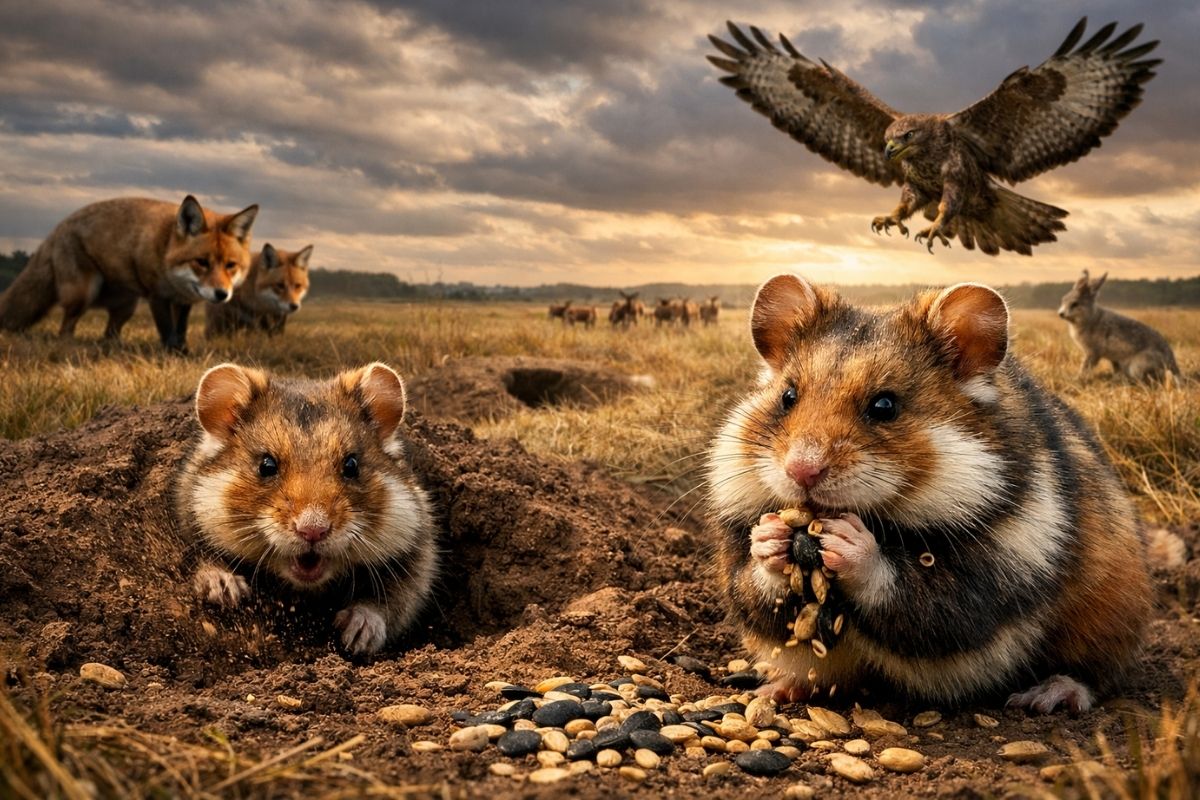
European Hamsters Larger Than Domestic Ones, Up to 30 Cm and Over 500 G, Have Been Reintroduced to the Steppe of Tarutino, Ukraine, with 13 Animals in Protected Enclosures. This Is the Third Release, Following 2022 and 2023, and 2025, with Monitoring and Ecological Gains for Biodiversity and Sustainable Local Tourism
The European Hamsters have returned to the Tarutino steppe in Ukraine, with the release of a group of 13 animals in a new phase of the reintroduction program conducted in the region. The initiative takes place in a wildlife restoration area linked to the landscape of the Danube Delta, where the goal is to rebuild natural processes that sustain the biodiversity of the steppe.
The reintroduction occurs with a gradual adaptation strategy: the hamsters are first placed in acclimatization enclosures with protection against predators and initial support, before being permanently released into the wild. In addition to a direct gain for the species, the growing presence of these rodents begins to reorganize the food chain and the dynamics of the soil, with ecological as well as economic impacts.
Where the Hamsters Are Being Released in Ukraine

The release occurs in the Tarutino steppe, Ukraine, within a large restoration area linked to the landscape of the Danube Delta.
-
Something is happening around the Earth: Inside the huge explosion of fireballs in 2026

-
A hot air bubble coming from Argentina expands over Brazil, causing thermometers to exceed 38 degrees with a thermal sensation of 40 degrees in late March, affecting 6 states at once.

-
The radish leaf that almost everyone throws away has more polyphenols, flavonoids, and fiber than the consumed root, and a 2025 study showed that the leaf contains compounds that protect the intestine, combat inflammation, and may inhibit the growth of cancer cells.

-
A planet that seemed to defy the laws of physics has intrigued scientists for decades, until the James Webb revealed what is really affecting Saturn’s rotation.


The work is conducted by the team from Rewilding Ukraine, in collaboration with the Kyiv Zoo and the Tarutino Steppe Natural and Ethnographic Park.
This is the third release of the ongoing reintroduction program.
Other groups were released in 2022 and 2023, and one in 2025, maintaining the logic of population reinforcement in successive cycles, with monitoring after each stage.
Why Wild Hamsters Change the Steppe Underground
Compared to pet hamsters, the wild hamsters reintroduced in Ukraine are considerably larger: they can reach 30 cm in length and weigh over 500 g.
Their routine is predominantly underground, spending most of their time in burrows and coming out mainly at dawn and dusk to feed, primarily on plants.
In the Tarutino steppe, this way of life generates cascading effects. By dispersing seeds, hamsters help redistribute plants in the landscape.
By digging tunnels and keeping burrows active, they create microhabitats that can be used by other species of fauna and flora and also contribute to improving soil fertility.
In a steppe ecosystem, where the structure of the terrain and the availability of refuges influence the survival of numerous species, this silent engineering changes the landscape without drawing attention.
Burrows, Seeds, and Food for Predators: The Food Chain Reconnects

Hamsters are also important pieces as prey.
Their presence supports predatory birds and mammals, helping to rebuild the predator-prey relationships that tend to weaken when a species disappears.
This means that the return of hamsters is not just a rescue of a rare animal: it is a replenishment of energy and behavior within the system.
In practice, the steppe gains more underground activity, more seed dispersal, and more feeding opportunities for predators.
This combination creates a foundation for broader biodiversity recovery, because it does not depend on a single isolated factor but rather on various gears functioning simultaneously.
How Acclimatization Works Before Permanent Release
The newly arrived hamsters have been placed in two large acclimatization enclosures, prepared to reduce the immediate risk of mortality and increase the chance of adaptation.
Within these spaces, several artificial burrows were created, offering shelter and initial guidance for occupying the underground.
The structure was designed to block specific threats.
Specially built walls prevent predators from digging in and entering the enclosures.
At the same time, the enclosures are covered with nets to protect the hamsters from raptors.
After a few weeks, the enclosures will be opened, allowing the animals to leave the protected area and enter the open landscape of the steppe, already with a repertoire of shelter and movement.
Post-Release Monitoring and What the Team Seeks to Observe
The release does not end when the enclosure gate is opened.
After release, the hamsters continue to be monitored to check if they are adapting to the environment, if they are using the burrows, if they are feeding adequately, and if they can occupy the area without excessive predator pressure early on.
The assessment also helps to calibrate the next steps of the program, including the planned release for 2025.
Each reintroduced group becomes a real test of the balance between shelter, food, and risk, and monitoring is the mechanism that allows for corrections in the process before expanding the population.
Why the Species Almost Disappeared and Became a Conservation Priority
The European hamster once occupied steppes and steppe forests across much of Europe and was common in extensive areas of Ukraine. This scenario changed dramatically.
The disappearance in the wild has been associated with habitat destruction, environmental pollution, and targeted extermination because it is treated as an agricultural pest.
In Ukraine, the European hamster was listed in the Red Book in 2009. Additionally, it has critically endangered status on the IUCN Red List, reinforcing the urgency of reintroduction.
The Tarutino steppe provides a context of environmental protection and increasingly wild landscape, which increases the chances of hamsters establishing a stable population.
From Local to Regional: The Larger Project in the Danube Delta
The reintroduction program for hamsters is part of a broader effort to restore wildlife in the landscape of the Danube Delta.
This work began in early 2019 with funding from the Threatened Landscapes and Seas Program, through Rewilding Europe.
This emphasis is important because it connects the release of a small rodent to a landscape strategy: it is not just about “releasing animals,” but about recovering ecological functions, increasing biodiversity, and reconstructing food chains on a scale capable of sustaining populations over time.
Other Reintroduced Species That Reinforce the Natural Dynamics of the Steppe
Hamsters are part of a larger set of reintroductions of native herbivores in the Tarutino steppe.
Populations of kulan, European fallow deer, and steppe marmot are also cited as thriving, contributing to shaping a wilder landscape.
The central goal of these efforts is to create a steppe more governed by natural processes, such as natural grazing and a balanced and healthy predator-prey dynamic.
When multiple species return together, the environment stops depending on constant interventions and begins to self-regulate more effectively.
National Park in Discussion and Coordination with the Community and Government
In recent years, the Rewilding Ukraine project team, in collaboration with the Borodino community and the Odessa Department of Ecology, has made significant progress toward the creation of the Budzhak Steppe Natural National Park.
The proposal covers the Tarutino steppe and adjacent areas, although disconnected, extending the formal protection of the habitat mosaic.
This coordination indicates that the reintroduction work is being treated as part of a long-term vision, where conservation, territorial governance, and local development go hand in hand, avoiding that ecological recovery relies solely on isolated actions.
Nature Tourism and Local Economy: When Wildlife Becomes an Asset of the Territory
Besides its ecological value, the presence of hamsters is seen as a component that can attract tourists and boost nature tourism.
This tends to strengthen the local economy, which is described as dependent on nature for survival.
The economic effect is indirect but powerful: when the landscape becomes richer in wildlife, it gains value as a destination and as a local identity.
At the same time, the territory gains more incentive to maintain and expand environmental protection, because the return also comes in the form of sustainable activity.
Support for the Work and Partners That Sustain the Restoration
The support for Rewilding Europe’s work in ecological restoration landscapes is described as coming from a wide network of partners, with highlights for essential funding.
Among the supporters mentioned are the Ecological Restoration Fund, the Dutch Postal Lottery, WWF-Netherlands, and Arcadia.
This type of support is what allows to maintain ongoing programs, such as the reintroduction of hamsters, with successive release cycles, acclimatization structures, monitoring, and associated territorial planning.
Do you think hamsters can become the silent symbol of the reconstruction of the Ukrainian steppe, or does a broader strategy to protect wildlife still need to be developed?







-

-

-

-

-

-

40 pessoas reagiram a isso.