





 Portuguese
  English
  Spanish
 4 min of reading
  0 comments


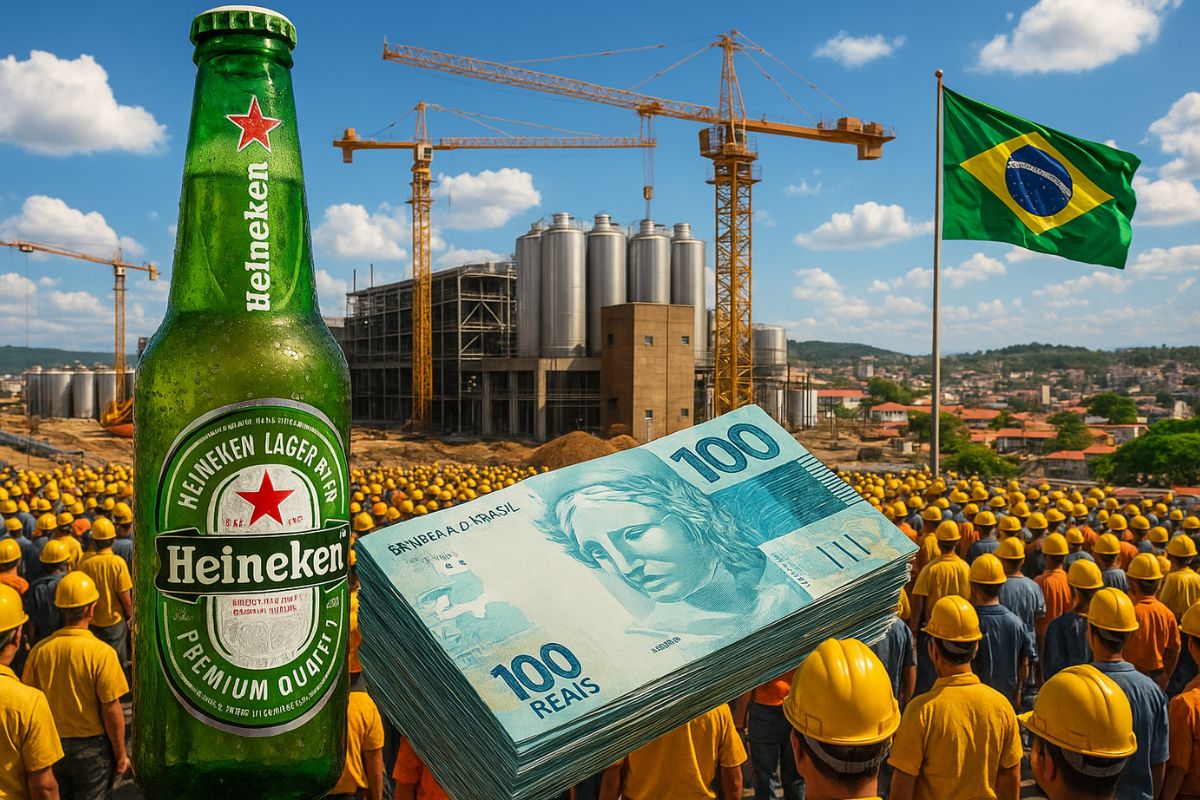
With A Factory In Passos, Heineken Accelerates Minas Gerais With R$ 2.5 Billion In A Project For Scale And Efficiency For Pure Malt Beers, Integrating Logistics In The Southeast, Bottling Lines And Synergies With Amstel To Consolidate National Participation And Supply With Quality And Predictability
Heineken opened its first unit built from scratch in Brazil in Passos (MG), an investment of R$ 2.5 billion created to meet the growing demand for pure malt beers and reinforce its portfolio with Amstel. The plant starts operations with a capacity of 500 million liters per year, with potential to expand to double, anchored in regional logistics and a factory design focused on productivity and quality control.
The Minas Gerais project positions Heineken closer to major consumer centers in the Southeast, reducing cycle times, transportation costs, and risks of disruption. Minas Gerais was chosen due to the combination of consumption potential, road infrastructure, and water availability in the Basin of the Grande River, critical elements for a complex that prioritizes operational stability and high-consistency pure malt beers.
Capacity, Mix And Rationale Of The Portfolio
The Passos unit was born focusing on Heineken and Amstel, with bottling lines calibrated for high volume and delivery regularity.
-
Oil surged to $115 a barrel due to the war in the Middle East, and diesel in Brazil has already risen to R$ 7.45 per liter, while the United States…
-
Brazilian city bets on the business environment to generate jobs and attract investments in the energy sector — secretary reveals strategy at Macaé Energy 2026.

-
50 viaducts, 4 tunnels, 28 bridges, and 40 kilometers of bike paths: BR-262 in Espírito Santo will receive 8.6 billion reais for the largest engineering project in the state’s history, inspired by the Immigrant Highway in São Paulo.

-
Brazil produces too much clean energy and doesn’t know what to do with it: over 20% of solar and wind capacity was wasted in 2025 while investors flee and 509 renewable generation projects were abandoned in the last year.


The strategy is to capture the expansion of the pure malt segment, which grew from 4% in 2012 to 24% of the Brazilian market, sustaining margins through scale and manufacturing efficiency.
The proximity to Southeast markets increases supply predictability and reduces logistical costs per hectoliter.
By centralizing production in a plant designed to grow in modules, Heineken gains flexibility to adjust the mix, absorb peaks, and maintain stable sensory quality from batch to batch.
Why Minas Gerais Entered The Map
The decision for Minas Gerais combines capillary distribution, access to interstate routes, and availability of quality water.
The Basin of the Grande River supports process security, while the service radius to the Southeast reduces kilometers travelled and logistics losses, improving the total cost of service.
For a portfolio that values pure malt beers, stable water and efficient logistics are determining variables.
The road design in Minas facilitates shorter lead times to consumer hubs and distribution centers, supporting seasonal campaigns and demand peaks without compromising Heineken and Amstel on the shelves.
Process Technology And Environmental Performance
The plant incorporates horizontal tanks and longer fermentation times, an arrangement that reduces pressure on the liquid and contributes to a cleaner and more consistent sensory profile in pure malt beers.
The process flow has been organized to minimize variations and allow for scalability without loss of control.
In terms of sustainability, the factory operates with 100% renewable energy and biomass boilers for thermal generation.
Water reuse and wastewater treatment systems allow for up to 30% reduction in water consumption, with disposal within environmental standards.
This package reduces carbon intensity and improves operational costs throughout the cycle.
Jobs, Chain And Regional Effects
The construction mobilized 2,200 direct jobs and 11,000 indirect jobs.
In operations, there are 350 professionals, about 70% from the southern region of Minas Gerais, which internalizes income and strengthens the local supply chain.
Maintenance, logistics, packaging, and utility services are activated through medium- and long-term contracts.
By anchoring volume in Passos, Heineken energizes regional suppliers and transporters, gaining demand predictability.
Scale helps reduce freight cost per unit and stabilize delivery cadences of Heineken and Amstel to retailers and on-trade channels in the Southeast.
Previous Investments And Operational Learning
The investment of R$ 2.5 billion adds to a recent cycle of investments in the country, with expansions in Ponta Grossa (PR), improvements in Jacareí (SP), and Alagoinhas (BA), and expansion in Igarassu (PE).
These projects provided productivity learnings, process standardization, and logistical synergies that guided the design of the Minas unit.
The chaining of initiatives allowed for maturing quality routines, efficiency KPIs, and environmental governance, now consolidated in Passos.
The expected result is greater stability of supply and resilience in response to demand variations in the pure malt segment.
Execution Risks And Next Steps
The main ramp-up risks lie in the learning curve of the high-capacity lines and the management of critical inputs.
Mitigation involves gradual commissioning, fine-tuning of fermentation and filtration, in addition to logistical redundancy to maintain service levels across the Southeast network.
The short-term priority is to consolidate capacity utilization, maintain the sensory quality of pure malt beers, and support Heineken and Amstel with predictability to the retail sector.
With the prepared expansion, the plant can double production in response to demand signals and operational performance.
The Passos (MG) complex marks Heineken‘s entry into a phase of scale, efficiency, and logistical proximity in the Southeast.
With R$ 2.5 billion invested, a focus on pure malt beers, and reinforcement of Amstel, the company adjusts its total cost, sustainability, and response capability to the market.
In your assessment, what is the main immediate effect of this project for consumers in the Southeast: supply predictability, more stable sensory quality, or reduced logistical cost on the shelf?







-

-

3 pessoas reagiram a isso.