





 Portuguese
  English
  Spanish
  7 min of reading
  14 comments


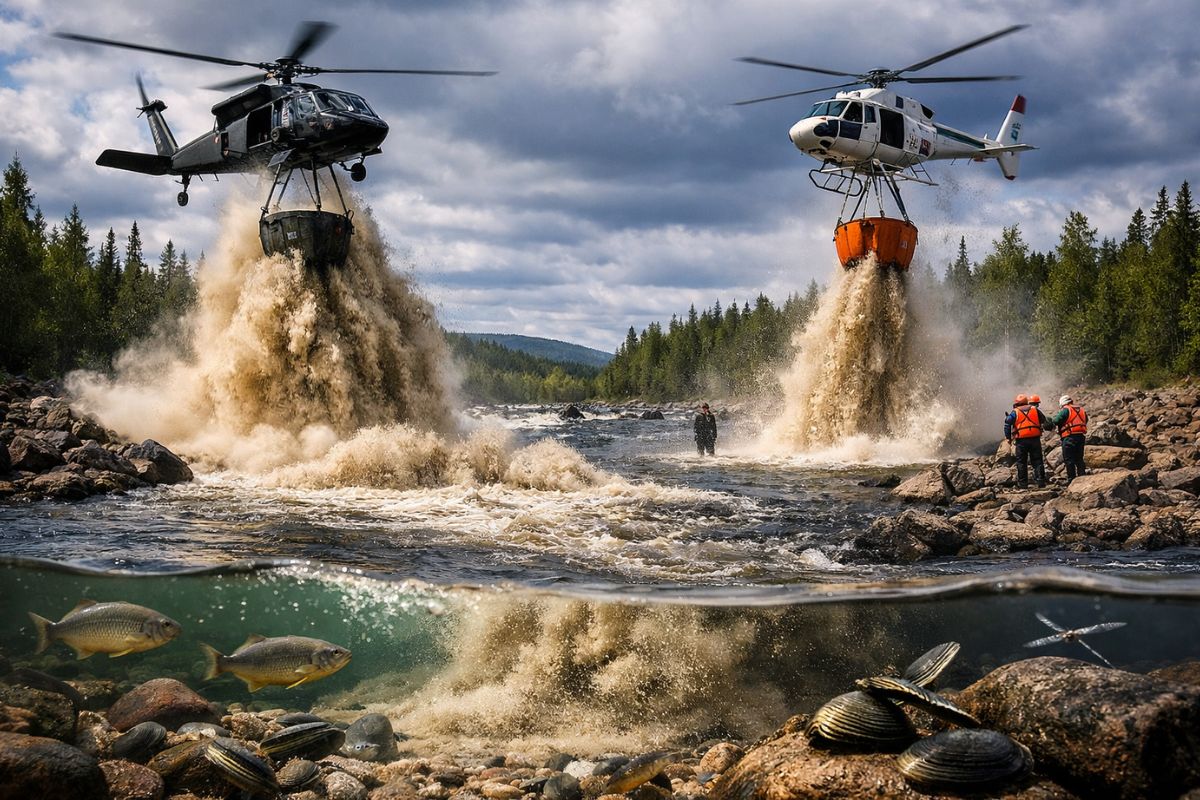


In The Abramsån River, A Tributary Of The Råne, In The Swedish Lapland Restoration Area, Rewilding Sweden Airdropped 150 Tons Of Sand And Gravel In September 2024 To Replace Sediments Lost To Logging And Accelerate The Return Of Benthic Fauna, Trout, Salmon, And Freshwater Mussels In Northern Europe.
The Abramsån River, in the environmental restoration area of Swedish Lapland, became the site of a rare intervention: in September 2024, helicopters dropped 150 tons of sand and gravel to attempt to reverse ancient damages that left the riverbed impoverished and aquatic life without a foundation to sustain itself.
The operation, led by the Rewilding Sweden team, aims to accelerate a process that would take centuries to occur on its own. The goal is to return fine sediment pockets essential for benthic insect larvae to the river, improve spawning sites, and reopen space for trout, salmon, and freshwater mussels to resume their natural cycle.
Where Is The Abramsån River And Why Did It Become A Laboratory

The Abramsån River is located in Swedish Lapland and is a tributary of the Råne River, a watercourse with a length of 210 kilometers described as the longest unregulated forest river in Europe.
-
The most famous volcano in the world could paralyze one of the largest metropolises on the planet: Japan accelerates emergency plans for the eruption of Mount Fuji, which could bury Tokyo in ash for over two consecutive weeks.

-
The United States has a serious problem with its F-35s: China is already producing fighters at a pace that exceeds American capacity and could manufacture up to 300 aircraft per year before the end of the decade, shifting the global military balance.

-
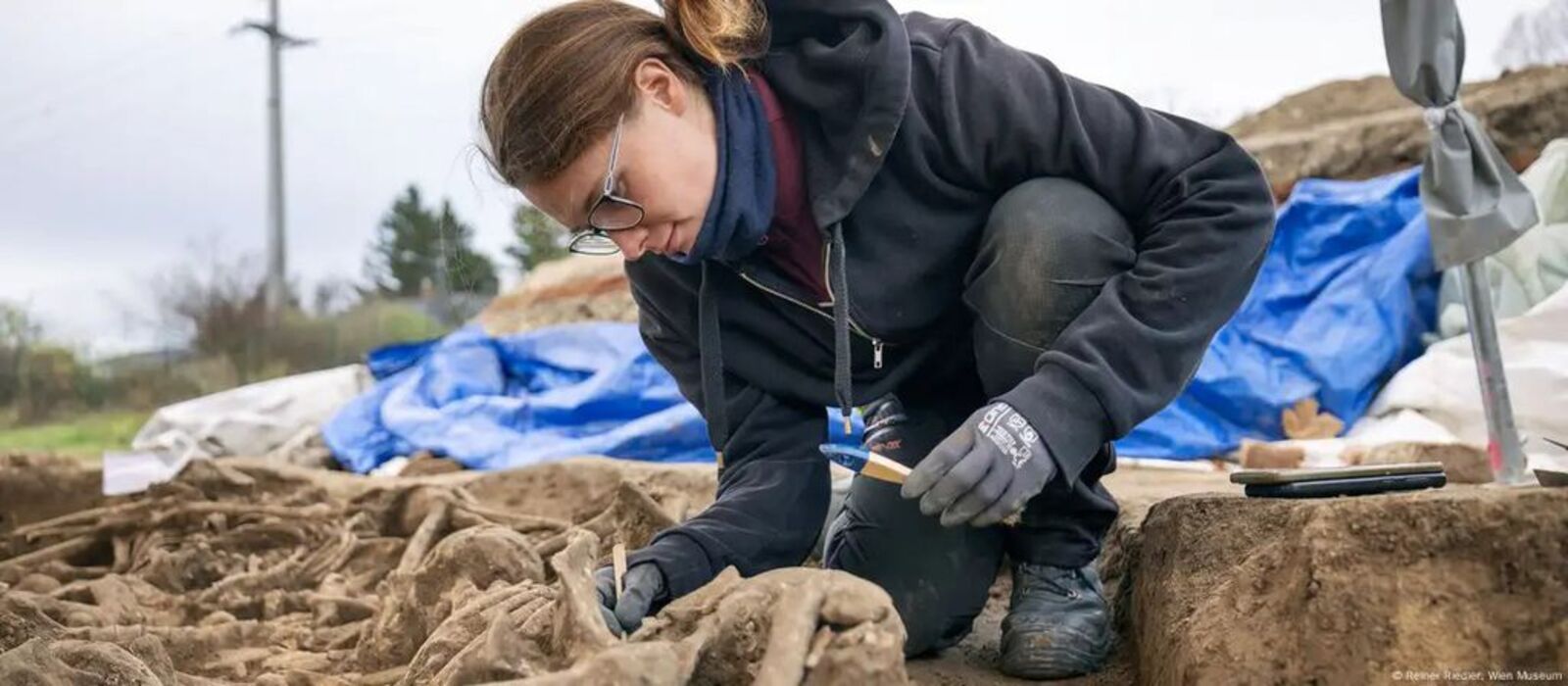
Remains with battle wounds of over 100 soldiers from the Roman Empire are found beneath a football field in Vienna, leaving everyone surprised.
-
Elon Musk notes Brazil and lowers the price of his internet, Starlink, promising to connect all corners of the country with affordable plans, 10,000 satellites, and 1 million active users in the national territory!


This geography matters because the Abramsån represents a typical snapshot of many rivers in northern Sweden: watercourses that seemed “functional” from a distance but bear deep scars from historical logging exploitation.
Embedded in the environmental restoration area linked to the Rewilding Europe project, the Abramsån came onto the radar for a direct reason: it was altered to serve timber logistics, and the way it was “optimized” in the past made the river faster, narrower, and biologically poorer.
The sand and gravel intervention was designed precisely to address what was missing from the riverbed: the fine material that sustains microhabitats and keeps the food chain intact.
What Logging Changed In The Riverbed

In the early 20th century, the Abramsån was heavily impacted by the industrial-scale forestry industry in Sweden.
To facilitate the transportation of logs, large rocks and boulders were removed from the riverbed and piled along the banks, changing the natural design of the channel.
In some sections, a wooden floor made of individual logs was placed inside the river, a kind of “passage engineering” for the floating of timber.
Moreover, the channel was straightened and narrowed to make floating more efficient.
This straightening had a cascading effect: by concentrating the flow, the water speed increased, and the river began to carry away almost all the fine-grained sediment that, under natural conditions, would be protected in pockets, eddies, and cavities around larger rocks.
The result was a silent but decisive loss. Without fine sediment, many benthic insect larvae lost habitat and their populations declined until disappearance.
Along the same lines, fish spawning sites and the habitat of freshwater mussels were also eliminated because the structure of the riverbed no longer offered the physical conditions necessary for these organisms to anchor, reproduce, and complete their cycles.
Why Dumping Sand And Gravel Into The River Became The “Extreme” Choice

Rewilding Sweden began efforts to restore sections of the Abramsån in 2023, returning natural shape and flow.
This work is part of the approach called “aquatic landscape,” which aims to broaden green-blue corridors for nature, restoring free water flow and strengthening the connection between healthy rivers and surrounding landscapes.
However, there was a structural issue: even with the reversal of the channelization and the return of a more natural flow, fine sediment continued to be absent.
And this type of material does not reappear quickly. The expectation described for the Abramsån is that it would take centuries for the sediment to accumulate naturally again.
That’s where the helicopter intervention came in.
By reintroducing sand and gravel, the declared goal is to shorten decades and even centuries of waiting, quickly creating conditions for benthic fauna to reestablish, also boosting the reproduction of fish like trout and salmon and favoring the return of freshwater mussels.
In September 2024, in the second year of the restoration process in the Abramsån, the team organized the drop of 150 tons along the restored stretch.
The number is impressive, but the logic is specific: to fill cavities, pockets, and holes formed in the riverbed between and under larger rocks that were returned during the restoration.
On the scale of a riverbed, 150 tons may be less than it seems when the mission is to replace a functional layer of fine sediments in multiple microenvironments.
Who Is Monitoring And What Is Being Measured In The Abramsån River

The impact of this intervention is being monitored by Vebjørn Kveberg Opsanger, a Norwegian PhD student at the Norwegian Institute for Nature Research (NINA), based in Trondheim.
He is participating in the monitoring and has already collected samples from the Abramsån River during the summer, before the sand and gravel drop, to measure how the benthic fauna was in the pre-intervention scenario.
The analyses of these samples had not been completed at the time of reporting, but the expectation presented is clear: populations of organisms associated with sand and gravel are expected to be very low in the degraded stretch, especially when compared to natural stretches of other rivers in the same region.
The monitoring design also includes comparison. A restored location, but without the addition of sand and gravel, will serve as a control area.
This is crucial because it allows separation of what was the effect of restoring the flow and form of the river from what can be specifically attributed to the replacement of fine sediment.
The plan is to return to the Abramsån River in 2025 and 2026 to observe changes in benthic fauna populations.
The expectation is to observe some positive impact within two years, considering that the recolonization of sediment by insects and other organisms may depend on dispersal from other rivers, which may take time.
Why Benthic Fauna Sustains The River’s Food Chain
Benthic fauna consists of small animals that live on the bottom of rivers and lakes and includes many different groups, such as insect larvae, small polychaetes, nematodes, mussels, snails, clams, mites, beetles, and leeches.
In the Abramsån, recovering this set means rebuilding an ecological base that was removed when the fine sediment disappeared.
The ecological logic pointed out is straightforward. By allowing the recovery of these animals, the restored stretch of the river tends to have greater nutrient retention, because many of these organisms feed on organic matter in the water, such as that derived from leaves.
At the same time, predatory fish feed on benthic fauna, which creates potential to strengthen the entire food chain.
There is also an operational function of the ecosystem: organisms on the bottom act as decomposers and help clean the water through filtration.
In other words, it’s not just about “bringing life back,” but about recovering processes that stabilize the river as a system.
Will The Sand Stay In The River Or Could It Wash Away With The Current
Even with careful planning, nothing placed in a river is guaranteed to stay in place.
The sand and gravel were deposited at various points by helicopter along the stretch that the team recently restored.
Part of the material may have been redistributed by the natural flow of the river, but the expectation is that a portion will accumulate in places where it would be naturally found, such as pockets and eddies around larger stones.
This point is decisive because the intervention is attempting to “hasten” a dynamic that the river would do slowly.
Success depends on the balance between redistribution and retention, so that fine sediments settle in cavities and zones of lower hydraulic energy, creating stable microhabitats.
If the intervention proves successful, Rewilding Sweden considers using the same approach in other stretches of the Abramsån and in sections of other restored rivers in the future, expanding what is currently a pioneering test.
What Changes If The Experiment Works In Northern Europe
If the addition of sand and gravel really accelerates the return of benthic fauna, the Abramsån could become a practical example of how directed engineering can shorten the recovery time of a river damaged by past alterations.
The point is not just to repopulate fish but to recover the “biological ground” that allows the river to function as an ecosystem.
The very description of monitoring indicates the size of the challenge: previous gravel replenishment initiatives in northern Sweden were more focused on fish, while this is among the first interventions of this kind to primarily focus on benthic fauna.
This raises the value of the test and at the same time explains why it is still difficult to accurately state how long it will take for the impact to become perceptible and what its magnitude will be.
The operation to return sand and gravel in the Abramsån was funded by EKOEnergy, allowing the project to advance to a scale of intervention that requires aerial logistics and careful planning of deposition points.
Do you believe that dumping sand by helicopter into a river should be a common strategy to accelerate ecological recovery, or does it only make sense in extreme cases like that of the Abramsån?






Só faz sentido para recuperar rios como no caso do Abramsan, que o objetivo foi repôr sedimentos levados pela correnteza, quando as curvas dos rios foram retiradas para uma maior fluidez da navegação e transporte de madeiras.
Quanto aos outros rios que não tiveram essa devastação, a areia poderia causar o assoreamento, sendo um enorme problema, comprometendo a profundidade do rio e o volume de água, levando à destruição do ecossistema ali presente.
Eu acredito que a força das águas e a profundidade do rio definem a alimentação que esse rio vai fornecer,e os peixes e insetos que vão fazer morada nele. Com o tempo recupera,com certeza.
Os cara corre atrás depois que a **** foi feita, vai acontecer o mesmo com o aquecimento global, Cada ano que passa as coisa estão cada vez mais nítidas sobre isso, Gelereis de milhões de anos tendo um descongelamento em um ritmo extremamente acelerado, Desastres ambientais cada vez mais frequentes e etc etc etc.