





 Portuguese
  English
  Spanish
  6 min of reading
  0 comments


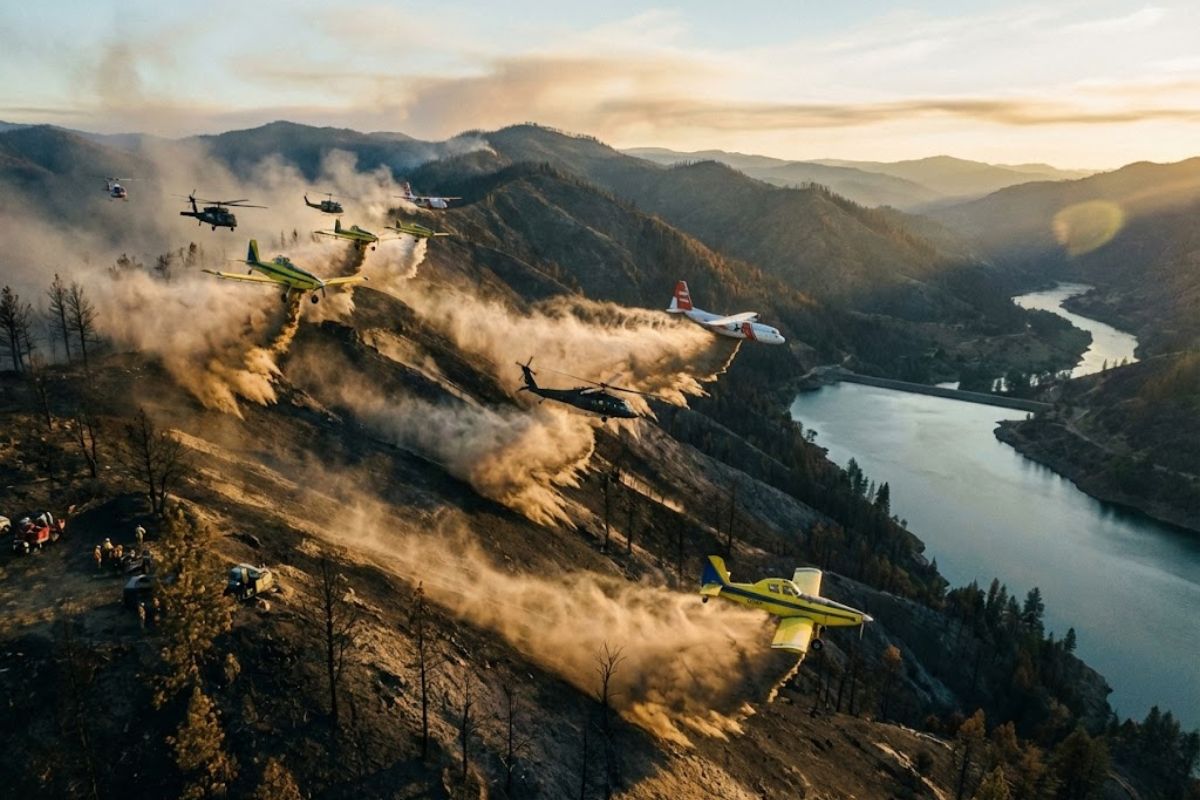
In The Fire In The Western US, Burning Scars In California, Including Around Los Angeles, Receive Aerial Seeding And Mulching Between November And February. The Action, Used By The BLM, Seeks To Prevent Mudslides, Landslides, And Sediments In Rivers, Stabilizing Hydrophobic Soil Until Spring 2026 Entire
The fire in the Western US has opened a high-risk race against time: before the winter rains and storms arrive in full force, helicopters and planes are mobilized to drop seeds and mulch over burnt slopes, trying to prevent the post-fire scenario from turning into a second disaster.
The focus is on holding loose soil and ash, reducing erosion by up to 80% in moderate rain events, and protecting rivers and reservoirs from sediments. In January 2026, the technique continues to be considered crucial after devastating fires in California in 2025, when extensive areas were left exposed and vulnerable.
Where Operations Are Happening In The Western US

The fire in the Western US left scars that require a rapid response in different states, prioritizing areas of high burn severity, especially where the terrain is steep and land access would do more harm than good.
-
With a cost per shot close to zero, the DragonFire laser could change naval warfare in 2027 and provide British ships with nearly unlimited defense against drones.

-
A British startup creates tires that generate electricity in electric vehicles when passing over potholes, speed bumps, and cracks.

-
Scientists have created robots made with living cells that have their own nervous system, swim on their own, explore the environment, and self-organize without any genetic engineering, and now they want to do the same with human cells.

-
Students create a solar-powered ambulance that operates without a plug, without fuel, and still keeps medical equipment running in remote areas.


In California, the strategy targets burnt slopes in 2025, focusing on areas around Los Angeles and regions in the southern part of the state, where winter storms can trigger landslides and debris flows.
In Idaho, aerial seeding actions by helicopter are scheduled for late January 2026 in the Valley Fire area of the Boise River Wildlife Management Area, seeking to restore habitat and stabilize soil.
In New Mexico, scars from recent large fires, such as the Hermits Peak Calf Canyon complex, continue to receive federal interventions for watershed protection.
In Washington, mountainous areas like the Okanogan Wenatchee National Forest are under consideration due to their inaccessibility by land and a high risk of post-fire erosion.
What Helicopters And Planes Drop And Why This Needs To Be Done Before The Rain

The response to the fire in the Western US usually begins with two main inputs: seeds and mulch.
Aerial seeding disperses native grass and shrub seeds to create, as quickly as possible, a root system that helps secure the soil.
Mulch serves as immediate protection, covering the exposed surface with straw, wood chips, or hydromulch, reducing the direct impact of rain and preserving moisture to promote germination.
The logic is to prevent the first significant rain from encountering bare slopes, fine ash, and loose soil.
Without cover, water runs off the surface, gains speed, and carries sediments, causing mudslides and potentially impacting roads, homes, and infrastructure in minutes, as well as carrying material into rivers and reservoirs.
The Invisible Enemy Of The Post-Fire: Hydrophobic Soil And Water That Does Not Infiltrate

One central reason for the mobilization after the fire in the Western US is the formation of hydrophobic soil.
In high-intensity burns, extreme heat vaporizes organic compounds from the vegetation.
These gases penetrate the soil and, upon cooling, can form a wax-like layer that repels water.
The result is a scenario of high instability: instead of infiltrating, rain runs off the surface quickly, carrying ash and loose particles.
That is why the post-fire scenario can turn into a sudden hydrological crisis, with debris-laden floods rushing down slopes and accumulating sediments in waterways.
Mulch As Immediate Shield And Seeds As Long-Term Anchorage

In managing the fire in the Western US, mulch and seeds have different but complementary roles.
Mulch is described as more effective than just seeding in the first year, precisely because it offers instant protection.
By covering the soil, mulch reduces the impact of raindrops, diminishes particle displacement, and weakens the speed of surface runoff under moderate conditions.
Seeds enter as a structural solution for the following months.
They need time to germinate and form roots capable of binding the soil.
Thus, the strategy combines short-term and medium-term solutions: mulch secures now, roots secure later, when the cover starts to decompose and the vegetation begins to support the slope.
The Number That Guides The Urgency: Erosion Can Fall By Up To 80% With Mulch
The most repeated figures in post-fire in the Western US operations is the potential for erosion reduction: mulch can reduce erosion rates by up to 80% in moderate rain events.
This percentage is treated as an operational reference because it translates, in a direct metric, what is at stake in the short term.
Less erosion means less sediment descending the slope, less risk of mudslides, less channel siltation, and a lower load of ash entering rivers and reservoirs.
In practice, sediment reduction connects both to public safety and the protection of water supply and storage.
How Teams Choose Targets And Design The Flight Plan
The response to the fire in the Western US does not begin in the helicopter.
First, there is a mapping and prioritization process that identifies burn severity and the most critical slopes.
Areas where vegetation was completely consumed and the soil tends to become hydrophobic come as a priority, because the risk of debris flow increases with the first sequence of storms.
To make the launch more efficient, routes are planned to cover large areas in a short time, taking advantage of the window between the end of the fire and the beginning of the rainiest period.
The window is short, and therefore November to February appear as a strategic period to execute the bulk of stabilization before winter closes the door.
How It Works In Practice: Helicopter Networks, Fixed Wing, GPS, And Soil Coverage
Post-fire in the Western US work combines different platforms depending on the terrain and the area size.
Helicopters are used especially on very steep slopes and in difficult-to-access locations.
They carry mulch in nets or baskets and release the material at low altitude to increase precision and achieve robust soil coverage, often in the 70% to 80% range to reduce rain impact and water speed on the surface.
Fixed-wing aircraft come into play when it is necessary to address large expanses quickly.
They drop seeds using calibrated dispersal systems, with navigation and planning support to distribute the material evenly.
In more sensitive areas, the option of hydromulching arises, a mix with water, seeds, wood fiber mulch, and an adhesive component to help the material stick to the slope, forming a protective layer that secures seeds on steep inclines.
Why The Strategy Accelerates At The End Of Autumn And The Beginning Of Winter
After the fire in the Western US, the schedule is not random.
Stabilization is usually planned for late autumn and early winter, between November and February, trying to arrive before the most intense storms and, when possible, taking advantage of initial snow as an ally.
The logic is simple: snow and moisture can help maintain favorable conditions for germination in spring 2026, while mulch already fulfills its immediate function of soil protection during the first rains.
It is a bet on the seasonal sequence: protect now, root later.
What Is Being Protected: Rivers, Reservoirs, And Water Quality
The ultimate goal of the post-fire in the Western US is not just to restore vegetation.
It is to reduce the chance that sediments and ash reach rivers and reservoirs, deteriorating water quality.
By holding the soil on the slope, the interventions help prevent watersheds from being loaded with fine material, which can increase turbidity and compromise systems that depend on stored water.
Furthermore, programs operated by federal agencies aim to restore native vegetation and reduce space for invasive species, a typical risk in severely burned areas when the soil is left exposed and recolonization occurs in a disorderly manner.
The Race Against Winter: Avoiding The “Second Disaster” After The Fire
The post-fire in the Western US is treated as a period when disaster can repeat itself, only in another form.
The fire destroys vegetation cover and alters the soil; the rain, in turn, can turn slopes into debris slides, with mud and sediments descending into populated areas and the water network.
That is why aerial mobilization is described as routine in the West: it is a way to treat thousands of hectares quickly, when the critical window is too short to rely solely on ground teams.
Do you think that, after the fire in the Western US, the use of mulch and seeds by helicopters and planes should become an automatic rule in all burned areas, or should it be limited only to the most critical slopes?







-

2 pessoas reagiram a isso.