





 Portuguese
  English
  Spanish
  4 min of reading
  0 comments


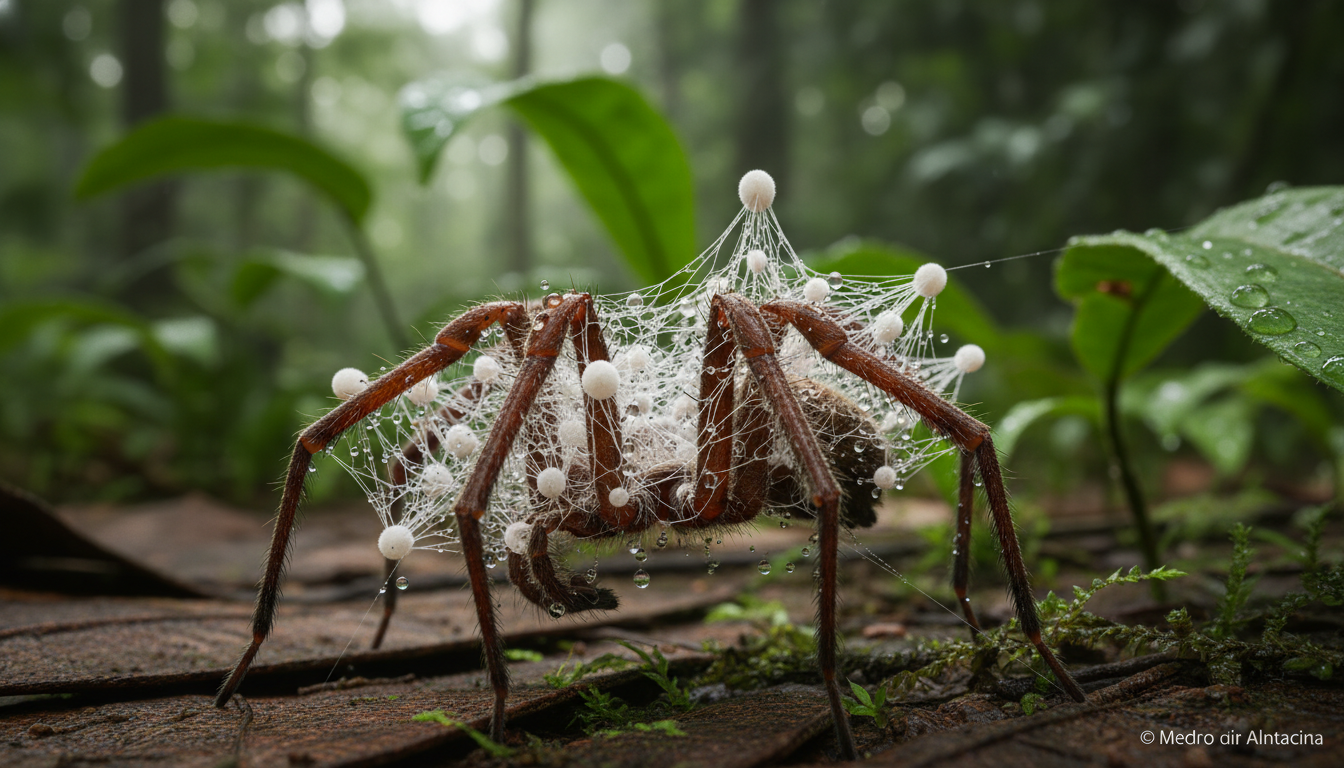
New species Gibellula mineira infects 25% of host spiders in a fragment of Atlantic Forest within the UFV campus in Viçosa, MG, and reveals a behavioral manipulation mechanism that science still cannot fully explain
The discovery seemed like something out of science fiction — but it happened in a preserved forest within the campus of a Brazilian university. Researchers from the Federal University of Viçosa (UFV), in Minas Gerais, identified a new species of zombie fungus for spiders that can reprogram the behavior of its victims and force them to die in specific positions and locations. According to G1 Terra da Gente, the fungus was found in the “Biology Forest,” an area of 75 hectares within the UFV campus, and was scientifically named Gibellula mineira.
The publication of the results occurred in mid-March 2026, in the scientific journal Fungal Biology, of the British Mycological Society. The confirmation of the new species involved DNA analyses and morphological comparisons with all other known species of the genus Gibellula. Therefore, it is not a variation — it is an entirely new species for science.

How the zombie fungus for spiders transforms its victims into puppets
The behavioral manipulation mechanism observed by the UFV team impressed even the researchers themselves. While healthy spiders of the species Iguarima censoria usually stay on the upper side of leaves to hunt, those infected by Gibellula mineira exhibit completely different behavior.
-
Country on high alert: banned list of school supplies could result in fines of up to R$ 18.8 million and reveal abusive practices that many schools are still trying to impose in Brazil.

-
The largest oil field in the United States had entire layers that no one knew existed, and the U.S. government has just confirmed 1.6 billion barrels hidden in rocks that have been invisible for decades.

-
Family loses custody of 3 children after living isolated in the woods with solar panels, well water, and growing their own food in a routine far from the city, in Italy.

-
A British startup has just done what no private company has achieved before: igniting plasma inside a nuclear fusion-powered rocket engine, and if it works at scale, trips to Mars could take weeks instead of months.

Parasitized spiders are driven to die on the underside of leaves, in higher locations with less light. In this way, the fungus not only kills — it controls where and how the victim dies.
“Our initial interpretation is that dying in higher positions favors the dispersion of spores, while the choice of less illuminated locations may reduce the dehydration of the fungus,” explained Professor Thiago Gechel Kloss, co-advisor of the research and professor in the General Biology Department at UFV.
Moreover, the underside of leaves protects the spores from rain, ensuring that the fungus remains viable for a longer time. Thus, every detail of the “zombie” behavior serves a precise function for the parasite’s survival.
Other cases of behavioral parasitism have already drawn attention in Brazil, such as the tarantula infected by a zombie fungus in the Amazon, which revealed rare behavior never documented before.

The numbers that surprised scientists about the zombie fungus for spiders
The research revealed data that the team did not expect to find. Approximately 25% of the analyzed host spider population in the study area was infected by Gibellula mineira — a rate considered high for parasitic interactions of this type.
However, the most surprising result was another. According to an official statement from Metrópoles: “Smaller spiders showed a higher likelihood of being parasitized, an unexpected pattern that raises new questions about the dynamics of the interaction between the fungus and its host spiders.”
The research began in 2024, during the master’s program of Aline dos Santos, the lead author of the study. The team included:
- Dr. Thairine Mendes Pereira — advisor, researcher at the Ecology and Behavior Laboratory of UFV (Labecom)
- Professor Thiago Gechel Kloss — co-advisor, from the General Biology Department at UFV
- Camila Ribeiro — undergraduate research assistant, responsible for nighttime photographic records
- Butantan Institute — provided support in identifying the host species Iguarima censoria
Urban Atlantic Forest reveals species that science was unaware of
The discovery reinforces a point that many researchers have been trying to demonstrate for years. Even small forest fragments, inserted within cities, can harbor completely new species for science.
The “Biology Forest” and the “Cicada Retreat” — both preserved forest areas on the UFV campus — are located next to Viçosa, a city of 80,000 inhabitants. Yet, Gibellula mineira remained hidden there until researchers found it by chance during a study that initially aimed to evaluate behavioral changes in spiders.
The hidden biodiversity of the planet continues to surprise science in unexpected places. Recently, researchers found unknown species at nearly 5,000 meters deep in Japan, inside a rare “glass castle” at the bottom of the ocean.

What remains to be discovered — and what is already known about risks to humans
As frightening as the mechanism may seem, Gibellula mineira poses no risk to humans. As the researchers clarified, this type of behavioral parasitism occurs only in insects and spiders — unlike what films and games like The Last of Us depict in fiction.
Still, identifying the host spider represented one of the greatest technical challenges of the study, as the fungus covers almost the entire body of the animal during parasitism. Consequently, the team needed support from the Butantan Institute to confirm that the host species was Iguarima censoria.
The next step for the UFV researchers will be to understand exactly how Gibellula mineira manages to manipulate the spider’s physiological system to force it to act against its own survival instincts. According to Folha da Mata, this is one of the most intriguing questions that Brazilian ecology will have to answer in the coming years.




Seja o primeiro a reagir!