





 Portuguese
  English
  Spanish
  8 min of reading
  1 comment


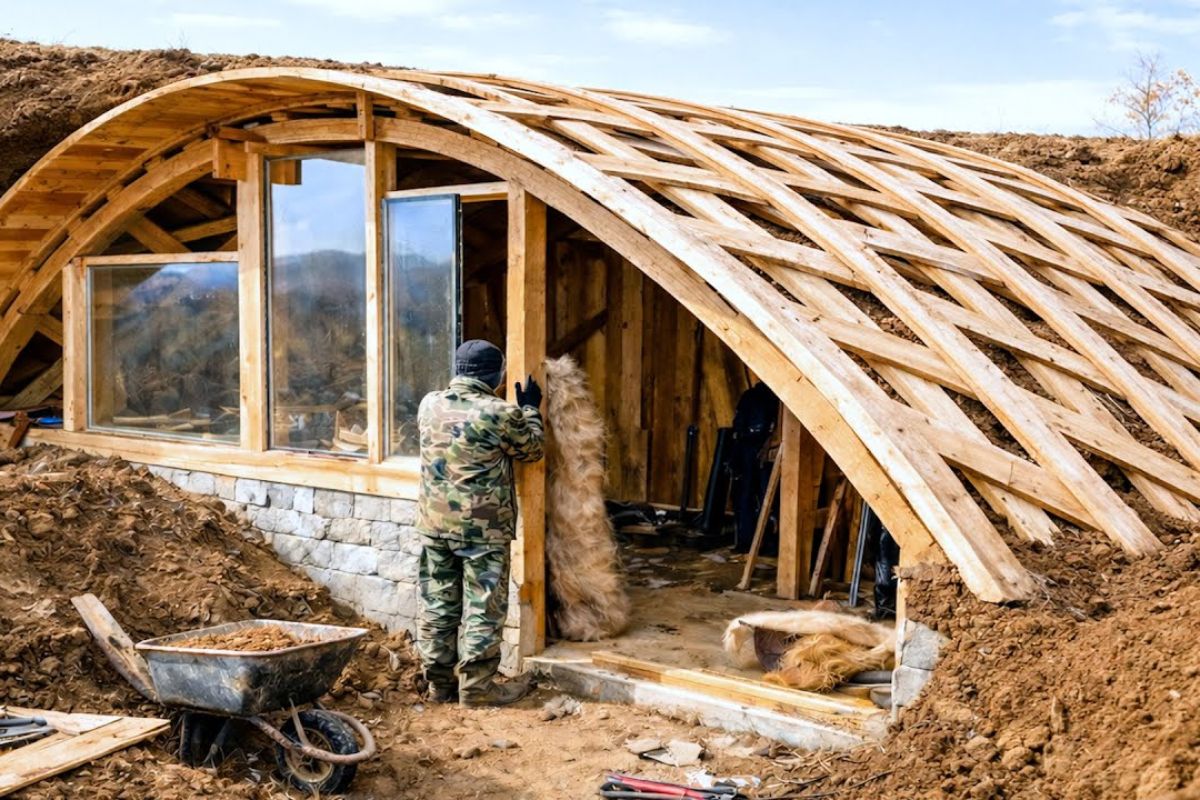


With Only US$ 2,000, The Hobbit-Style Underground House Rises from Excavation, Burned Posts with Hot Asphalt, Dry Logs Fitted Together, and an Arched Roof Tensioned by a Winch. Bioarchitecture Gains Waterproofing by Burned Membrane, Layered Insulation, and Grass, Integrating Shelter and Landscape with Ventilation in Tubes and Triple Glazing.
The Hobbit-style underground house started as a direct excavation into the ground and evolved, step by step, into a curved shelter that mixes wood, earth, and bioarchitecture techniques. The idealizer, Aloha, led the project with attention to curved lines seen in nature and inspired by the work of Antonio Gaudí. The stated budget, of only US$ 2,000, made the method depend on planning, repurposing, and manual execution.
At the construction site, the logic is simple and ruthless: secure the structure before beautifying it. Vertical posts, dry logs, and an arched roof are assembled to receive layers of insulation and waterproofing, as well as compacted earth and grass. The result attracts those seeking affordable housing integrated into the land, without compromising safety.
Excavation, Posts, and the Anchoring That Prevents Collapse

The first phase of the Hobbit-style underground house is the excavation and the creation of a gravel bed.
-
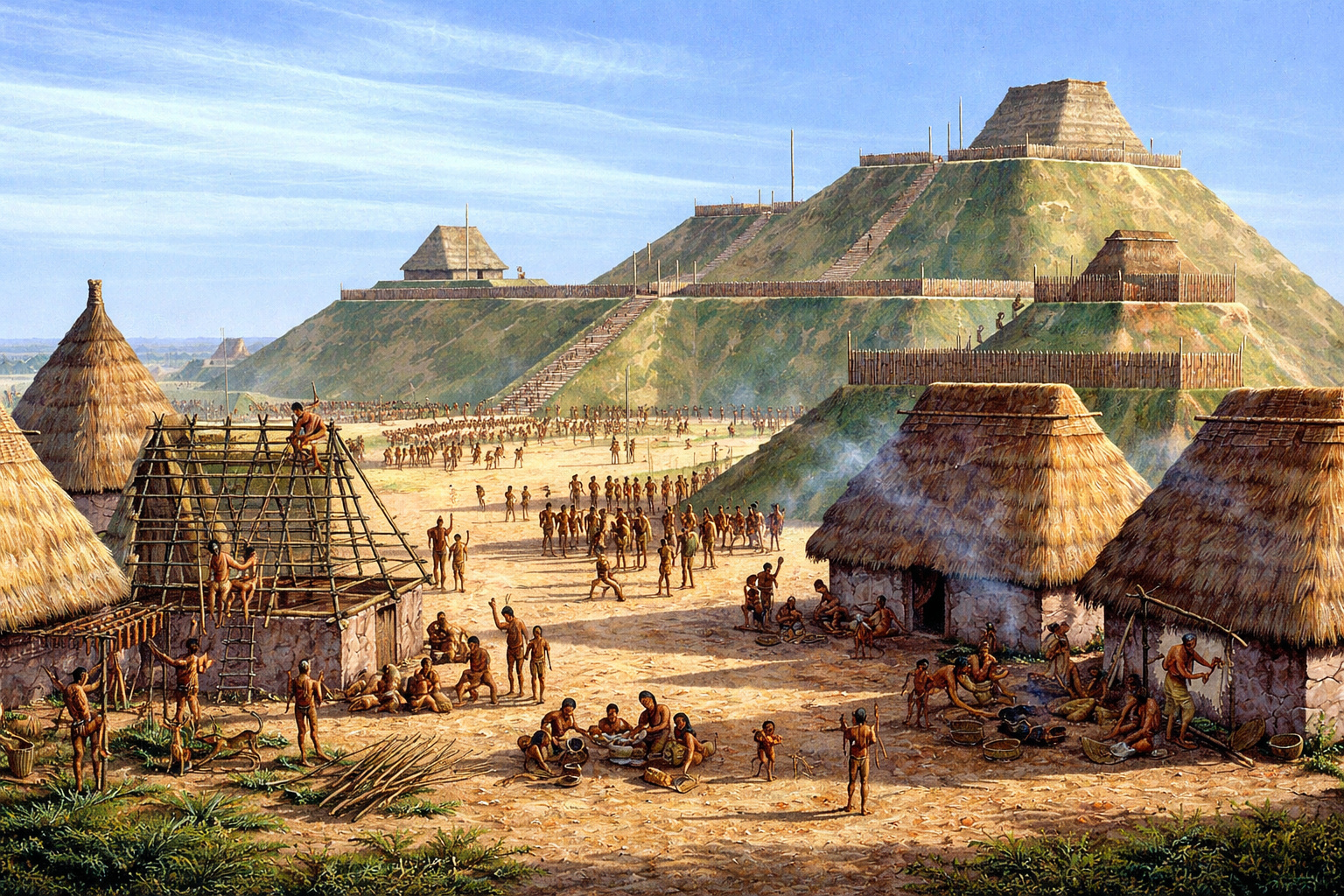
With over 14 million baskets of earth moved, an ancient North American metropolis built a monumental pyramid of 30 meters and established a city with 20,000 inhabitants nearly a thousand years ago.
-
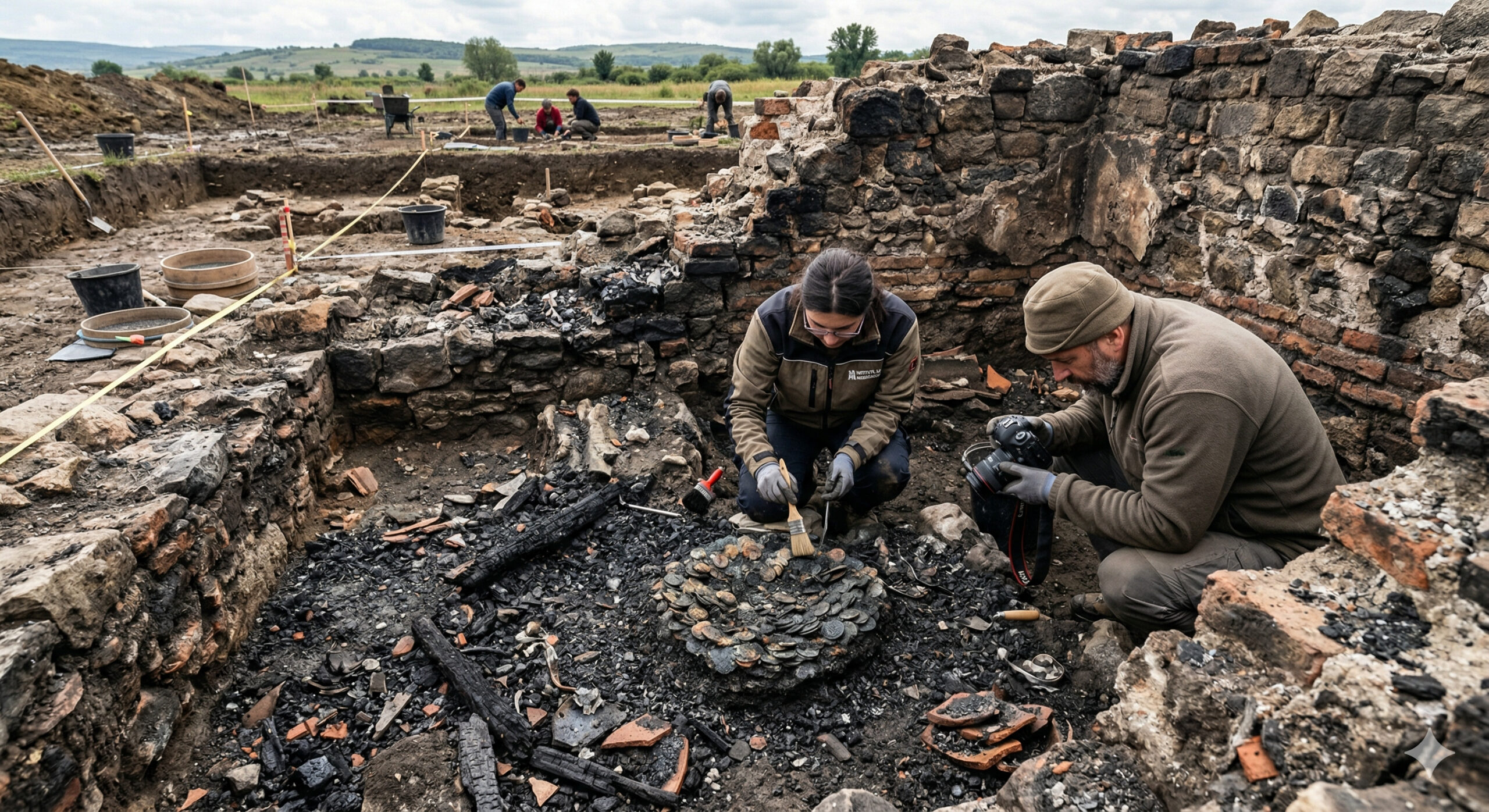
A 1,900-year-old treasure emerges from a Roman house destroyed by fire and sealed since antiquity in Romania, with coins and metals fused among the ashes.
-
The Brazilian colonial city that stopped in time and shares territory with a rocket launch base.

-
79-year-old woman challenges limits, visits 193 countries in the world after 56 years of planning and reveals the behind-the-scenes of a global journey that few have managed to accomplish.


This is where the supporting posts come in, prepared to prevent the log walls from collapsing inwards and to create a waterproof barrier.
The ends of the posts are burned and receive hot asphalt at the bottom, creating a barrier against moisture.
After being positioned in holes over the gravel, the posts are secured with large rocks hammered and compacted around them.
This tight compaction transforms the base into a solid and immovable set, an essential condition before bearing the weight of the walls and, later, the roof.
Dry Logs on the Walls and the Settlement Control

With the posts firm, the wall logs come into play.
In the Hobbit-style underground house, the logs are placed horizontally between the vertical supports and the choice is strict: only dry and dead logs to enhance durability.
Partially rotted logs are still collected, but they become firewood, not structure.
The positioning of the logs is planned in advance to avoid obstacles and allow for continuous installation.
Ropes and reinforced digging rods control each piece, guiding the fit and preventing rollovers.
Then, the soil around is compacted with the logs, creating additional support and reducing settlement and displacement risks over time.
Arched Roof, Template, and the Tension That Maintains the Curve

The design of the Hobbit-style underground house relies on an arched roof.
To form each arch, lower quality wooden boards are curved in a template with pins driven into the ground, evenly distributing the pressure.
The curvature is tested to the maximum possible limit without cracking.
Each arch is assembled with three stacked boards, fixed with screws and nails, creating total thickness.
Next, sockets are carved into the walls to receive the arches with a precise fit, without gaps.
A ratchet winch keeps the tension under control during the night when the wood tends to relax and straighten, avoiding sharp movements.
Temporary supports and jacks keep the arches in place during installation.
The function is to relieve weight from the visible points of the roof and the hidden connections in the log walls, until everything is secured.
T-Beam, Main Column, and the Truss Against Lateral Movement
With the arched roof set, the construction receives a T-beam installed below the vault, connecting the front wall to the back wall.
The main column is prepared with a rectangular fitting to adjust under the lower flange of the beam, serving as a stable vertical support that transfers load to the foundation.
At the base, a dug recess prevents the vertical member from sliding along the log, acting as a mechanical lock against lateral movement.
The assembly is adjusted slowly: the top is raised, lifting the set about 10 cm to seat the beam evenly.
Then, diagonal rods in a diamond shape form a truss that adds stiffness, stabilizing the vault against front, rear, and diagonal movements.
Two additional pieces close an external arch, with external support absorbing tension and internal rod working in compression. It is the skeleton that prepares the roof for the heavier layers.
Waterproofing with Membrane and Layers of Insulation
The critical phase of the Hobbit-style underground house is to protect wood and insulation against water.
Before the final solution, a temporary plastic layer covers the roof to keep it dry until work resumes.
In the next step, a vapor barrier and two layers of foam insulation are added.
Before closing the package, the roof beams receive treatment with copper sulfate to reduce the risk of fungi and prolong durability.
Waterproofing is done with a heavy bitumen membrane. As the material is brittle, the work is done on a hot day to prevent tears.
The joints of the membrane receive adherence by the burning method, heating each section to the adhesive point to firmly unite sheets, creating a continuous layer.
With the waterproofing completed, longer beams are cut to function as sunshade and rain cover.
In addition to protection, this advancement of the roof helps with environmental control, reducing heat gain at openings and keeping entry areas drier.
Metal Edge, Linseed Oil, and Ventilation Through Tubes
To support the grass over the curve of the roof, metal sheets are bent at a 90-degree angle, forming a continuous edge that keeps the soil in place when the earth cover is added.
The exposed wooden structures receive linseed oil, reinforcing resistance to water absorption and weathering, complementing the waterproofing.
Ventilation is ensured with air tubing installed throughout the structure.
PVC tubes descend from the lower external entrance and rise to higher internal exits, promoting natural flow and allowing the air to be slightly warmed in winter.
The tubes are insulated to reduce heat loss and condensation, and the soil is compacted around for secure fit without distortion.
Reused Back Wall, Chimney, and Structure Closure
At the back, the wall is built with reused cedar boards, fitted between the foundation beam and earth wall.
The boards fit tightly to form a stable enclosure and save material. A plastic barrier at the base reduces water infiltration.
The stove chimney is installed to safely ventilate smoke and combustion gases.
The connections are sealed and supported, and the penetrations in the roof are reinforced, with waterproofing checked to prevent leaks.
The alignment of the chimney maintains safety distances from combustible materials and is verified to ensure unobstructed airflow.
Clay Lock, Terraces, and Grass that Becomes a Living Cover
Closing the roof involves a shaping stage with lightly compacted soil. To prevent slipping, a clay lock is applied.
The mixture is prepared in a concrete mixer with straw to increase tensile strength and reduce cracking.
The application is manual, pressed and molded to form a continuous layer, a work spanning several days to maintain uniform thickness and proper adhesion.
After the clay lock, additional clay and subsoil come in to form stepped terraces that follow the curve of the vault, resembling a Mayan pyramid.
Each step is leveled and compacted to stabilize the grass.
The layered earth reinforces thermal mass, improves natural insulation, promotes biodiversity, and helps manage rainwater, making the roof a functional part of the Hobbit-style underground house.
The grass carpets come from original cuts of the terrain and the path leading to the entrance.
Each piece is placed over the soil and the clay lock, pressed for total contact.
Over time, roots grow into the soil and anchor the cover, while the straw in the clay lock helps retain moisture to support rooting.
Glass Facade, Sealing Foam, and Deformation Correction
The front wall is constructed as a non-structural framework to receive the glass facade.
Logs are lifted and positioned with ropes and metal rods, with cuts made to navigate vertical columns.
Before backfilling, tubing and conduits are installed as per the plan, and the space between the walls and the earth is filled.
As logs are naturally irregular, adjustments require chisels, chainsaws, and saws for alignment.
In the chainsaw cuts, extra care is taken for a risk described on-site as the ascending boomerang effect, when the blade is not controlled correctly.
The foam is applied to fill gaps between logs and roof joints, reducing cold air entry and increasing thermal efficiency.
For the fitting of the glass, a professional carpenter opens a trench marked by two parallel lines, each 5 mm wider than the thickness of the triple glazing.
The trench is then leveled with a chisel. During installation, a base board supports the glass and is screwed to the central column.
Vertical boards hold the panels, and at the arched part, a curved board creates the seat for the polycarbonate.
Foam tubes are placed in the cutouts to absorb small movements and compensate for irregularities in the wood, reducing the risk of cracks.
During the loading of earth over the roof, a slight deformation appears on one side of the vault and is corrected with an additional vertical column, requiring a pre-cut of about 2 inches in the front logs for correct fitting.
Insulated Door, Interior Finishing, and Curved Window Seat
The door uses plywood as the main panel, with a central geometric cut for glass and natural light gain.
After the installation of the glass, the fastening receives internal structure, and the remaining spaces are filled with rigid foam insulation to withstand winter.
As the unit is heavy, sturdy hinges are installed for reliable operation.
In the interior finishing, there are details of synthetic leather and decorative studs, used as a final touch on the door.
In the closure, gaps and joints are reviewed for resilience and visual harmony.
A wooden window sill is cut into a curved shape, echoing the arches of the roof.
In addition to finishing, it becomes a seating area, uniting comfort and view.
The Hobbit-style underground house arises from a direct method: excavate, secure posts, organize logs, assemble an arched roof, and only then protect everything with insulation and waterproofing.
With US$ 2,000 and bioarchitecture solutions, the project shows that affordable housing can exist when the site respects sequence, compaction, and sealing.
If you’re thinking of following a similar path, start by testing small sections of waterproofing and sealing before scaling up, and record each stage of compaction and fitting to reduce rework.
In your region, would you trust a Hobbit-style underground house with a grass roof and exposed logs, or does the fear of moisture still speak louder?








You may fool the casual reader, but you won’t toil anyone with even a little experience if building. Even the materials shien in the project photo would cost more than 2 thousand dollars.
This whole article is pure BS.