





 Portuguese
  English
  Spanish
  5 min of reading
  0 comments


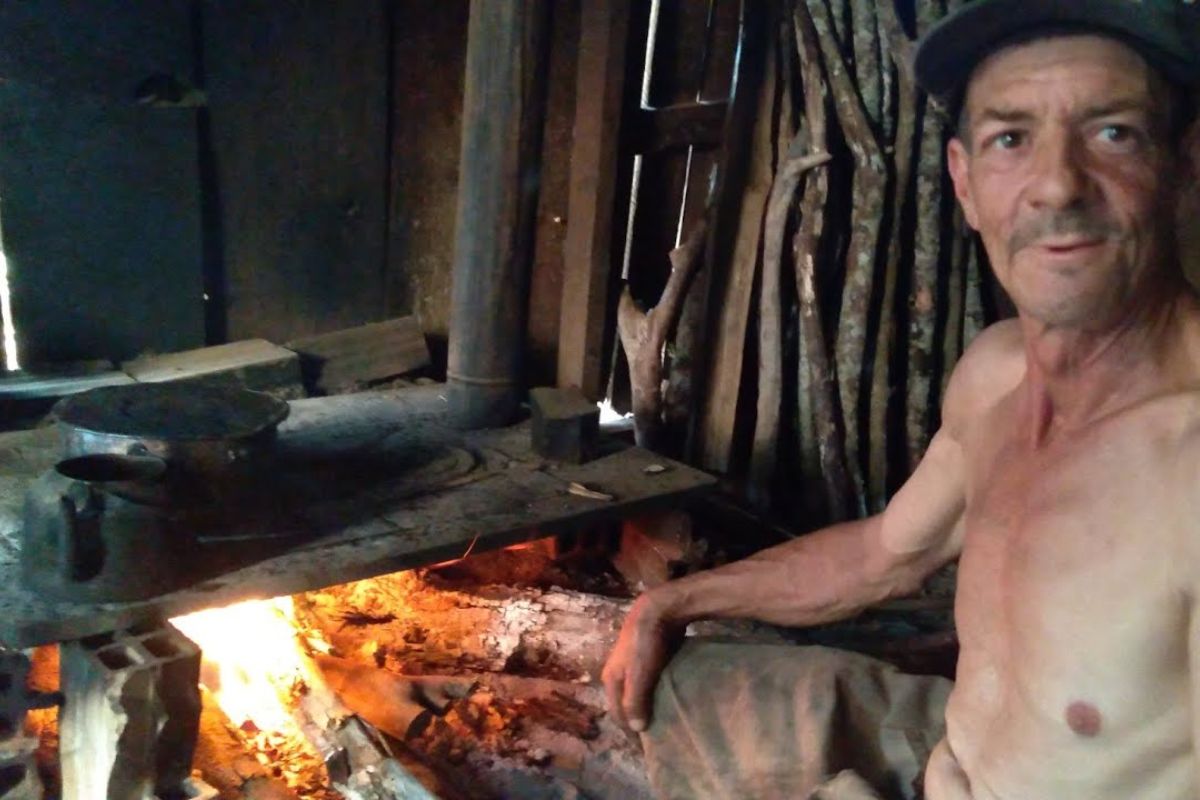
In Pinhal da Serra, His Tinga, Rosselino Known as Portinga, Says Man Has Lived Alone for More Than 40 Years and for Eight Years He Hides in the House; Cooks Beans on the Ground Fire, Plants Corn, Manioc and Sweet Potato, While the Drought Coils the Corn and Dries the Beans
The account recorded on the property in Pinhal da Serra, in Rio Grande do Sul, shows that the man has lived alone for more than 40 years in the woods and defines the choice as “my type.” He presents himself as Rosselino, known by many as Portinga and called his Tinga by reporter Jaon Moraes from channel JJ88.
In the conversation, the resident claims to have been “hiding” in the current house for eight years and that he has tried to live with others, but “it never worked out.” On 4.5 hectares, he describes a routine sustained by what he produces, focusing on beans, corn, manioc, and sweet potatoes, in addition to dogs and livestock that roam near the shed.
Where He Lives and Why He Says He Hides

Upon arriving at the house, the reporter asks if “this is really where you live,” and the answer comes straightforward: “this is where I hide.”
-
Italian researchers have detected what appears to be a second Sphinx buried under the sands of Egypt, and satellite scans reveal a gigantic underground megastructure hidden beneath the Giza Plateau for over 3,000 years.

-
There are 4,223 drums and 1,343 metal boxes concreted with 50-centimeter walls that store the radioactive waste from Cesium-137 in the worst radiological accident in Brazil, just 23 kilometers from Goiânia, with environmental monitoring every three months.

-
Giant Roman treasure found at the bottom of Lake Neuchâtel in Switzerland reveals an advanced trade system, circulation of goods, and armed escort in the Roman Empire about two thousand years ago.

-
He buried 1,200 old tires in the walls to build his own self-sufficient house in the mountains with glass bottles, rainwater, and an integrated greenhouse.

The resident associates isolation with a choice of life and reinforces that for him, living “alone” is preferable to a coexistence that limits autonomy.
In the same passage, he summarizes his own metaphor: a bull alone “licks itself entirely” and does what it wants, while a pair of oxen “only licks the tip of its snout.”
The comparison appears as a practical explanation of why the man has lived alone for more than 40 years.
The Kitchen on the Ground Fire and Today’s Beans

The reporter states that he only found the resident that day because he was “cooking beans.”
The kitchen is located outside, near where the dogs are, with a ground fire covered by a metal plate.
According to the resident, “the fire never goes out”, and he uses firewood stored in the corner to keep the flame going.
Next, he shows the process of dealing with the beans: there is “black beans” in the field and “red beans” already harvested, which he fans to remove stones and clods before “throwing them in the pot.”
The beans also appear as an item sold to a neighbor named César, in addition to being a central food of the meals, which he says he prepares “only at noon and at night.”
Corn, Drought, and the Risk of Loss in the Crops

The planting scenario is described as critical: “we need rain,” says the reporter while showing the corn “coiling.”
The resident confirms that the situation is general and observes that the corn “of this age is drying.”
In the dialogue, there is an assessment that “the loss will be significant this year”, if the rain does not come.
There is also reference to time: the reporter comments that “in 15 days, if it rains, it will be saved.”
The resident points out that the region of “Costa de Rio” usually receives “a good amount of rain.”
In the production area, he mentions “half a hectare” of crops near the house, in addition to pointing out parts of the land with pasture and an area “down there” with corn.
Manioc and Sweet Potato in the August Calendar
When listing what he cultivates, the resident explicitly mentions manioc and sweet potato as part of the routine and animal care.
He claims to plant “in August” and that during this period, he puts manioc, sweet potato, and other crops in the ground.
In the field, he describes conservation techniques, burying the stems to store them and later remove shoots.
The topic resurfaces when the reporter asks about planting: depth, cutting, and how to stake the stem.
The resident explains that he can plant “very low” and reports a learning experience with “Italians” from Criúva, advocating the method of cutting and burying directly so that the manioc “grows all around the base.”
At another point, he comments on the use of sweet potato stems to feed pigs and emphasizes that sweet potato and manioc are options that, according to him, few people in the region want to plant.
Dogs, Pigs, and Partnership to Continue
Near the house, he introduces “my little companions” and mentions that he has five dogs, including one he calls “American.”
The resident describes the relationship as part of the place’s security, saying that “strange people don’t enter.”
The routine includes pigs, a shed built by him, and animals sheltered, such as a calf and a piglet that appear together in the account.
He also mentions a partnership with a relative, described as someone who helps him in times of illness and who received animals and part of the care.
On the same day, he reports that he sold pigs and that the relative “took them over there” and keeps “50 bags of corn inside the house.”
The dynamic is summarized in the phrase: “he helps me and I help him”.
Relics of the Property and Stories That Became Local Memory
In addition to production, there are objects treated as “relics.”
The resident shows an old Monarque bicycle and says he bought a “little motorcycle” six months ago.
He shares that they tried to buy the bicycle to sand and paint it, but he refused and concluded: “it truly is a relic”.
On the land, he mentions “Japanese grapes,” planted eight years ago, and describes how the house, tools, and wood have aged over time.
In the end, he leaves a message of gratitude to those who help and asks people to “help everyone.”
In the overall account, the man has lived alone for more than 40 years appears as a description of a choice sustained by daily work, beans, corn, manioc, and sweet potato, despite the drought and the risk in the crops.
If you live in a rural area and recognize signs of drought such as corn coiling or beans drying, document the situation and talk to neighbors and relatives who depend on the crops to plan the next cycle.
What caught your attention the most in the routine of someone who says that the man has lived alone for more than 40 years, the ground fire, the beans, the corn, the manioc, or the sweet potato?










-

-

-

-

-

11 pessoas reagiram a isso.