





 Portuguese
  English
  Spanish
  6 min of reading
  0 comments


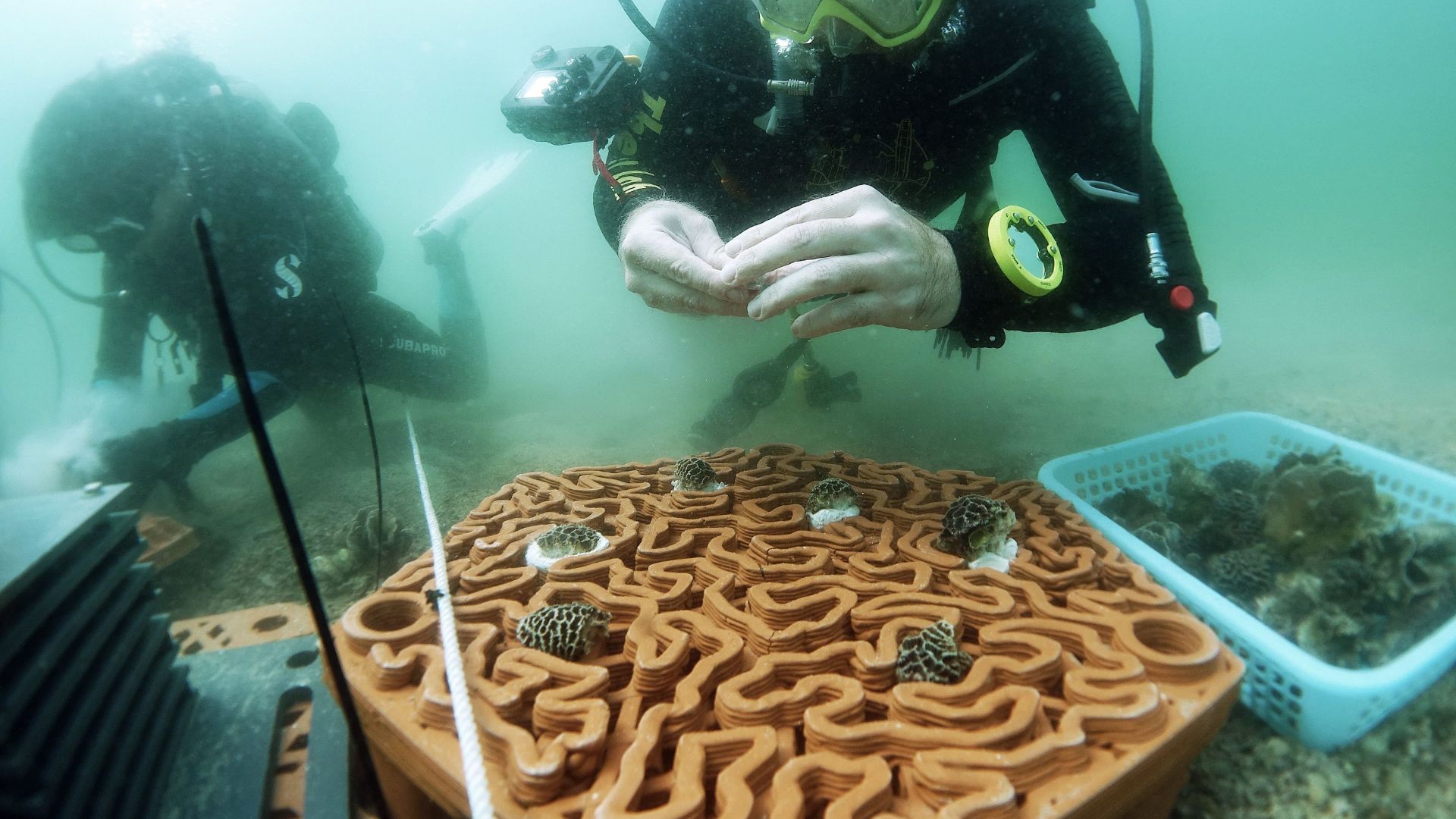
3D-Printed Terracotta on the Seafloor Becomes the Base for Corals to Attach, While Researchers Monitor Survival and Growth in Protected Areas of Hong Kong, with Pieces Installed to Recover Degraded Reefs and Favor the Return of Marine Biodiversity in Points Monitored by Universities and Environmental Agencies.
A series of 3D-printed terracotta pieces have been placed on the seafloor in Hong Kong to support coral restoration and recreate, in degraded areas, the physical conditions that favor the return of marine communities.
The initiative stems from a study commissioned by the Agriculture, Fisheries and Conservation Department of Hong Kong (AFCD) and executed by researchers linked to the Swire Institute of Marine Science at the University of Hong Kong, with deployment at different points in Hoi Ha Wan Marine Park, a protected marine area known for its biodiversity.
The principle is simple: instead of relying solely on already compromised natural structures, researchers add “artificial reef” units in tile form to the environment, produced in terracotta with a surface designed to offer a more favorable substrate for the attachment and growth of coral fragments.
-
With a cost per shot close to zero, the DragonFire laser could change naval warfare in 2027 and provide British ships with nearly unlimited defense against drones.

-
A British startup creates tires that generate electricity in electric vehicles when passing over potholes, speed bumps, and cracks.

-
Scientists have created robots made with living cells that have their own nervous system, swim on their own, explore the environment, and self-organize without any genetic engineering, and now they want to do the same with human cells.

-
Students create a solar-powered ambulance that operates without a plug, without fuel, and still keeps medical equipment running in remote areas.

These units are installed in locations where the original reef has suffered loss of coverage and where the seafloor, smoother and less stable, tends to hinder new corals from establishing and surviving long enough to repopulate the area.
How 3D Printing Creates Substrate for Attachment of Fragments
In practice, the method combines two fronts of work.

First, the terracotta units are placed in the chosen location and begin to function as a solid base.
Next, coral fragments are “seeded” onto these structures and monitored over time to measure survival and growth.
Monitoring is a central part of the project because the effectiveness of the method depends on measurable and repeatable results, especially when it comes to restoration in open marine environments, subject to variations in currents, temperature, and sediments.
Hoi Ha Wan Marine Park and Installation Points
In Hoi Ha Wan Marine Park, deployment occurred in three areas with distinct functions within the study: one site defined as an experimental area, one site as a restoration area, and a demonstration site linked to WWF Hoi Ha Marine Life Centre.
In the experimental area called Coral Beach, 24 artificial terracotta reef units were installed, and 378 coral fragments were seeded onto them.
In the point designated as the restoration area at Moon Island, four units were installed, while the demonstration site received five units, also with fragments from different species.
Quarterly Monitoring and Survival Results
The team recorded the survival and growth of these fragments in quarterly evaluations over a period of 15 months.
At the experimental site, the study reported a survival rate of 97.6% of the seeded fragments, as well as positive physical growth for three monitored genera.

The data cites a maximum increase in linear extension of 69% for Acropora, 37% for Pavona, and 25% for Platygyra during the monitored period, a set of results used to support that the structures provide a suitable substrate to favor attachment, survival, and growth in restoration projects.
Why Terracotta Was Chosen for the Artificial Reef
The choice of terracotta is linked to the idea of using a ceramic material that can remain in the marine environment without the logic of a heavy coastal engineering project, allowing biological colonization to occur on top of the structure.
In this type of intervention, the piece does not “replace” the reef; it serves as a platform for the coral to reclaim space and, over time, create structural complexity and microhabitats that attract other organisms.
As corals are known to form three-dimensional habitats, their presence often increases the availability of shelter and food for various species, and a successful restoration tends to have an effect on local diversity.
Marine Biodiversity in Hong Kong and Pressure on Reefs
The study also frames the project as a response to pressures facing coastal coral communities.
Hong Kong is often associated with an urban and financial landscape, but the territory is home to thousands of marine species and dozens of species of reef-building corals, making the conservation of these environments a relevant issue for public management and the maintenance of ecosystem services.
The area of Hoi Ha Wan Marine Park itself is treated as a natural heritage that relies on active protection when previous losses hinder spontaneous recovery.
What Is Observed Beyond Initial Survival
As it involves restoration, the results are not limited to initial survival.

Quarterly monitoring is designed to observe not only whether the fragments remain alive but if they grow consistently and if the surrounding environment begins to retain more life, such as small fish and invertebrates.
The project documentation highlights the attraction of marine life to restored habitats and the systematic monitoring as part of the scientific design, which helps differentiate point interventions from actions with technical validation.
University Research and Conservation in a Protected Area
Another feature of the project is the effort for continuity.
The study reports the intent to expand monitoring to collect long-term data and incorporate biodiversity analysis techniques on a finer scale, seeking to assess with greater precision the effect of restoration on the biological community.
This stage is relevant because, in reefs, real changes can become clearer as the coral grows, consolidates its structure, and begins to perform its role as an “ecosystem engineer,” creating more surfaces and refuges for other species.
Technology-Based Solution and Assisted Restoration
The proposal also fits into an international trend of nature-based solutions and technology-assisted restoration.
3D printing allows for creating pieces with controlled geometry and texture, something difficult to achieve on a large scale using only traditional methods, and this opens space to test different designs, compare performance, and adjust the shape based on what works in the field.
In journalistic terms, what stands out is the contrast between the visual simplicity of “tiles on the seafloor” and the sophisticated biological objective: to provide coral with a base capable of accelerating repopulation in areas where the natural substrate no longer fulfills that function.
Clear Metrics and Reference for Other Initiatives
The experience in Hong Kong also illustrates how marine projects can unite public policy, university research, and conservation in protected areas, with monitoring metrics that make the process auditable.
When a restoration presents clear numbers for deployment, quantity of fragments, monitoring timeframe, and indicators of survival and growth, it becomes comparable to other initiatives and can serve as a reference for decisions in locations facing similar degradation, as long as the environmental conditions of each region are respected.
If a coastal city can “rebuild” part of its reef with 3D-printed terracotta tiles and seeded corals, what other discreet infrastructures can still be installed in the sea to restore biodiversity without turning the coast into a construction site?







-

-

-

-

-

-

72 pessoas reagiram a isso.