





 Portuguese
  English
  Spanish
  5 min of reading
  0 comments


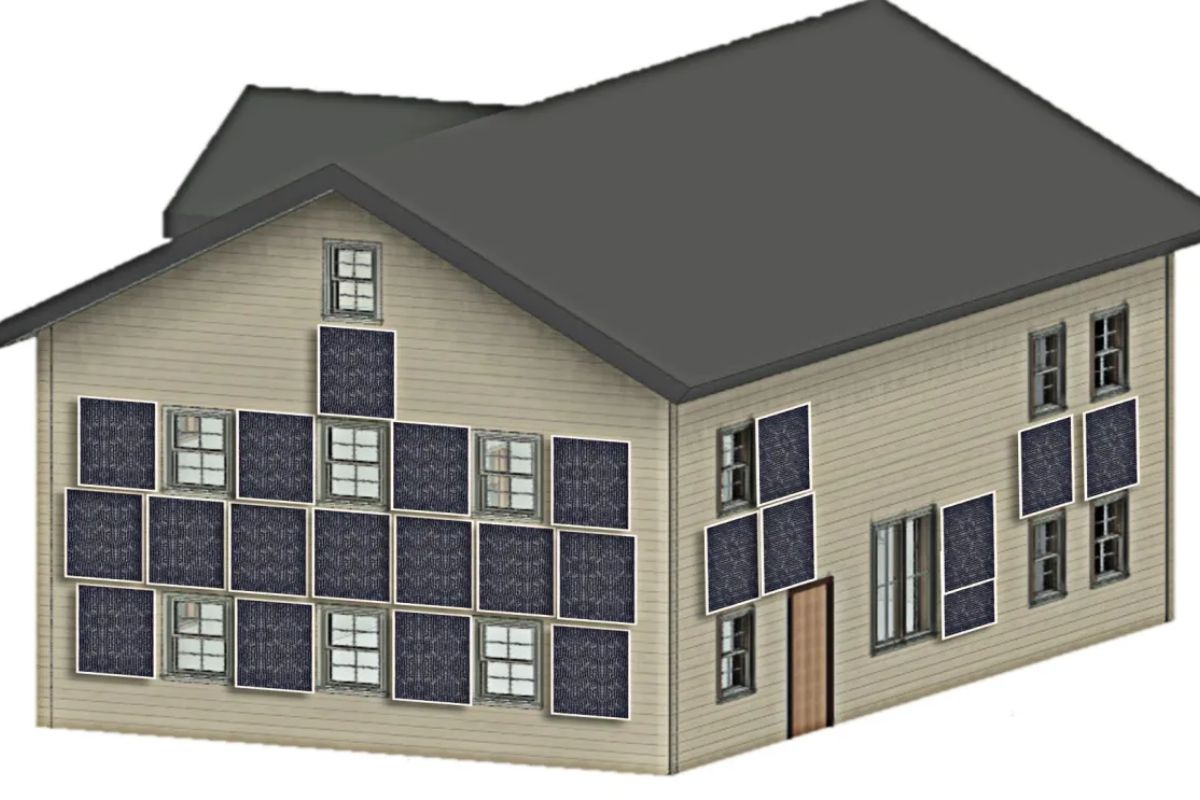
The sweater for buildings uses lightweight photothermal fabric that can be installed by residents to heat facades and reduce heat loss; simulations indicate up to 15% savings in homes and up to 23% in buildings.
The sweater for buildings is based on a simple and straightforward technology: covering the facade with removable fabric panels that capture solar radiation, convert it into heat, and help maintain the temperature inside the house. The proposal was developed by researchers at the University of Massachusetts Amherst and aims to address a real problem for those living in cold places, especially tenants who cannot renovate the property to improve heating.
Instead of relying on expensive and invasive construction, the team sought something that anyone could install on their own. The sweater for buildings acts as an external layer that heats the wall and reduces heat loss from the interior to the outside, promising to reduce heating consumption without needing the landlord’s permission.
Why the idea of the sweater for buildings emerged
The starting point was to think about what a human does when they feel cold. Professor Carolina Aragón, one of the lead authors, summarizes the logic with a simple comparison: when you are cold, you put on a sweater. The question then turned into another: what would a building do if it could wear something to stay warmer.
-
A student from the Bahia semi-arid region discovers that the skin of the pine cone has cleaning power and creates a biodegradable detergent that can transform the waste from the largest producer of the fruit in Brazil into a sustainable product and generate income for the community.
-
An extratropical cyclone more intense than usual forms this Tuesday and is expected to hit the South of Brazil with winds of up to 125 km/h, rainfall of 100 mm, and a real risk of hail and destruction between Tuesday and Wednesday.

-
It wasn’t China: a European country tests the world’s first train with quantum technology that eliminates the need for GPS and inaugurates a new era in rail transport.

-
Scientists create a filter made from organic materials that transforms even seawater into drinking water using only sunlight, without electricity, without chemicals, and with almost zero production cost.

This line of reasoning guided the design of the sweater for buildings towards a practical path. Instead of structural changes, which often require renovation, time, and budget, the solution aimed to be removable, lightweight, and easy to install, especially for those living in rental properties.
How the sweater for buildings works in practice

The sweater for buildings operates on two fronts simultaneously, which explains why it is not just “a fabric on the wall”.
Solar heat capture
The panels absorb sunlight across a broad spectrum and convert this energy into heat, warming the external surface of the wall.
Thermal insulation
In addition to heating from the outside, the panel acts as a barrier that reduces heat loss from the interior to the external environment, decreasing the thermal exchange that cools the house throughout the day.
In practice, the proposal is to create an “extra envelope” on the outside of the property. That’s why the term sweater for buildings makes sense: it is not an electric heater; it is a layer that helps the building retain heat.
What makes the fabric special in the sweater for buildings
The central invention is not simply the fabric, but the photothermal dye applied to it. The work cites a special dye developed by chemistry professor Trisha Andrew from the Wearable Electronics Lab, described as a functional organic polymer applied using a deposition technique.
What this dye does is the differentiator of the sweater for buildings: it increases the ability to absorb sunlight and convert it into heat with high efficiency. As it can be applied to various textile substrates, the team tested it on umbrella fabric, chosen for its durability, waterproofness, and low cost. The intention was to keep the technology accessible without relying on expensive materials.
Results of the simulations and what they mean
The computational simulations evaluated exactly the two physical properties of the sweater for buildings: heating of the external surface and reduction of internal heat loss. With this, the modeling indicated that the panels could keep the interior of a residence up to 4.5°C warmer throughout the day.
In terms of energy consumption, the percentages cited by the modeling are:
Up to 15% reduction in homes;
Up to 23% reduction in large apartment buildings.
Here, the most important point for credibility is the limit of the result: the numbers come from computational models, not from physical tests at a real scale. The team itself acknowledges that full-scale prototypes still need to be tested to confirm performance outside the laboratory.
Why the sweater for buildings may be of great interest to tenants

The text links the proposal to a specific social problem: “eviction due to renovation,” when landlords renovate properties and adjust the rent to a level that the tenant cannot afford. Since the sweater for buildings is removable and installable by the resident, the idea is that it improves thermal comfort without triggering a renovation and rent increase.
In other words, the benefit is not just technical. It is also an attempt to create a solution that does not depend on the property owner, which is often the most common barrier for those wanting to improve insulation and heating.
Simple installation and aesthetics: the sweater for buildings as “do it yourself”
The team describes a “do it yourself” scenario. The image is quite concrete: rolls of fabric sold in hardware stores could be installed by the tenant themselves in an afternoon, without specialized labor and without heavy construction.
Moreover, since the central element is a dye, it can be applied in various decorative patterns. This allows the sweater for buildings to be integrated into the aesthetics of different regions, something the authors consider relevant for adoption: it is not enough to work; it needs to match the facade and architecture.
What to observe before believing in easy promises
The sweater for buildings has an enticing proposal because it mixes simplicity with potential impact. But the material itself raises an important warning: there is still a lack of full-scale physical tests to validate the projections.
In other words, the next steps are crucial to answer practical questions, such as durability over seasons, performance in rain and wind, maintenance, and how much the projected savings hold up under real conditions.
Would you use a sweater for buildings installed by yourself to reduce your energy bill in winter, or would you only trust it after seeing real tests outside of simulations?






Seja o primeiro a reagir!