





 Portuguese
  English
  Spanish
  6 min of reading
  0 comments


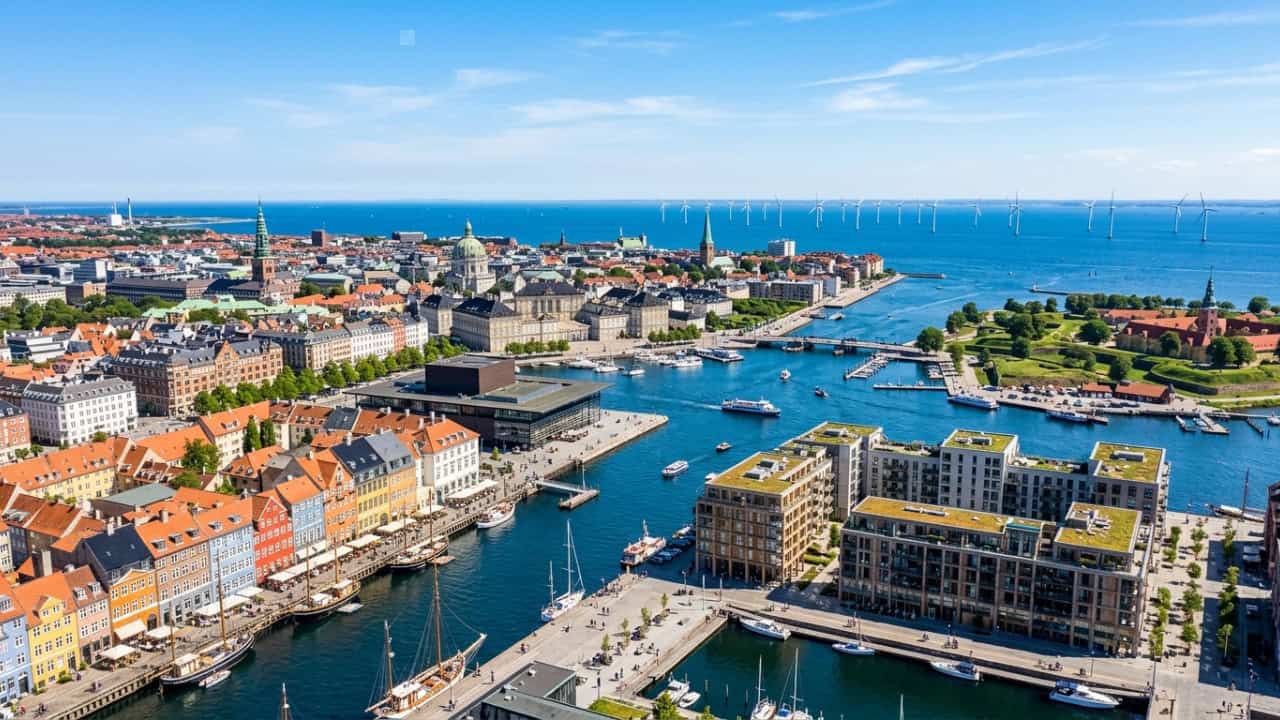
This global metropolis applies disruptive infrastructure and urban management solutions to consolidate its position as a reference in clean energy, attracting the attention of governments and investors in 2026.
The city of Copenhagen, Denmark, has earned the title of the world’s greatest reference in clean energy by integrating a zero-emission system with high urban efficiency. The Danish capital currently operates with an energy matrix based almost entirely on wind and biomass sources, eliminating dependence on fossil fuels in record time.
This urban model combines smart bike lanes, energy self-sufficient buildings, and a district heating network that reuses residual heat from industry. The practical result is seen in the quality of life of residents, who breathe cleaner air and enjoy a fully electrified public transportation system.
Governments from various continents send delegations to study how the city balances economic growth with environmental preservation.
-
Couple buys 1846 church in ruins for R$ 660,000, invests R$ 3.2 million in renovations, transforms it into a millionaire mansion, and even preserved a historic cemetery with over 300 graves.

-
He started running at 66 years old, broke records at 82, and is now a subject of study for having a metabolic age comparable to that of a 20-year-old, in a case that is intriguing scientists and inspiring the world.

-
Oldest tree on the planet reappears after 130 years of searches: Wattieza, 385 million years old, was 10 meters tall and had no leaves or seeds; Gilboa fossils in New York solved the mystery in 2007.

-
A 48-square-meter house assembled in hours with 4,000 bricks made of recycled plastic that does not absorb moisture, has natural thermal insulation, and costs less than 90,000 reais in a complete kit.


In 2026, Copenhagen not only meets its climate goals but also exports smart city technology, proving that sustainability works as a driver for social and financial development.
The strategic planning that created a reference in clean energy
Transforming a historic capital into a reference in clean energy required decades of rigorous planning and political continuity. The local government set ambitious goals back in the early 2000s, focusing on total decarbonization of the electrical grid.
The strategy prioritized the installation of offshore wind farms in the North Sea, thus harnessing the region’s constant winds to meet urban demand.
The Danish differential lies in integration. The city hall did not just install wind turbines; it reformed construction legislation. Today, new buildings must have state-of-the-art solar capture systems and thermal insulation.
This reduces the need for heating energy in winter, decreasing the load on the overall system. The city functions like a living organism, where each structure contributes to a positive energy balance, serving as a lesson for Brazilian metropolises seeking efficiency solutions.
Urban mobility: The revolution of bicycles and electrics
No place in the world surpasses the logistical efficiency of Copenhagen when it comes to low-impact transportation. More than 60% of the population uses bicycles as their primary means of daily transportation, even under adverse weather conditions.
The city has invested in “bike highways,” which feature smart signage synchronized with the average speed of cyclists.
In addition to two wheels, public transportation operates exclusively on batteries. Electric buses and the fully automated metro ensure silence and clean air on the streets. This transition to electricity drastically reduces nitrogen oxide and particulate matter emissions.
The local economy also feels the impact: public spending on health has decreased, as the population has become more physically active and less exposed to noise and air pollution.
The plant that turned into a ski slope
One of the most impressive symbols of this reference in clean energy is the CopenHill plant. It is an energy recovery facility that transforms solid waste (garbage) into electricity and heat for thousands of homes.

The curious detail is the architecture of the building: the roof of the plant houses an artificial ski slope open to the public year-round.
This engineering feat proves that industrial infrastructure does not need to be isolated or visually degrading. CopenHill filters 99.9% of combustion gases, releasing only clean water vapor through the chimney.
The project attracts tourists and sustainability enthusiasts, thus demonstrating that energy efficiency can go hand in hand with leisure and innovative urban design. It is the physical proof that waste, when well managed, becomes a source of wealth and renewable energy.
District heating: The secret of thermal efficiency
While many countries waste industrial heat, this city utilizes every calorie. The district heating system connects almost all households to an underground hot water network. Heat generated by industries, incineration plants, and data centers travels through insulated pipes to heat taps and radiators in homes.
This centralized system is much more efficient than individual boilers in each building. It allows the city hall to change the heat source globally; if a cleaner technology emerges, it is enough to change the production center, and the whole city instantly becomes greener.
This infrastructural flexibility ensures that Copenhagen maintains its technological leadership for decades, adapting to innovations without needing structural reforms in every block.
The real impact on the economy and the job market
The transition to become a reference in clean energy has driven the creation of a new job market. Thousands of green jobs have emerged in wind technology companies, energy efficiency consultancies, and mobility startups.
Denmark now hosts the largest turbine manufacturers on the planet, exporting equipment to Brazil, the United States, and China.
The economy of Copenhagen has grown significantly since it began its decarbonization plan. This debunks the myth that environmental protection hinders development.

On the contrary, sustainability has attracted global talent and technology companies seeking headquarters with high quality of life and low environmental impact. The city’s GDP shows robust numbers, driven by constant innovation and reduced operational costs with imported energy.
Coastal engineering and offshore wind farms
Geography plays a crucial role in maintaining the energy matrix. The installation of giant turbines in the open ocean allows for capturing much stronger and more constant winds than on land.
Danish engineering has developed underwater foundations that minimize the impact on marine ecosystems, creating artificial reefs that attract local biodiversity.
These offshore wind farms generate so much energy that, on days of strong winds, the city produces a surplus. Copenhagen exports this energy to neighboring countries through high-voltage submarine cables.
This international trade of clean energy strengthens the trade balance and ensures that the initial investment pays off in a few years. The model serves as inspiration for Brazil, which has a vast and still underexplored coastline for offshore wind generation.
Citizen participation and social engagement
The success of this reference in clean energy does not depend only on machines but on people. The population of Copenhagen actively participates in urban decisions.
Energy cooperatives allow residents to buy shares of wind turbines, becoming “owners” of electricity production. This generates a sense of responsibility and community pride.

Social engagement facilitates the implementation of changes that, in other places, would face resistance. When the city hall decides to close a street to cars or install new recycling infrastructure, citizens understand the long-term benefit.
Environmental education begins in primary schools, where children learn about the water cycle, the origin of energy, and the importance of the circular economy.
Digital technology and Smart Cities
Copenhagen utilizes a dense network of sensors to monitor everything from air quality to the occupancy level of trash bins. The “Smart Grid” system adjusts energy consumption in real-time.
For example, street lighting reduces intensity when no one is on the street, saving precious megawatts.
Smart traffic lights detect the approach of groups of cyclists and prioritize the green signal for them, reducing travel time. All this data volume (Big Data) serves to plan the city of the future.
Urban managers know exactly where to invest to reduce bottlenecks and optimize resource use, ensuring that efficiency is not just a buzzword but a measurable reality.
What the world can learn from the clean energy reference of Copenhagen
The trajectory of Copenhagen proves that the combination of clean energy, quality of life, and technical efficiency is the only viable path for modern cities. Being a reference in clean energy requires political courage, investment in technology, and above all, a focus on human well-being.
The Danish model shows that it is possible to live in a vibrant, wealthy, and technologically advanced metropolis without destroying natural resources.
The real impact of this transformation crosses borders. By serving as a living laboratory, the city reduces the costs of new technologies for the rest of the world. What today seems like futurism in Scandinavia will soon become the global standard.
For the oil and gas sector, the message is clear: the energy transition is an opportunity to reinvent the concept of public utility and infrastructure, ensuring a more sustainable and prosperous 2026 for all.







Seja o primeiro a reagir!