





 Portuguese
  English
  Spanish
  5 min of reading
  0 comments


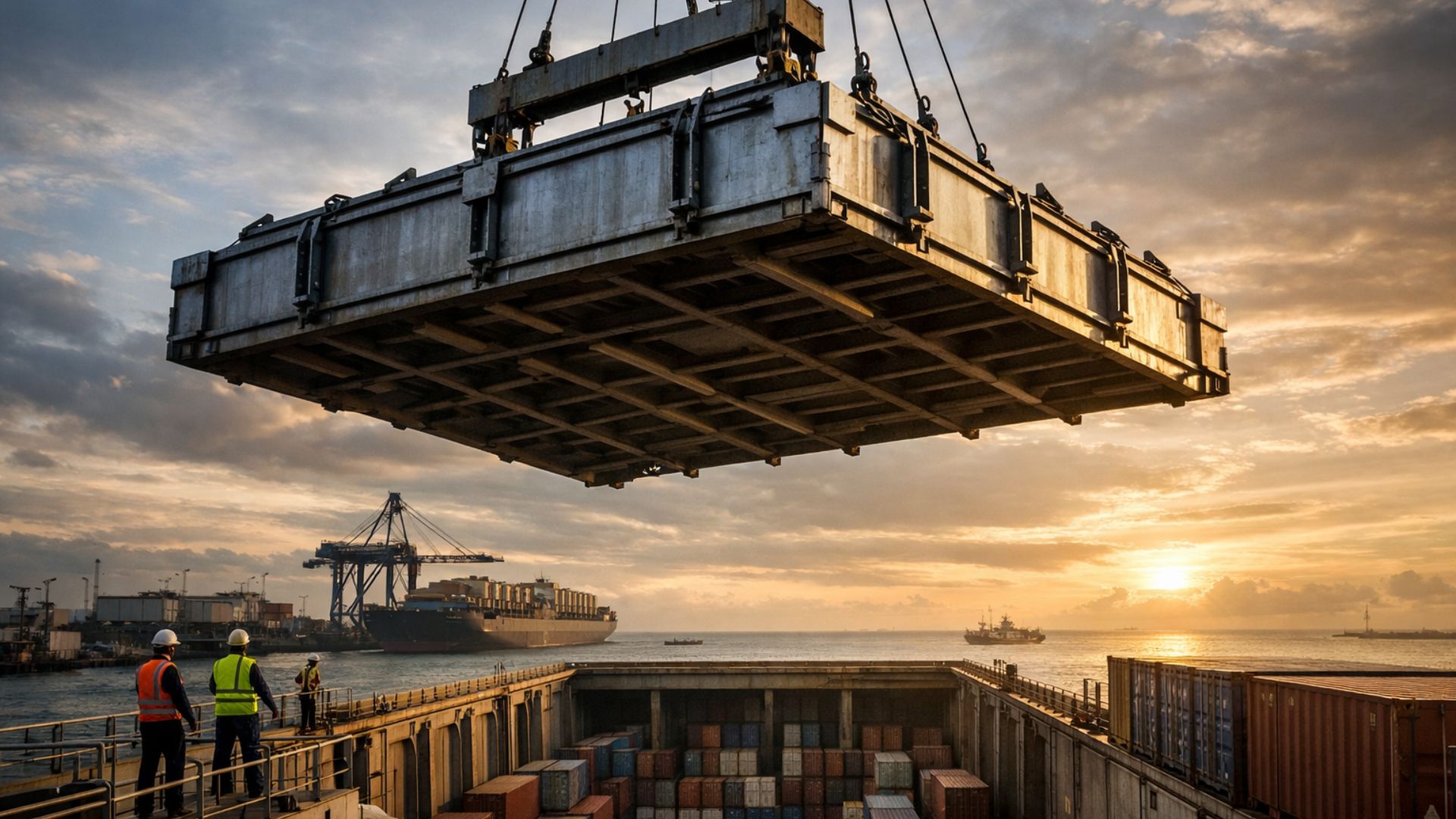
Structures of up to 45 tons act beyond sealing and support part of the operational logic of the largest container ships, combining engineering, logistics, and resistance to allow quick opening of the holds and recomposition of the cargo surface at sea.
On the largest container ships, the hold cover is both a structural and operational component.
It closes the opening of the compartment, helps prevent water entry, and recomposes the cargo area on which part of the containers will be positioned on the deck.
According to MacGregor, a global supplier of marine cargo handling and stowage systems, each opening can be covered by one to five panels, and each panel can weigh up to 45 tons.
-
A Brazilian inherits a farm with a century-old mansion and 150 years of coffee tradition in Minas Gerais, restores the main house with water-powered machines, creates a new chalet, and transforms the historic property into a space that blends memory, nature, and culture.

-
The United Kingdom transforms chewed gum thrown on the streets into an ambitious and surprising project that could forever change the way cities and stations deal with one of the stickiest and most expensive types of waste to remove.

-
While Argentina reactivates the Dardo gliding bomb after more than a decade of inactivity, Brazil is keeping an eye on it and speeding up its national missile with airborne MANSUP, a range of over 200 km, royalties, and export potential.

-
Society says that family is sacred and that a good child can endure everything, but psychology shows that distancing oneself from toxic parents is not ingratitude; it is the only way to preserve one’s mental health and break cycles of abuse.

This set has gained relevance as ships have grown in width, capacity, and operational complexity, because the hold needs to be opened quickly during port calls and return to operate as a secure base as soon as loading is complete.
It is therefore not a passive cover.
The component directly participates in port operations and navigation, in a cycle that involves removal, temporary storage, repositioning, and sealing of the cargo compartment.
Port operation and dynamics of hold covers
During loading and unloading operations, these covers need to completely move out of the way to free access to the hold.
In this space, the containers are distributed in defined rows according to the ship’s stowage plan.
When the terminal completes this stage, the panels return to their original position and restore the upper surface of the compartment.
This movement allows the area to reintegrate into the vessel’s transport logic in open sea.
In lift-away systems, common in container ships, the panels are moved with a spreader.
This is the same type of device used in container handling. The operation occurs through the terminal’s cranes or the ship’s own cranes.
The manufacturer also states that these elements can be stacked on the quay or on the deck during operation.
This feature shows how the hold cover functions as a active part of logistics, and not just as a simple fixed metal closure.
Why are the panels divided on large ships
The division of a single opening into several segments follows the size of the ship.
It responds to the need to combine wide access, orderly removal, and safe repositioning of very heavy structures, without slowing down the pace of port calls.
On wider vessels, covering the hold with several independent panels allows the system to adapt to the design of the cargo area.
It also ensures compatibility with the reach of the equipment used at the terminal.
This solution directly affects how the ship organizes the separation between the cargo accommodated inside the hold and the cargo that will be stacked above the deck line.
When repositioned, the cover ceases to be just a top closure.
It becomes part of the surface on which the stowage system resumes operation.
In this context, demands for strength and stability arise that go beyond the function of covering.
Sealing against water and cargo protection
The sealing is one of the central responsibilities of this set.
The opening of the hold needs to function again as a reliable barrier between the marine environment and a space where the cargo must remain protected throughout the journey.
The covers are designed to prevent water entry into the compartment.
Additionally, they operate in a weathertight configuration, a term used to indicate impermeability to weather and seawater under expected conditions.
This point helps to gauge the technical challenge involved.
The same structure that needs to be removed and replaced repeatedly must maintain sealing performance even under hull deformations and operational wear.
Water tightness depends on the combined functioning of seals, supports, restrictions, and positioning of the parts of the cover.
This indicates that the final result depends on a complete system.
How the covers support containers on the deck
The importance of these covers becomes even clearer when observing how the forces generated by the containers are transmitted to the ship’s structure.
This occurs especially in the stacks installed on the deck during ocean crossings.
The transfer of efforts to the hull involves components such as hatch covers, lashing bridges, and deck stanchions.
This set places the hold cover within the structural chain that helps support and stabilize the transported cargo.
In practice, the ship does not rely solely on the available space inside the holds.
It also depends on the ability of its structured surfaces to participate in the distribution of loads above the deck.
When observing a loaded mega-container ship, attention often falls on the height of the stacks or the size of the hull.
Still, part of the support in this scenario comes from components that rarely appear outside the technical vocabulary of the industry.
Additional functions beyond hold closure
Another aspect that is not very visible outside the shipbuilding industry is that these covers can receive specific accessories.
These features vary according to the operation and the profile of the cargo being transported.
The panels can be equipped with container fittings, ventilation openings, and bulkheads.
They can also include water spraying systems aimed at transporting hazardous cargo.
This versatility expands the function of the component beyond the closure of the hold. It reinforces the role of the covers as a multifunctional element within maritime operations.
Whenever the hold opens to receive containers and then closes again to support part of the cargo on the deck, this mechanism highlights a central requirement of modern maritime transport.
Transforming a large structural opening into wide access at the port and, shortly after, into a safe operational surface at sea.






Seja o primeiro a reagir!