





 Portuguese
  English
  Spanish
  4 min of reading
  0 comments


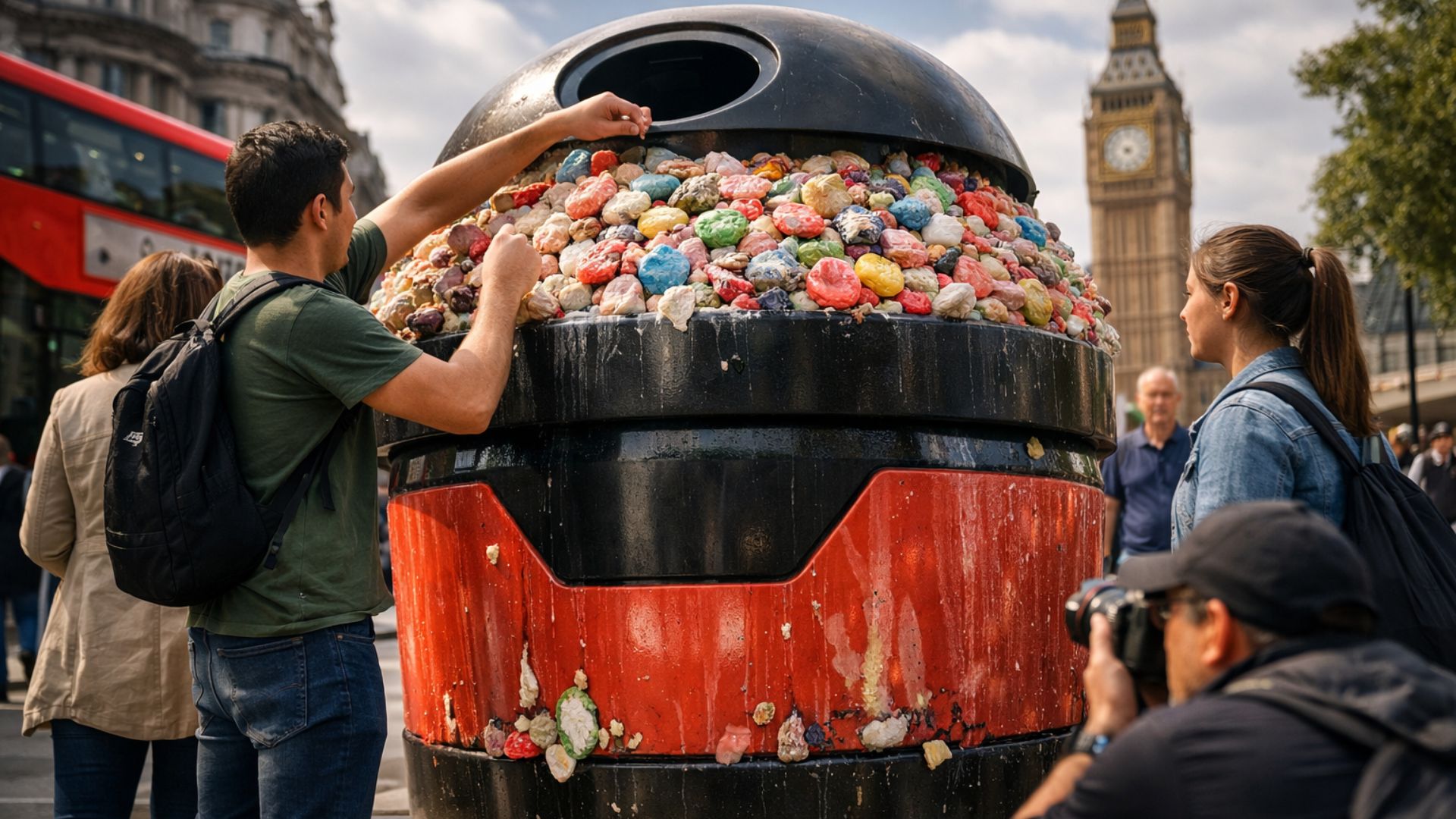
British system transforms discarded gum into industrial raw material and reduces urban cleaning costs by combining specific collection, recycling, and reuse into new products within a circular economy logic applied to high-traffic public spaces.
The United Kingdom has started treating discarded gum on the streets as an urban cleaning problem, but also as raw material for industrial reuse, in a model that combines specific collectors, waste separation, and recycling for reinsertion into new products.
The initiative has gained traction in high-traffic areas by simultaneously addressing visible dirt on the ground and the high cost of manual or mechanized removal of this type of material.
Gum recycling becomes urban solution
At the center of this system is the British company Gumdrop Ltd, which claims to have developed the first process aimed at the commercial-scale recycling of used gum, converting the material into a compound called GUM-TEC.
-
Amid the United States’ economic blockade, China delivers 15,000 tons of rice to Cuba as part of a 60,000-ton donation personally approved by Xi Jinping. The package includes 80 million dollars and solar panels for hospitals.

-
For around 200 reais, anyone can buy a kit and have a chip implanted between their fingers to replace cards, keys, badges, and even medical information in case of a hospital emergency.
-
A 600-meter hill in the interior of Santa Catarina hides a volcanic past of almost 600 million years. The Morro do Garrafão in Corupá may have been an ancient extinct volcano, and science now confirms what the residents have always suspected.
-
Family has lived for over 50 years without electricity and running water at home in the South of Minas, 10 minutes from the city, improvising light, bath, and water while facing a lack of basic resources and awaiting property regularization.





According to the company, the process uses both post-consumer gum, collected at disposal points, and pre-consumer waste provided by manufacturers, to produce an alternative material applicable to the plastics and rubber industry.
How collection works at strategic points
The operation begins before the waste reaches the ground, with collectors designed to exclusively receive chewed gum in high-traffic locations such as building entrances, shopping centers, airports, offices, cinemas, and train stations.
The logic is to reduce improper disposal in public spaces and prevent the material from sticking to surfaces that require frequent, costly, and inefficient cleaning once the problem is already established.
Closed loop transforms waste into new collectors
One of the most unusual aspects of the project lies in the very design of the reuse cycle, because the containers used in collection also re-enter the recycling chain once full.
According to Gumdrop, each collector can hold up to 500 pieces of gum, a quantity sufficient to generate three new containers, which transforms the disposal point itself into an active part of the closed production system.
This model draws attention because it attempts to solve an old urban problem through prevention, rather than just subsequent cleaning, which often consumes public funds without changing disposal behavior.
Economic impact and reduction of public costs
The numbers help explain why the topic has moved from the realm of curiosity to interest public managers and operators of high-traffic spaces.
Gumdrop reports that when its collectors were launched, improper gum disposal fell by 46% in the first 12 weeks in actions focused on behavior change, while broader programs recorded even greater reductions.
The financial dimension also weighs in this discussion, because gum is a cheap waste to produce but expensive to remove once it hardens on sidewalks, floors, and urban furniture.
The problem is associated with the improper disposal of 3.5 billion pieces per year in the United Kingdom and a potential cost of up to 150 million pounds for local authorities.
From waste to product: new uses of GUM-TEC
In practice, the project ceases to be merely a cleaning action when the waste returns to the market as input for new products, something that reinforces the appeal of the proposal outside the urban management sector.
Gumdrop reports that GUM-TEC has already been applied in containers for beverages and food, stationery items, collectors of its own brand, and even shoe components, showing that an item associated with improper disposal can return to the production chain with commercial value and industrial utility.
Real case shows savings in cleaning
One of the most cited cases by the company is that of the British Library, which installed collectors to reduce the presence of gum at the entrance of the building and in frequently used internal areas.
The location has begun to save about 7,500 pounds per year in cleaning costs, a figure that illustrates how prevention can have a direct effect on maintenance and conservation contracts for public or institutional spaces.
Public policy expands combat against the problem
Alongside this business front, the United Kingdom has increased institutional pressure on gum waste in recent years through the Chewing Gum Task Force.
The program has distributed 6.46 million pounds in resources, financed the cleaning of over 4.15 million square meters of pavement, and boosted prevention campaigns in dozens of local councils.
The growing interest in this type of solution stems from the changing perception of a waste that has long been seen as too small to justify innovation and too expensive to remove without wasting resources.
By transforming chewed gum into recyclable input and integrating collection, processing, and industrial reapplication, the British model repositions this material within the logic of the circular economy and opens space for new strategies in urban waste management.








Be the first to react!