





 Portuguese
  English
  Spanish
  7 min of reading
  1 comment


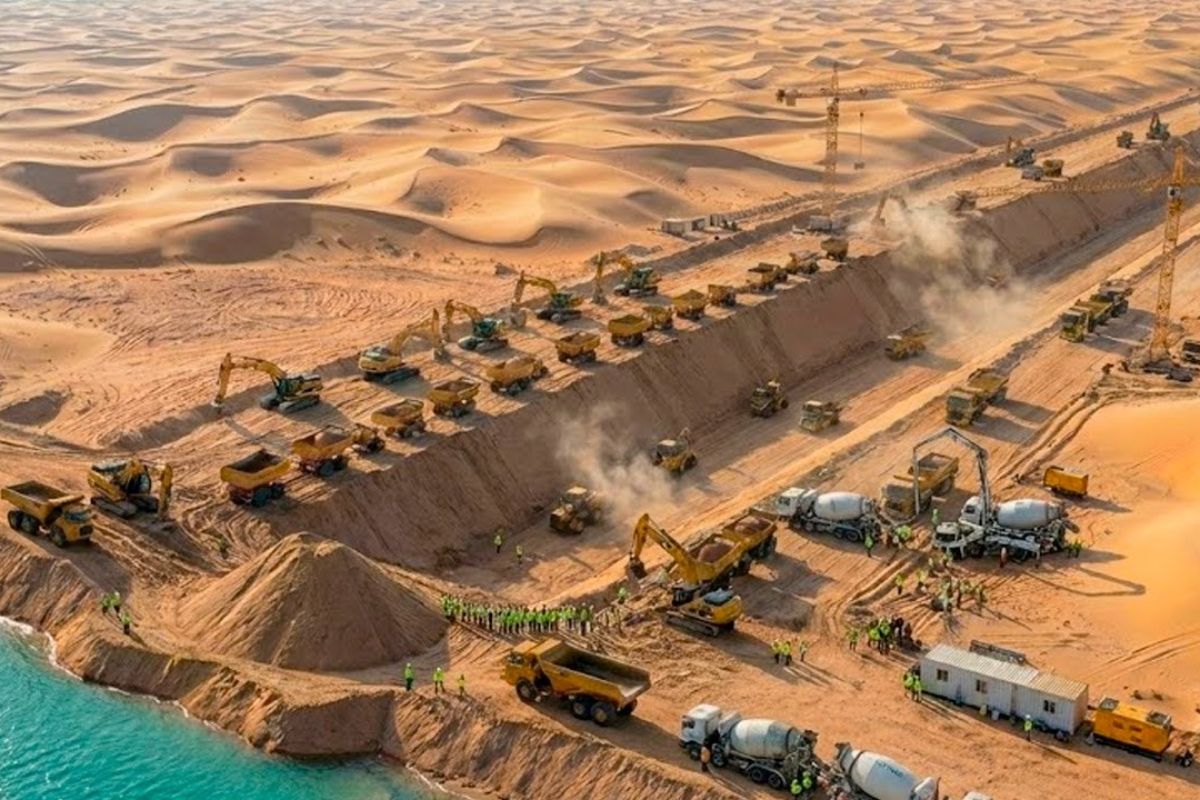


Rivers In The Desert Show How Artificial Channels, Drip Irrigation, And Desalinated Water Redesign The Negev Desert And Reveal The Limits Of Engineering In Arid Areas.
Creating rivers in the desert is to challenge, in practice, what physics, climate, and common sense would say is impossible. In regions where rain is rare, sand swallows any exposed drop and evaporation works against man, engineers are designing rivers in the desert with millimeter precision to keep cities alive and fields green.
Over the past few decades, massive projects in Pakistan, Israel, and Saudi Arabia have proven that rivers in the desert are not a biblical metaphor, but heavy infrastructure: channels nearly 500 km long, tunnels, steel pipes buried under mountains, and irrigation systems that deliver water drop by drop. These rivers in the desert are, at the same time, the salvation of millions of people and a reminder of the price humanity pays to survive on an increasingly hostile planet.
What It Means To Create Rivers In The Desert Today

Creating rivers in the desert is not simply digging a channel in the sand and waiting for water to flow. It is an engineering operation that combines mountain-scale earth movement, control of tilt in centimeters, and a constant battle against gravity, evaporation, and infiltration.
-
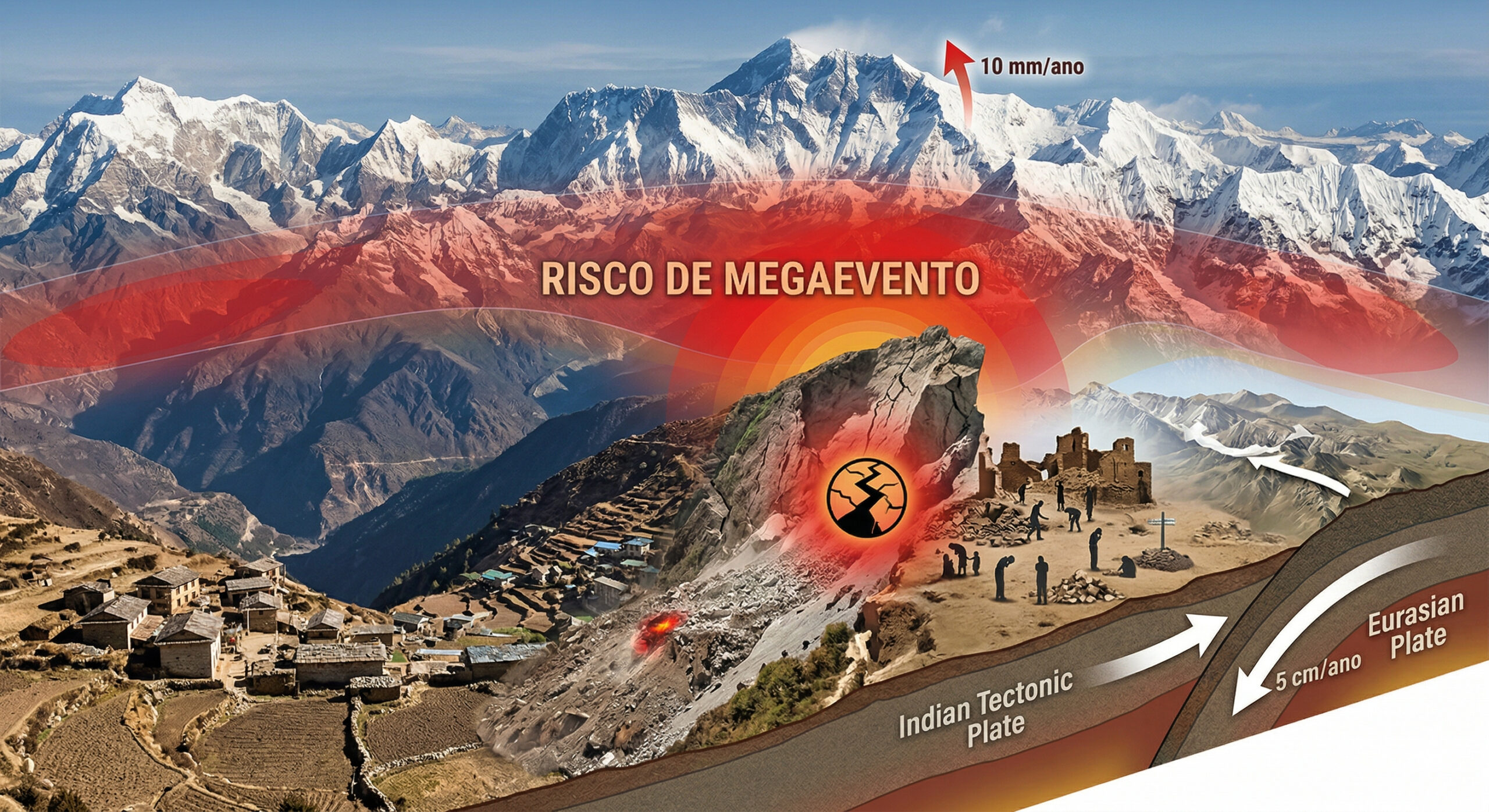
The Himalayas continue to grow to this day, with tectonic plates advancing 5 cm per year, mountains rising up to 10 mm annually, and the 2015 earthquake that killed 9,000 people may have increased the risk of an even larger seismic mega-event.
-
At an altitude of 400 km by astronauts from the International Space Station, Paris transforms at night into a golden mesh so precise that it reveals the outline of the Seine River, avenues, and entire neighborhoods like a luminous map drawn over the Earth.

-
iPhone 17 reaches historic low price with 256 GB, 120 Hz display, and drops to R$ 5,703 on Shopee, featuring A19 chip, dual 48 MP cameras, battery life of up to 30 hours, and advanced AI features.

-
Trip to Mars getting closer: Pulsar Fusion, from the UK, advances with plasma ignition in fusion engine and could drastically reduce space travel time, making crewed missions faster, safer, and economically viable.

In many of these projects, the margin of error for water to flow by gravity is almost zero. When the slope is adjusted by a few centimeters over dozens of meters, any deviation causes the flow to stagnate.
At the same time, the dry soil acts like a sponge, ready to suck up all the water if the channel bed is not sealed like a vault.
Therefore, the rivers in today’s desert are arteries of concrete, steel, and high-density plastic, with lined beds, bituminous joints to prevent cracking, geomembranes to prevent leaks, and dikes built with the excavated sand.
All this so that, in the end, the water reaches a plantation or a city that literally depends on every cubic meter transported.
Pakistan: The Canal That Brings A Great River To The Heart Of Drought
The story of one of the largest rivers in the desert begins in the scorching plains of South Asia, in a region where drought has defined the fate of communities for centuries. There, Pakistan made a radical decision: divert a major river to the heart of the desert through a canal about 499 km long.
The goal was straightforward and brutal: to transform a landscape of cracks and lines for water into fertile land. But digging a ditch nearly 500 km long in the sand does nothing if the hydraulic flow is not perfect.
The canal was shaped in a U-form, approximately 45 m wide at the base and with an average depth of 7 m. The longitudinal slope was maintained within an incredibly narrow margin, about an inch every 100 feet, which is nearly invisible to the naked eye.
Survey teams checked the elevation with laser instruments every few dozens of meters. Any deviation from the range would mean that this river in the desert would simply cease to be a river, becoming a stagnant lake in the middle of the sand.
The physical effort was colossal. Over 10,000 workers, hundreds of machines, decades of construction. The excavated sand became dikes of 3 to 5 m along the banks. In weak soil, sand stakes or mixtures of cement and clay were drilled to ensure that all this mass would not slowly sink.
The Secret Of The Lining: Shielding The Water From The Desert

In the desert, the enemy is not just heat, but the thirst of the sand itself. If the bed is not sealed, the artificial river disappears before reaching the farm or city. That is why many rivers in the desert only exist because their bottoms are treated as if they were the base of a dam.
In the case of this large canal, the bed and slopes were first moistened and leveled with a layer of fine sand. Then, the critical phase began: the concrete lining.
Panels about 10 to 12 cm thick were molded in sections of several meters, separated by expansion joints filled with hot bituminous sealant. This “flexible glue” prevents leaks and allows the concrete to expand and contract under the scorching sun without cracking.
In stretches with unstable subsoil, an additional layer of high-density polyethylene geomembrane was installed beneath the concrete and anchored with steel. The result is a riverbed in the desert that is virtually impermeable, capable of conducting water for hundreds of kilometers without being consumed by the soil.
When the water finally flows, viewed from above, this concrete artery resembles a silver ribbon traversing a golden sea of sand. Where there were once cracks and dust, irrigated fields and green patches emerge in the arid landscape.
Israel: Rivers In The Desert And The Invention Of Precision Irrigation
If in Pakistan the challenge was to excavate and line a gigantic canal, in Israel the problem was different: to transport water on a large scale while ensuring that every drop was used with maximum efficiency.
In the Negev Desert, water scarcity was an existential threat. To solve this, the country built a colossal system known as a national carrier, capable of transporting up to tens of thousands of cubic meters per hour from the wetter north to the arid south.
This hydraulic powerhouse required massive excavations, with about 70,000 tons of sand and soil removed daily in some stretches and over 100 engineers and operators working in shifts under temperatures exceeding 40 °C.
But the real revolution came after the water arrived. Instead of flooding fields and losing a huge fraction to evaporation, Israel transformed its rivers in the desert into drip irrigation networks, delivering water through secondary channels and pressure tubes directly to the root of each plant.
Every drop becomes a surgically controlled resource. Instead of flooding the soil, small amounts are released right at the root, at the exact rate the plant can absorb.
Thus, rivers in the desert cease to be just large visible works and become invisible systems of pipes, valves, and drippers that allow orange groves, vineyards, wheat fields, and rows of date palms to flourish where there was once dust and sun.
Seen from satellites, these rivers in the desert materialize as a long green ribbon winding through the golden desert, connecting the wetter north to the parched south.
Saudi Arabia: Steel Rivers Bringing The Sea Inland
There are places where there are not even big rivers to divert. In Saudi Arabia, the only truly abundant “river” is the sea, but it is too salty to drink and is far from the inland cities. The solution was to create rivers in the desert with another material: steel.
First, gigantic desalination plants next to the sea convert millions of liters of salty water into drinking water every day, at an extremely high energy cost.
Then, this fresh water is pushed inland through buried pipelines, true steel rivers traversing mountains and rocks.
In many stretches, mechanical excavation is not enough. Explosives are used to open trenches directly into solid rock, creating corridors wide enough to accommodate large-diameter pipes.
Sections of pipe several meters long and about 42 inches in diameter are aligned with internal hydraulic clamps that ensure a perfect fit before welding.
Each joint is welded, inspected with ultrasound, and then coated with liquid epoxy for corrosion protection.
Several tractors with side cranes work together to slowly lower this column of steel to the bottom of the trench, centimeter by centimeter, over a prepared sand bed.
Buried under tons of compressed sand and rock, these rivers in the desert transport desalinated water for hundreds of kilometers, feeding cities that, without it, would simply cease to exist.
The cost per cubic meter is often much higher than in humid regions, but in the desert the value of water is measured in survival.
Rivers In The Desert In An Increasingly Hostile Planet
All these projects have something in common: they are extreme responses to a planet that is becoming more hostile, whether due to chronic drought or an increase in extreme weather events.
Creating rivers in the desert is both an act of survival and a demonstration of how far engineering can go when there is no alternative.
While some countries divert rivers, build lined channels, and install steel pipes under mountains, others face volcanoes with seawater and drill tunnels hundreds of meters below the ocean to connect isolated regions. The logic is the same: use knowledge, materials, and energy to bend natural conditions to the limit.
The big question is that each river in the desert comes with a high energy, financial, and environmental price, from the colossal electricity consumption to desalinate water to the ongoing maintenance of giant structures in extreme environments.
On the other hand, these projects show that humanity tends to respond to scarcity with innovation. When the soil absorbs too much water, we create concrete linings and geomembranes.
When evaporation steals everything, we invent drip irrigation. When the sea is the only possible source, we build steel rivers to bring it inland.
In the end, the rivers in the desert become symbols of an age where the survival of entire regions depends on engineering decisions made based on hundredths of degrees of slope, millimeters of weld, and centimeters of concrete.
Do you think betting on rivers in the desert is a sustainable solution for the future, or are we just pushing the problem onto the next generation?




Creo que de todas estás megaobras, la más interesante es la de Arabia Saudita ya que el agua desalada es transportada por las tuberías de acero a los antiguos acuíferos que fueron esquilmados durante siglos por las poblaciones nómadas, de tal manera que los acuíferos se reponen sin perdidas de evaporación.
El norte de nuestro país es abundante en lluvias y un sistema de tuberías que conectara los embalses de la España húmeda con los acuíferos y embalses de las zonas áridas, sin duda podría combatir la desertificación que sufrimos actualmente.