





 Portuguese
  English
  Spanish
  6 min of reading
  0 comments


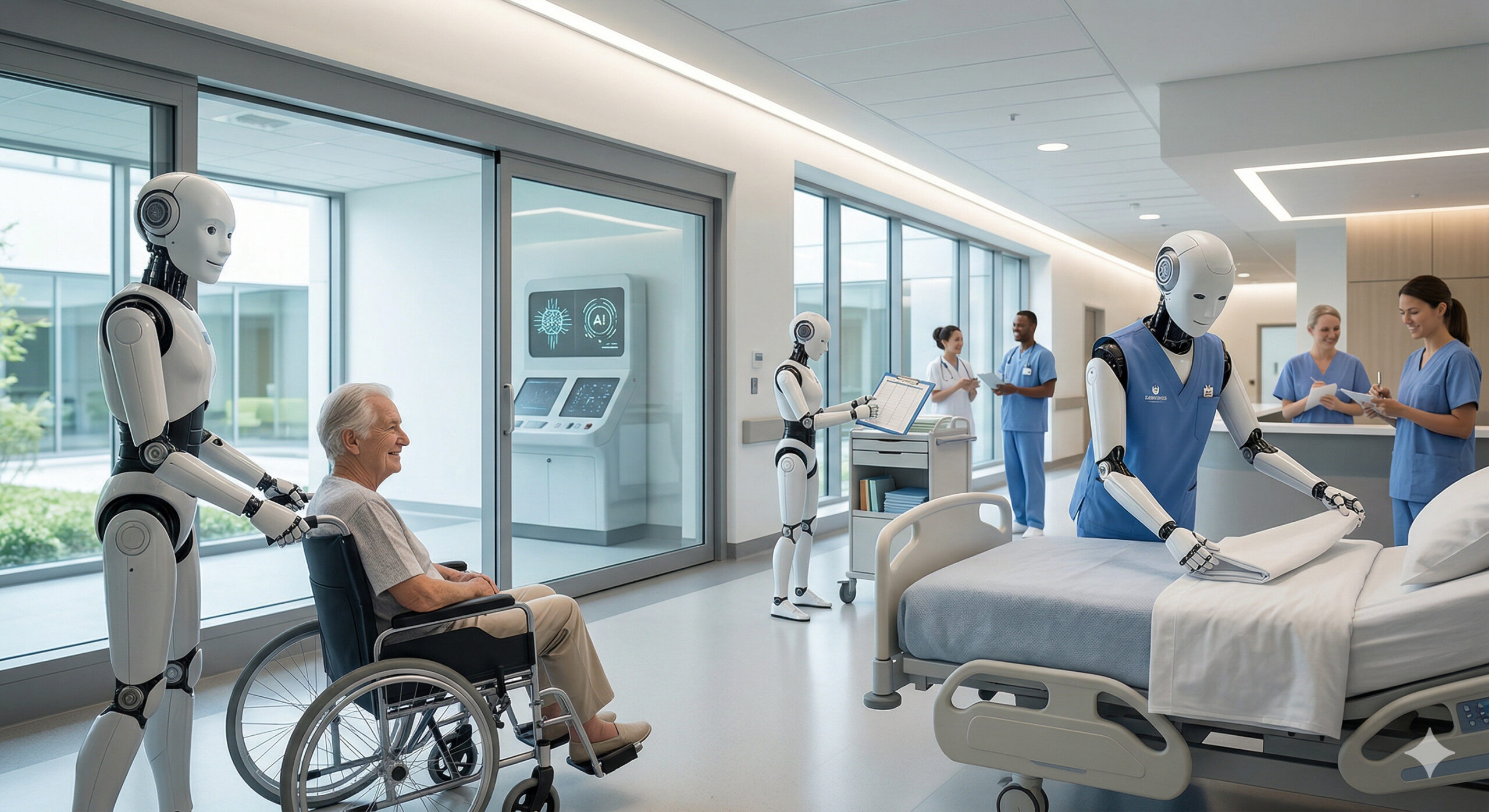
Humanoid robots are already working in hospitals, pushing wheelchairs, organizing beds, and marking the transition of AI from the digital to the physical world.
In 2026, hospitals and research centers in countries like Japan, China, and the United States began to expand testing and applications of robotics in real clinical environments, signaling an important shift in the recent trajectory of artificial intelligence. In Japan, ZEALS reported the first proof-of-concept test with a humanoid robot at the University of Tsukuba Hospital, between March 23 and 25, 2026, with the Unitree G1 performing autonomous walking, obstacle avoidance, voice guidance, and item transport within the hospital environment. In China, the Beijing Anzhen Hospital, presented by Xinhua in material republished by the People’s Daily, was already operating in 2026 as a demonstration unit “robots plus medical”, with 25 types of medical robots in clinical testing distributed across outpatient clinics, pharmacies, wards, surgical rooms, and other areas.
Recent industry reports, such as the compilation published by Nurse.org, reinforce that the presence of these systems has ceased to be merely a futuristic hypothesis and has begun to integrate practical discussions about hospital flow, logistical support, and care assistance. At the same time, academic studies published in arXiv, such as “Humanoids in Hospitals: A Technical Study of Humanoid Robot Surrogates for Dexterous Medical Interventions”, show that the focus of AI is advancing from processing text, images, and data to the physical execution of concrete tasks, with humanoid robots being evaluated in medical procedures, physical examinations, and teleoperated interventions.
This change represents a milestone because it shifts artificial intelligence from the purely digital realm to the physical world, where interpreting information is no longer enough: the challenge now is to act with precision, safety, and usefulness in real care environments.
-
5 mysteries of the Moon that the Artemis missions could finally solve

-
Goodbye common charger: users around the world are replacing the old item with this more compact, powerful, and efficient GaN model that charges a phone, tablet, and laptop at the same time.

-
New high-end condominium in Campo Grande comes under scrutiny for being too close to an archaeological site and may have construction affected.

-
Researchers transform food waste into a material stronger than concrete, made without cement, using cabbage, peels, and coffee grounds, which can still be consumed in an emergency.
What humanoid robots can already do in hospitals today
In the hospital environments where they are being tested, humanoid robots have already demonstrated the ability to perform practical tasks that previously relied solely on human professionals. Among the observed functions are the transport of equipment, organization of materials, assistance in patient movement, and logistical support in wards.

In demonstrations conducted by robotics companies and research centers, these systems were able to push wheelchairs, open compartments, fetch objects, and even adjust hospital beds. These actions, although simple at first glance, require motor coordination, computer vision, and real-time decision-making, highlighting the level of technological evolution achieved.
Furthermore, some models can already interact verbally with patients, answering basic questions and assisting in communication within the hospital environment. This interaction combines natural language processing with sensors and cameras that allow them to recognize the environment and the people around.
The turn of AI from the digital to the physical world redefines the role of technology
For years, artificial intelligence evolved mainly in the digital field, with advances in image recognition, machine translation, and text generation. However, starting in 2024 and with more intensity in 2025 and 2026, the focus began to shift.
The integration of AI and robotics has allowed algorithms to move from merely analyzing data to controlling physical movements in complex and unpredictable environments. This advancement relies on multiple systems operating simultaneously, including depth sensors, high-resolution cameras, machine learning, and motors capable of replicating human movements with precision.
This technological convergence is what makes the operation of robots in hospitals possible, one of the most challenging environments due to the need for precision, safety, and constant interaction with people.
Global shortage of healthcare professionals drives robotics adoption
The adoption of humanoid robots in healthcare is not only due to technological advancement but also to structural necessity. International organizations point to a growing deficit of healthcare professionals worldwide, driven by an aging population and increasing demand for continuous care.
Projections indicate that the world may face a shortage of millions of professionals by the end of the decade. This scenario creates pressure on healthcare systems, which seek solutions to maintain care without compromising quality.
Robots enter this context as support tools, capable of taking on repetitive and logistical tasks, allowing doctors and nurses to focus their time on more complex and critical activities.
Japan and China lead tests with humanoid robots in real environments
The most advanced countries in implementing this technology are Japan and China, which combine strong investment in robotics with significant demographic challenges.
In Japan, the accelerated aging of the population has created an urgent demand for assistance solutions. Robots are already being used for social interaction with the elderly, monitoring, and basic support in care institutions.
In China, the advancement occurs on an industrial scale, with companies developing humanoid robots capable of operating in various environments, including hospitals. The combination of state investment, technology industry, and domestic demand accelerates the adoption of these solutions, making the country one of the leading hubs for development in this area.
Robots are beginning to participate in assisted medical procedures
Although they do not yet perform surgeries autonomously, humanoid robots are starting to appear in more advanced contexts within medicine. In recent studies, robotic systems have been used to assist in procedures, providing visual support and stability in tasks that require high precision.
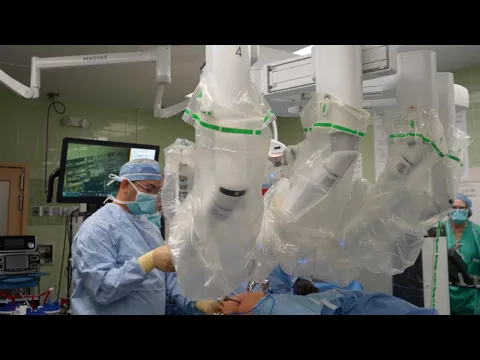
These tests indicate that the technology may evolve into more complex functions in the future. However, currently, the operation remains restricted to support, always under human supervision.
This intermediate stage demonstrates that medical robotics is gradually advancing, expanding its role without replacing professionals.
Current limitations prevent complete replacement of human professionals
Despite advancements, humanoid robots still face significant limitations. Operational autonomy is restricted, and most tasks require direct or indirect human supervision.
Moreover, hospital environments are highly dynamic, with unpredictable variables that hinder complete automation. Issues related to safety, data privacy, and cost also influence the speed of adoption.
Robots do not yet replace doctors, nurses, or caregivers, but act as complementary tools, especially in physical and repetitive tasks.
The impact of robotics could transform hospital routine in the coming years
The introduction of humanoid robots is likely to gradually alter the dynamics within hospitals. With the automation of logistical tasks, healthcare professionals can dedicate more time to direct patient care.
This change may increase operational efficiency and improve the quality of care, especially in overloaded systems.
In the long run, the integration between humans and robots may redefine roles within the healthcare field, creating new work models and requiring new skills from professionals.
Artificial intelligence enters a new era of direct interaction with humans
The advancement of humanoid robots represents a structural change in the evolution of artificial intelligence. The focus shifts from merely processing information to including the execution of actions in the physical world.
This movement expands the reach of technology, allowing applications in sectors that go beyond the digital. Healthcare is one of the first fields to adopt this transformation, but the trend extends to industry, services, and home care.
The ability to interact physically with the environment places AI on a new level, bringing it closer to functions that were previously exclusive to humans.
And you, do you believe that humanoid robots will become common in hospitals in the coming years?
Leave your opinion in the comments and tell us if this technology can transform the way patient care is provided in the future.








Seja o primeiro a reagir!