





 Portuguese
  English
  Spanish
  6 min of reading
  0 comments


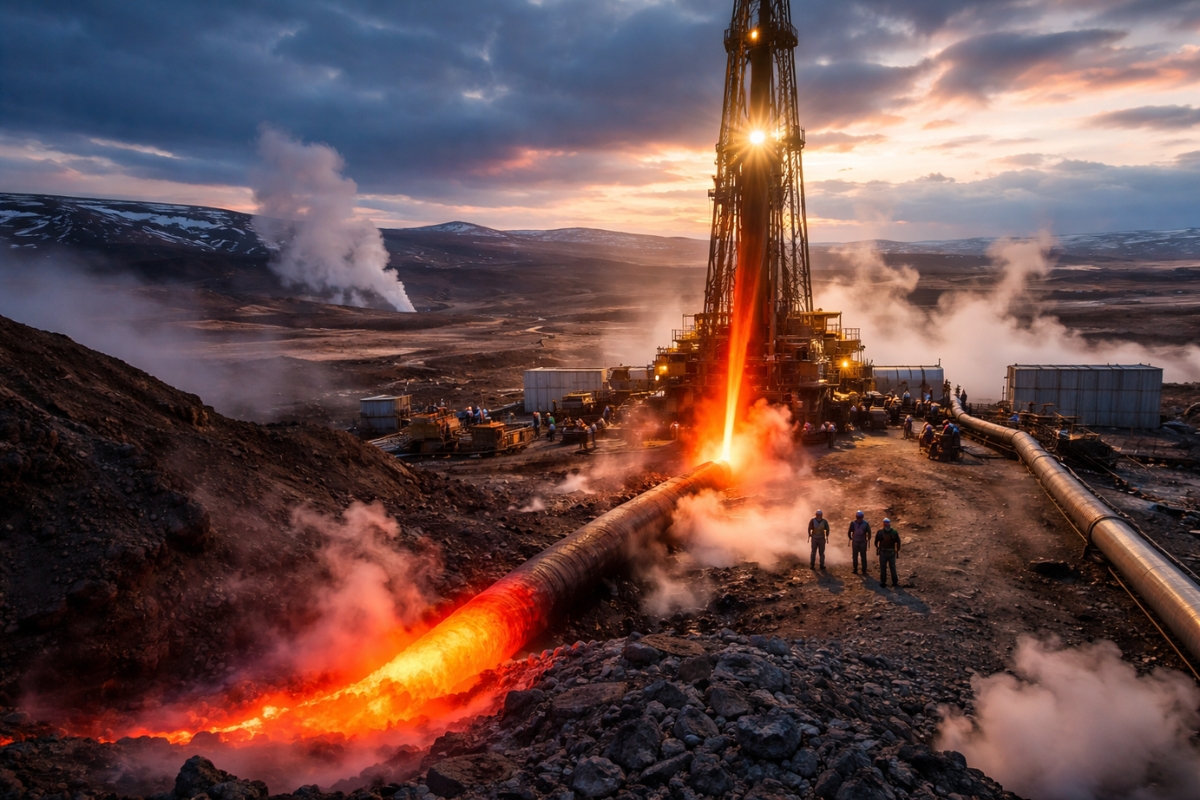
What seemed like a technical error in Iceland ended up revealing something much larger: the possibility of using magma chambers as a basis for high-temperature geothermal systems, with constant generation and enormous energy potential.
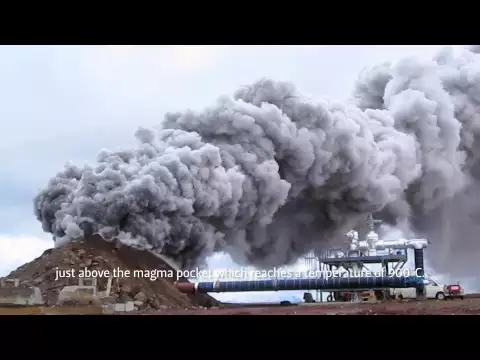
In 2009, drilling in the Krafla geothermal field in Iceland led engineers to accidentally reach molten rock at a surprisingly shallow depth: only 2,100 meters. The episode, which at first could sound like a high-risk error, ended up becoming one of the most fascinating discoveries in modern geology.
The material extracted from this extreme contact cooled rapidly and turned into volcanic glass. This process preserved valuable clues about the Earth’s interior and provided scientists with a rare opportunity: to directly analyze the physical and chemical conditions of an active magma chamber, something that normally remains hidden beneath the Earth’s crust.
The accident in Krafla that became a historical scientific discovery
The drilling took place in the Krafla geothermal system, one of the most studied volcanic areas in Iceland. The original goal was not to reach magma, but to explore the geothermal potential of the region. However, upon finding molten material so close to the surface, the operation completely changed its significance.
-
Discovery of a 15-kilometer labyrinth beneath the buildings of Rome raises alarm for collapses and reveals the largest underground network ever found in the Italian capital.
-
A rare storm phenomenon in the United States alerts meteorologists worldwide due to four different forms of water falling from the sky, which freeze immediately upon touching the ground, poles, cars, or trees.
-
He has been using a wheelchair for almost 10 years, lives alone, is independent, and decided to become a delivery driver for an app: Samuel makes up to 6 deliveries a day, covering routes of 1 km in his wheelchair and has even managed to do 2.5 km in a single run.

-
An island of 7,500 people received 38,000 bananas by mistake, was left unsure where to store everything, and turned the error into a viral case with donations, hustle, and fruit overflowing everywhere.


Instead of causing a catastrophe, as many initially feared, the incident opened an unprecedented window into the planet’s interior. From then on, researchers began to understand much more accurately how magma behaves, how it is stored in the depths, and how it reacts when there is human intervention, such as in the case of deep drilling.


Volcanic glass: the “time capsule” hidden beneath the Earth’s crust
One of the most impressive aspects of the episode was the formation of fragments of volcanic glass. According to volcanologist Ben Kennedy from the University of Canterbury, these fragments act as true “time capsules” because they preserve records of the conditions that existed at the moment the magma was reached.
Thanks to this material, scientists were able to investigate pressure, temperature, and gas composition in an active volcanic environment with an unprecedented level of detail. Instead of relying solely on indirect models, the research began to include physical evidence coming directly from the magma zone, greatly enhancing the reliability of the analyses.
What scientists discovered inside the magma chamber
The most recent study, published in the journal Nature, revealed that the Krafla find was not just curious: it has profound implications for Earth science and the future of energy. The analysis of the recovered materials allowed for the reconstruction of how magma accumulates and circulates beneath active volcanic systems.
The gases trapped in the volcanic glass also provided unprecedented information about the internal dynamics of volcanoes. This helps to better understand how these systems evolve, what signs precede possible eruptions, and how underground processes can be monitored more efficiently in areas of intense geological risk.
Pressure, temperature, and gases: the technical data that makes the case so valuable
The great scientific value of the discovery lies in the type of information preserved. Under normal conditions, directly measuring the parameters of a magma chamber is extremely difficult because these structures are buried in hostile environments, with extremely high temperatures and intense pressures.
In the case of Krafla, researchers were able to extract concrete evidence about the physical state of the magma and the composition of the gases dissolved in it. This data is crucial for modeling the behavior of magma reservoirs, refining volcanic activity predictions, and improving the safety of populations and infrastructures located in volcanic regions.
How this discovery can improve eruption prediction
Understanding how magma is stored underground and how it responds to external disturbances can significantly increase the accuracy of eruption prediction models. This is because eruptions depend not only on the presence of magma but also on internal pressure, gas release, and the interaction between rocks, fluids, and heat at depth.
By studying materials coming directly from a magma chamber, scientists gain a much more solid foundation for interpreting seismic signals, ground deformations, and gas emissions. In practice, this can contribute to more efficient alert systems and safer urban and energy planning in volcanic areas.
Geothermal energy enters a new era
In addition to the scientific impact, the discovery has reignited interest in an ambitious energy frontier: high-temperature geothermal energy. Direct contact with zones near magma suggests that it may be possible to harness extreme heat continuously, with enormous generation capacity and potential for large-scale renewable energy production.
The most striking point is that the 2009 drilling practically demonstrated that this type of access can occur without necessarily triggering a disaster. This reinforces the hypothesis that future installations could be specifically designed to explore magma chambers in a controlled manner, transforming extreme underground heat into electricity consistently.
A source of continuous and high-capacity energy
Unlike intermittent renewable sources, such as solar and wind, geothermal energy has the advantage of offering continuous production. When associated with zones of extreme heat, such as those near a magma chamber, its potential becomes even more impressive, both in efficiency and energy density.
It is precisely this that has placed Krafla in the spotlight. The case suggests that geological reservoirs linked to magma can function as a lasting energy base, capable of providing intense heat for long periods. In other words, it represents a promising route for generating clean, stable, and high-power energy.
Why Iceland is in the right place to lead this technology
Iceland possesses unique geological characteristics for this type of advancement. The country is situated over a region of intense tectonic and volcanic activity, making the heat from the Earth’s interior more accessible than in much of the planet. Therefore, the Icelandic territory is already a global reference in geothermal utilization.
Krafla, in particular, represents a perfect natural laboratory to study the interaction between deep drilling, magmatic activity, and energy production. What happened there in 2009 can serve as a basis for future technologies capable of transforming volcanic areas into strategic hubs for highly efficient renewable generation.
The impact for other volcanic countries, such as New Zealand
The implications of the discovery are not limited to Iceland. Countries with strong geological activity, such as New Zealand, can directly benefit from the knowledge generated from Krafla. In these regions, the combination of energy demand and the presence of volcanic systems makes deep geothermal energy a particularly attractive alternative.
According to researchers, mastering safe drilling in such extreme environments could open a new chapter for the global energy matrix. If the technology advances, volcanic territories could cease to be seen merely as areas of risk and instead occupy a central position in the production of high-intensity renewable energy.
What began as an unforeseen event may redefine the future of energy
What seemed to be just a drilling accident ended up revealing something much larger: a novel way to access information about the Earth’s interior and, at the same time, a possible key to expanding clean energy generation in the future. Few events connect basic science, geological safety, and energy innovation so directly.
Krafla showed that magma is not just a geological threat or a symbol of the destructive power of volcanoes. Under certain conditions, it can also be an extraordinary source of knowledge and an invaluable energy resource. And all indications are that 2009 was just the beginning of this story.






Seja o primeiro a reagir!