





 Portuguese
  English
  Spanish
  5 min of reading
  2 comments


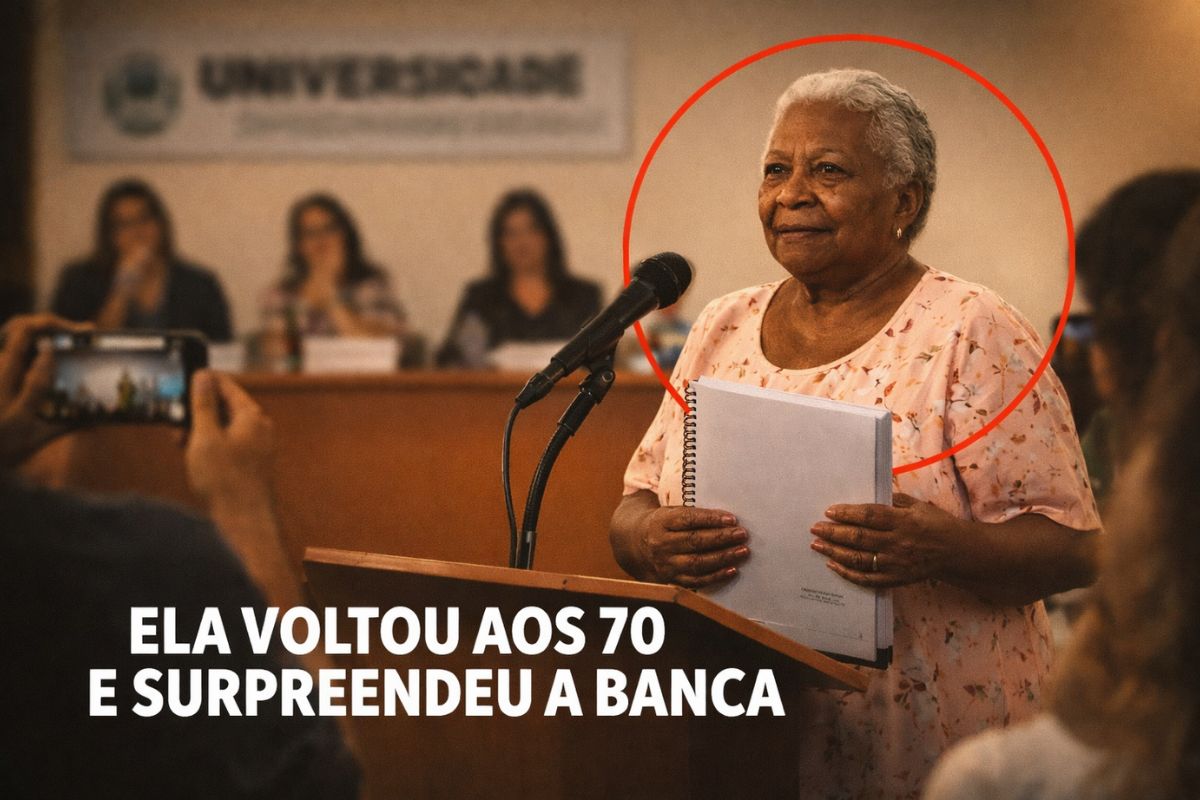


70-Year-Old Woman Returns to University After Decades Away from School, Defends Autobiographical Thesis at UFNT on Racism, Memory, and Resistance, Is Approved with Honors and Becomes a Reference in Field Education, Moving Judges, Colleagues, and Families with Her Life Reversal, in a Packed Auditorium, Emotional and Attentive.
A 70-year-old woman transformed the Babaçu Auditorium at the Federal University of Northern Tocantins (UFNT) into a stage for historical reparation. Before professors, colleagues, and family members, Maria de Fátima Abade Barbosa defended her Final Degree Project (TCC) in Field Education – Arts, after returning to school decades after being excluded from formal education.
Guided by Professor Iara Rodrigues da Silva, Maria de Fátima presented the work titled “It’s Never Too Late to Learn: The Life Story of a Black Woman Who Was Excluded from the Educational Process”, an autobiographical memoir that reconstructs her trajectory as a black peasant woman, daughter of a babaçu coconut breaker, and now becomes one of the most notable voices in Field Education at UFNT.
Memory, Resistance, and Rewriting of a Life

The TCC of the 70-year-old woman is not just an academic requirement. In the text, Dona Maria de Fátima narrates how poverty, racism, and the condition of being a black peasant woman distanced her from school in childhood, pushing the girl into work and social invisibility.
-
China is building a city in Brazil: a complex with an investment of R$ 5.5 billion comes to light, but allegations involving workers draw attention.

-
While Argentina buys old war equipment, Brazil is keeping an eye open and joins the select group of nations with advanced military technology by investing $5.2 billion, producing 36 Gripen fighters in the country, and reducing operational costs.

-
Brazil on alert? Why invading Brazil is a NIGHTMARE for the USA: 8.5 million km², 213 million inhabitants, Amazon covering 60% of the territory, trillion-dollar war, and resistance that even 13,000 aircraft could not control.

-
How to build a floating island from scratch with reeds, giant blocks, and stakes in the lake in a process that needs to be repeated almost every day.

By returning to her studies in maturity, she transforms these wounds into a tool for critical analysis.
The memoir rescues the struggle of babaçu coconut breakers, the harshness of rural life, the resilience of black women, and the role of education as a path to reexistence, autonomy, and the reconstruction of dignity.
Each chapter connects personal memories to collective processes, showing how a biography can illuminate the history of an entire people.
Historical Document for Field Education
The examining board, composed of Professors Lindiane de Santana and Mara Pereira da Silva, highlighted that Maria de Fátima’s text transcends the traditional format of a TCC.
For them, the memoir solidifies as a historical, formative, and political document, capable of dialoguing with future generations of students, researchers, and educators at the university.
The evaluators emphasized that the work symbolizes the collective struggle of black and peasant women, echoing ancestry, faith, and freedom. By recognizing the narrative of this 70-year-old woman as an act of resistance, the board reinforced the importance of the university welcoming stories that have long been excluded from books, official archives, and classrooms.
Academic Partnership That Becomes Community Building
One of the most discussed points during the defense was the participation of student Vinicius Maciel, a colleague from the Field Education – Arts program.
He acted as an active collaborator in organizing and writing the memoir, helping to structure the narrative in a careful and sensitive manner.
This partnership transformed the TCC of the 70-year-old woman into a truly community-driven construction. The writing process involved lengthy conversations, revisions, read-aloud sessions, and attentive listening to Dona Fátima’s memories, reinforcing the idea that learning is a collective gesture.
The course thus reaffirms its commitment to methodologies that acknowledge popular knowledge, life experiences, and orality as legitimate sources of knowledge.
The Advisor’s Perspective on a Journey of Courage
For Professor Iara Rodrigues, mentoring the work meant accompanying a journey marked by courage, memory, and ancestry.
Throughout the research, she witnessed the 70-year-old woman transform painful memories into critical reflection and pedagogical potential, demonstrating that the university can be a place of healing and recognition.
The advisor emphasized that Dona Maria de Fátima’s presence in the Field Education program strengthens the very essence of public university, which becomes more inclusive when it opens space for students who have been historically excluded.
In this context, the memoir becomes an example of how academic writing can simultaneously analyze and repair social injustices, while maintaining a connection to the concrete lives of individuals.
Approval with Honors and Symbol of Historical Reversal
At the end of the presentation, the TCC was approved with honors, to the applause of colleagues, faculty, and family. The moment was marked by visible emotion, not only for the individual achievement of the 70-year-old woman, but for what she represents for Field Education and for the university.
About to become licensed in Arts, Dona Maria de Fátima is seen as a symbol of historical reversal.
Her journey shows that, even after decades away, it is possible to return to school, earn a diploma, and transform pain into political, pedagogical, and emotional strength.
The message echoing from the Babaçu Auditorium is clear: it’s never too late to learn and rewrite one’s own story.
Field Education Strengthened by the Voices of Those Who Return to Study
UFNT, through the Licentiate in Field Education – Arts and the Center for Education, Humanities, and Health, reinforces with this defense the commitment to a formation that dialogues with traditional knowledge, the territory, and the realities of the field.
Cases like Maria de Fátima’s show that access, retention, and appreciation of diversity policies can change destinies.
By highlighting the story of this 70-year-old woman, the university sends a message to other rural workers, black women, children of coconut breakers, and people who interrupted their studies: the door to education remains open.
And you, do you know any stories of people who returned to study later in life and completely transformed their own lives?






Já houve outras duas depois de dona Fátima….uma de 86 e uma de 90
Parabéns a Dona Maria , e aos professores e orientadores. A educação muda pessoas pessoas mudam o mundo.