





 Portuguese
  English
  Spanish
  5 min of reading
  0 comments


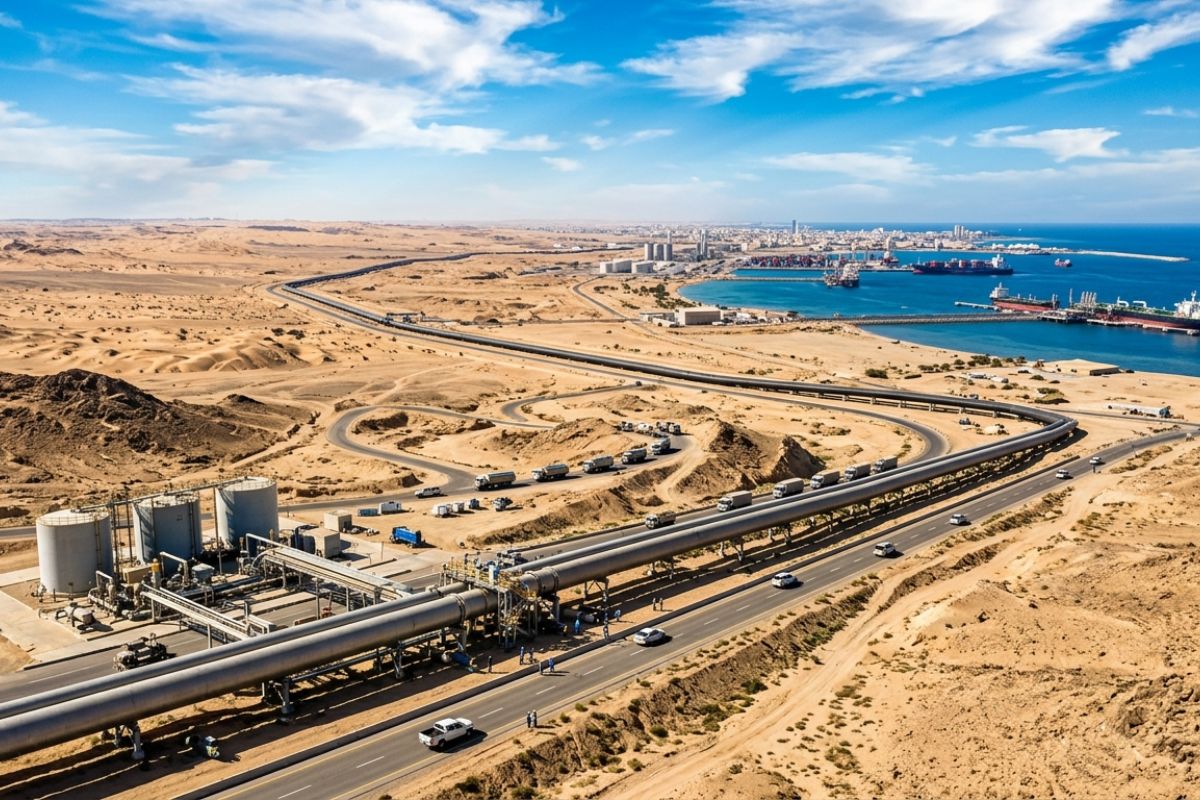
With oil under threat in the Strait of Hormuz, Petroline, the East-West pipeline of Saudi Arabia, gains significance by sending oil to the Red Sea near 7 million barrels per day
There is a point on the map where the whole world holds its breath: the Strait of Hormuz. In some stretches, it is just over 30 km wide, and through it passes about 20% of all the oil consumed on the planet. When tensions rise, with conflicts between Iran and the United States, attacks on ships, and threats of blockade, the risk shifts from regional to global.
If Hormuz closes, the effect is immediate: oil prices rise, logistics chains freeze, and countries go on alert. It is in this scenario that a strategic infrastructure built decades ago comes back to the center of the game: the East-West pipeline of Saudi Arabia, known as Petroline, a land route created to reduce dependence on this chokepoint.
Why Hormuz is the most dangerous chokepoint for oil on the planet
The Strait of Hormuz concentrates a decisive volume of global oil. When the corridor is under threat, the market understands that supply may fail, even if only for a few days. And a few days are enough to spread pressure on prices, freight, and risk.
-
Scientists restore seagrass meadows in the open sea.

-
Scientists find about 1 million giant live eggs hatching in an active underwater volcano, discover a natural furnace on the ocean floor, and reveal one of the most unlikely nurseries ever seen in the ocean.
-
Scientists launched a bait camera to the bottom of the Pacific Ocean and saw something that no one expected.
-
Is a smart plug worth it in a regular home? What does it offer: turns on and off via smartphone, creates routines by schedule, prevents forgotten devices, sometimes monitors consumption, and improves habits without renovation or miracles.


That’s why any alternative that allows maintaining the flow of oil outside of Hormuz gains geopolitical value. And this is exactly where Petroline comes in.
What is Petroline and how does it connect the Gulf to the Red Sea

To understand the structure, one must look at the axis of the map: on one side the Persian Gulf, on the other the Red Sea. Between them, a stretch of desert crosses Saudi Arabia from east to west. Along this route is the East West Pipeline, the East-West pipeline, with about 1,200 km in length, connecting the oil fields of eastern Saudi Arabia to the port of Yanbu, on the Red Sea.
For years, it served as a strategic alternative. Now, with rising tensions, it has been used more intensively. It is not just a pipeline; it is a land route capable of maintaining oil exports even when the sea becomes uncertain.
How the Tanker War in the 1980s changed the oil calculus
The logic of the project arises in a specific historical context. During the Iran-Iraq war in the 1980s, the episode known as the Tanker War showed how maritime routes could be interrupted with relative ease, directly affecting global supply.
It was in this scenario that Saudi Arabia decided to create a land alternative outside the direct reach of naval blockades. Thus, the East-West pipeline was conceived as a contingency, a plan B for crises. Today, this plan B becomes the main asset when oil enters risk mode.
The engineering behind a 1,000 km oil corridor in the desert

Operating an oil corridor of this size in the heart of the desert is not just a matter of scale. The environment imposes high temperatures, thermal variations throughout the day, and soils with variable geotechnical behavior. In more stable areas, stabilization measures and accommodation control are implemented. In rocky areas, specific excavation and settling techniques are required.
The pipes are described as high-strength steel, with anti-corrosive coatings and constant integrity monitoring. The assembly involves field welding, integrity testing, and commissioning stages before operation. It is a type of infrastructure that only works with technical discipline and constant verification routines, because oil transportation does not tolerate improvisation.
Pumping stations, automation, and fine control of pressure and flow

A central element of Petroline lies in the pumping stations distributed along the route. They maintain the continuous flow of oil for hundreds of kilometers, compensating for load losses and ensuring stability in transportation.
These stations operate with a high level of automation, integrated with systems that monitor pressure, flow, and operational conditions in real-time, allowing for dynamic adjustments according to demand. In a long system, small variations at one point can generate cumulative impact over hundreds of kilometers, which is why control needs to be precise and the response needs to be quick.
Safety and maintenance: oil only flows if integrity is up to date
As a strategic asset, there is continuous monitoring along the route, with layers of surveillance and operational control. Additionally, maintenance is treated as a critical factor because pipelines of this size operate in a practically uninterrupted regime.
Sections of the pipeline are evaluated with internal inspection tools, the instrumented pigs, capable of identifying corrosion, deformations, and thickness variations along the pipeline. These inspections build detailed integrity histories, allowing for preventive interventions before a failure appears critically. On an oil route, maintenance is geopolitical stability disguised as industrial routine.
Capacity and strategic role: why Petroline becomes a “weapon” when oil enters crisis
Reports indicate that Petroline has an operational capacity of around 7 million barrels per day, often cited as the approximate technical limit of the project. In times of heightened tension, the operation is used to redirect significant volumes of oil, reinforcing its role as an alternative to the Strait of Hormuz.
The central point is repositioning. Instead of operating merely as a secondary route, Petroline becomes more actively incorporated into logistical planning, functioning as a real alternative in a high-risk scenario. This requires integration with port terminals and coordination with global export flows. When Hormuz threatens to close, oil needs a path, and the path becomes power.
What changes for the world when there is a route outside of Hormuz
Petroline does not eliminate dependence on Hormuz, but it reduces exposure and increases flexibility, especially via the Red Sea. The existence of alternative routes helps mitigate interruption risks and can reduce extreme volatility spikes, even if it does not stabilize the international oil market on its own.
In the end, the message is straightforward: more than a project, Petroline is a strategic decision built over time. When oil becomes a global risk, engineering and logistics cease to be backstage and become geopolitical tools.
Do you think a land route like Petroline can really absorb the shock of oil if the Strait of Hormuz closes, or does the world still freeze the same way?





Seja o primeiro a reagir!