





 Portuguese
  English
  Spanish
  7 min of reading
  0 comments


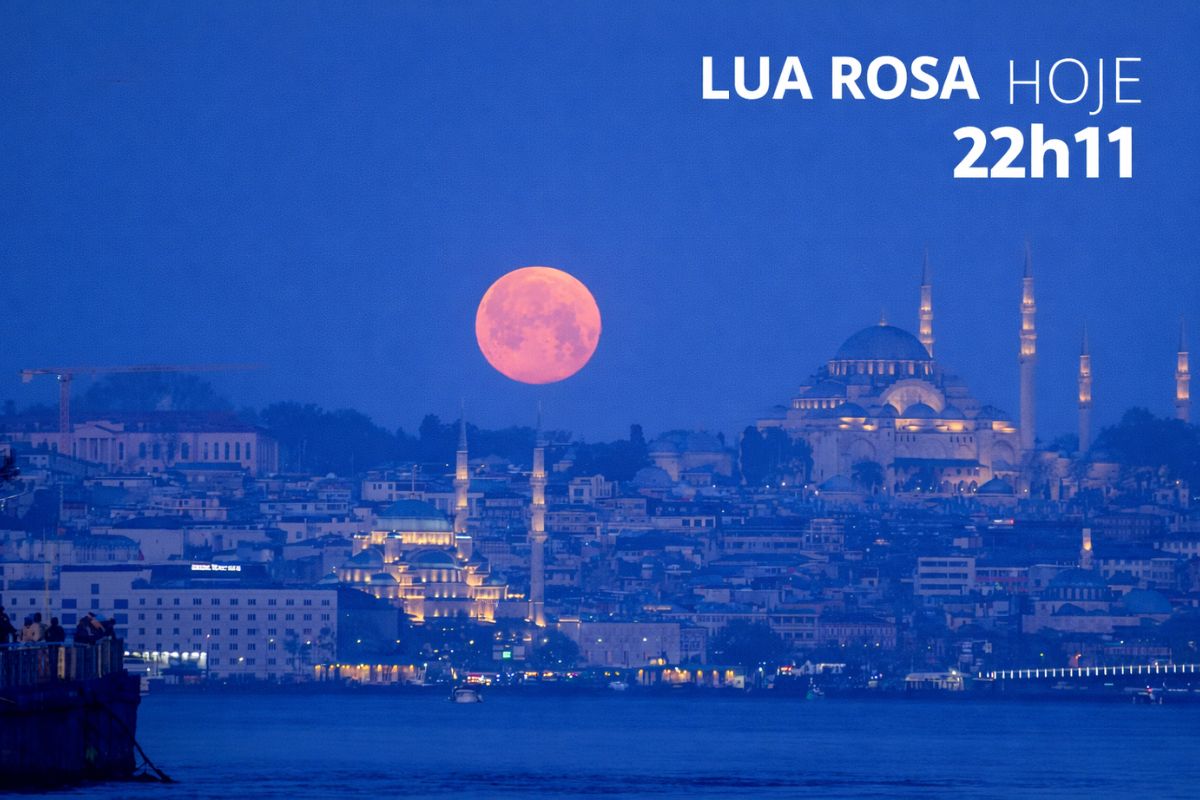
The Pink Moon of April 2026 is the full moon this Wednesday and also the Paschal Moon that determines the date of Easter, but it is not a supermoon and does not change color: the name comes from the blooming of a wildflower in the United States called Phlox subulata.
Anyone looking at the sky on the night of this Wednesday, April 1, 2026, will find the Pink Moon in its fullness. According to the National Institute of Meteorology (Inmet), the full moon of April reaches its peak at 11:13 PM Brasília time. The phenomenon marks the first full moon of autumn in the Southern Hemisphere and spring in the Northern Hemisphere, being visible to the naked eye throughout Brazil. But before going out expecting a pink moon in the sky, it is necessary to understand what is really behind this name.
According to the G1 portal, the truth is that the Pink Moon does not change color. It will remain the same silvery, golden, or white tone as always, depending on atmospheric conditions. The name is a legacy from Native American peoples and refers to the blooming of a wildflower called Phlox subulata, commonly known as “moss pink,” which covers the ground with pink flowers at the time when the full moon of April appears. The history, recorded by the Old Farmer’s Almanac, reveals a naming tradition that connected lunar cycles to the transformations of nature. And this full moon is more special than it seems: besides being the Pink Moon, it is the Paschal Moon that determines when Easter is celebrated, and it is not a supermoon, which means it will appear slightly smaller than full moons that are closer to Earth.
Why is it called Pink Moon if it doesn’t turn pink
The answer lies in a tradition that existed long before modern astronomy cataloged celestial phenomena. Native peoples of North America named each full moon of the year based on what was happening in nature around them.
-
Discovery at USP reveals how Brazilian arnica can revolutionize the production of silver nanoparticles with less environmental impact.

-
Harvard scientists have created a tissue exoskeleton that does not look like an exoskeleton, with no rigid parts and reduced weight, using flexible cables and miniaturized motors to assist the ankle and hip, reducing the effort of walking by up to 23% in controlled tests.

-
The Caspian Sea intrigues scientists as it is neither officially a sea nor a lake: the largest lake on the planet holds a hybrid crust, submerged cities, mud volcanoes, and billions of barrels of oil hidden at the bottom.

-
Why did the sky turn blood red in the west of Australia and it wasn’t sunset? Discover what is behind the change that took over the horizon for miles.


The full moon of April was named Pink Moon because it coincided with the blooming of Phlox subulata, one of the first wildflowers to color the ground in the eastern United States after winter. It was, therefore, a seasonal landmark: the name celebrated the arrival of spring, not the appearance of the satellite.
This same logic gave rise to all the other traditional names of full moons throughout the year: the Snow Moon in February, the Worm Moon in March, the Flower Moon in May, and so on. Each name served as a natural calendar.
The Pink Moon of April was also called the Breaking Ice Moon by the Algonquins, the Moon when Rivers Become Navigable by the Dakotas, and the Frog Moon by the Cree, each people observing a different sign of the same season. What they all had in common was using the full moon as a compass to understand the cycles of the earth.
What time to see the Pink Moon and how to observe it in Brazil
The peak of the Pink Moon of 2026 occurs at 11:13 PM this Wednesday, April 1, according to Inmet. The full moon can be observed throughout Brazilian territory, as long as the sky is clear.
In practice, the satellite already appears full from the beginning of the night, as when the illumination of the lunar disk is above 98%, the visual difference to 100% is practically imperceptible to the naked eye.
For those who want to enjoy the observation, no special equipment is necessary. The Pink Moon can be seen with the naked eye. The ideal is to find an open location, away from the artificial lighting of cities, and observe shortly after sunset.
The most photogenic moment is usually right after the moon rises, when it appears close to the horizon and takes on a golden or orange hue due to the scattering of light in the atmosphere. This effect, known as the Moon illusion, makes it appear larger than it actually is. Throughout the night, as it rises in the sky, the Moon returns to its usual white or silvery appearance.
The Pink Moon of 2026 is not a supermoon, and that makes a difference
One point that can cause confusion is the difference between a regular full moon and a supermoon. The Pink Moon of April 2026 is not a supermoon. A supermoon occurs when the full moon coincides with perigee, the point in the orbit where the satellite is closest to Earth.
On these occasions, the moon appears in the sky about 14% larger and 30% brighter than at apogee, when it is farthest away.
Since the full moon of April does not occur near perigee, attentive observers may notice that it will appear slightly smaller and less luminous than the supermoons that occurred in January and will occur in November 2026.
This does not take away from the beauty of the phenomenon. The full moon is the only phase in which the satellite is visible for practically the entire night, rising near sunset and setting close to dawn. In 2026, the year will have 13 full moons, one more than usual.
In May, there will be two full moons in the same month: the second one is called Blue Moon, another name that also has nothing to do with the actual color of the satellite. For those wondering if they missed any supermoons: the closest to Earth in 2026 will occur only in December, at a distance of 356,740 kilometers. Therefore, the difference between the Pink Moon and a supermoon lies in the orbital distance, not in the visual brightness perceptible to most people.
The Paschal Moon determines the date of Easter, and few people know this
Besides its cultural significance related to spring and flowers, the Pink Moon of April has a practical function that most people are unaware of.
It is the so-called Paschal Moon: the first full moon after the March equinox, and it is this moon that determines when Easter will be celebrated in the Western Christian calendar. The traditional rule states that Easter falls on the first Sunday after the Paschal Moon. Since this year’s full moon occurs on April 1, Easter 2026 will be celebrated on the following Sunday, April 5.
This is one of the rare moments when astronomy, indigenous culture, and religion converge in the same celestial event.
The same Pink Moon that the Algonquins used to mark the thawing of rivers is the Paschal Moon that the Christian calendar uses to position its main celebration.
And there is a coincidence that does not go unnoticed: the Pink Moon of 2026, which is also the Paschal Moon, reaches its peak on April 1, April Fool’s Day. It may seem like a joke to say that the moon will not turn pink on the night of the Pink Moon, but that is exactly what will happen.
What comes after the Pink Moon in the sky of 2026
After the Pink Moon, the lunar cycle of April follows its normal course. The Waning Moon arrives on April 10 at 1:55 AM, marking the beginning of the gradual reduction of brightness in the night sky.
Next, the New Moon occurs on April 17 at 8:54 AM, when the satellite becomes invisible, positioned between the Earth and the Sun. It is the best time of the month to observe stars and galaxies, as the absence of moonlight darkens the sky. The Waxing Moon closes the month on April 23 at 11:33 PM.
For those who got excited about the Pink Moon, 2026 has even more spectacular events in store. In March, a total lunar eclipse was visible in the Americas. In August, a total solar eclipse will be visible in Greenland, Iceland, Spain, and Portugal.
And in May, the sky will present two full moons in the same month, with the second one receiving the title of Blue Moon, which, like the Pink Moon, has no relation to the actual color of the satellite. The lunar calendar of 2026 reserves a total of 13 full moons, four supermoons, and four eclipses.
Are you going to look at the sky today?
The Pink Moon of April 2026 will not color the sky pink. It is not a supermoon. It will not appear larger than normal. But it carries a story that connects indigenous peoples, the Paschal Moon that defines Easter, and the cycles of nature in a single celestial event visible to the naked eye throughout Brazil.
At 11:13 PM this Wednesday, when the full moon reaches its peak, you will be facing the same Pink Moon that, for centuries, announces the end of the cold and the beginning of flowers.
Are you planning to observe the Pink Moon today? Did you already know that the name came from a flower and not from the color? Let us know in the comments if you managed to see it and what the sky was like in your city.









Seja o primeiro a reagir!