





 Portuguese
  English
  Spanish
  5 min of reading
  0 comments


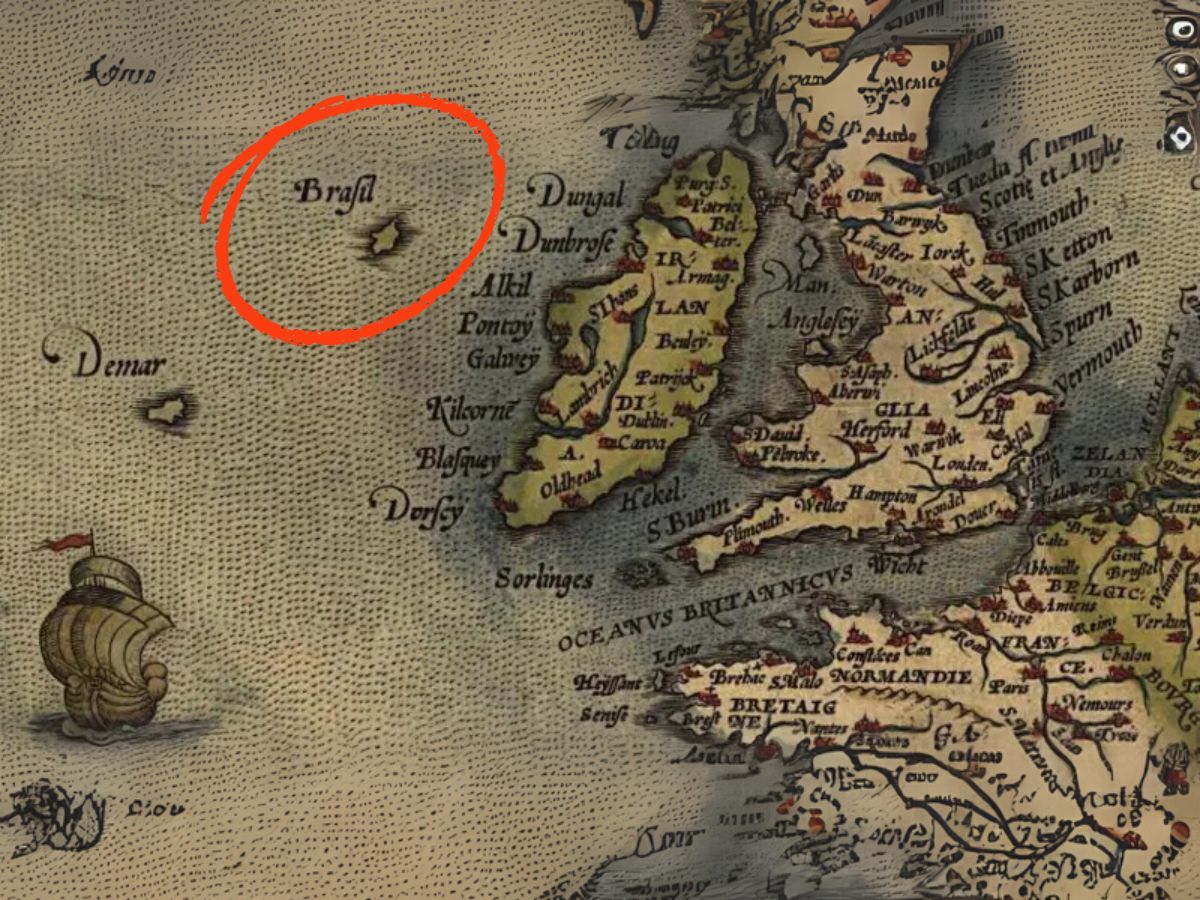
Long Before Cabral Arrived in America, Medieval Navigators Were Already Seeking the Mysterious Island of Brazil, Mentioned in European Maps Between the 13th and 19th Centuries. The Celtic Legend May Have Influenced the Name of the South American Country?
Long before the Portuguese arrived on the South American coast, the name “Brazil” already inhabited the imagination of European navigators and cartographers. It actually referred to a legendary island located west of Ireland, known by names such as Hy-Brasil or Island of Brazil, which frequently appeared on medieval maps for over five centuries. This mythical land, associated with Celtic folklore, still today raises debates among scholars about possible connections with the name of the South American country.
The Celtic Myth and the Island That Appeared Every Seven Years
In the Irish oral tradition, passed down for centuries before the arrival of Christianity, Hy-Brasil was described as a utopian paradise covered by eternal mists, visible only once every seven years. The island symbolized health, eternal youth, joy, and music — a kind of Eden lost to a people accustomed to constant rain and cold.
The legend was immortalized in poems, songs, and epic tales, such as the writings of Irish author Gerald Griffin, who described Hy-Brasil as the “island of the blessed,” “land of rest,” and “perpetual light.” The legendary Saint Brendan, a sixth-century monk, is said to have embarked on a quest for this island, feeding the Christian medieval imagination with tales of a promised land in the middle of the Atlantic.
-
YouTuber creates an excavator equipped with a giant 4.5-meter sword to challenge his brother to a rematch, and the invention quickly goes viral on social media.

-
The U.S. Army surprises the world by presenting the UH-60MX Black Hawk helicopter capable of flying without pilots, controlled by a tablet, featuring the MATRIX system, smart sensors, and full autonomy in real combat and rescue missions.

-
Heineken’s factory in Brazil produces 300 million beer cans in just 4 months, reaches 1 million hectoliters, received R$ 2.5 billion, and is already projecting an annual capacity of 5 million with sustainable technology.

-
Inside an active volcano in Africa, residents use volcanic rocks to build houses in an impressive setting.



A Constant in Old Maps
The first cartographic mention of the Island of Brazil dates back to around 1280. According to research by journalist and writer Geraldo Cantarino, author of the book Uma Ilha Chamada Brasil, it appeared on more than 120 medieval maps until the 19th century. In documents such as the nautical chart of 1424 by Zuane Pizzigano, it is positioned north of other legendary islands, like Satanazes and Antilia — also myths born from the mixture of Nordic legends and ignorance about the Atlantic.

This ocean was, in the Middle Ages, known as the “tenebrous sea,” due to the uncertainty surrounding what existed beyond the Pillars of Hercules. Returning navigators told stories of marine creatures and enchanted places, taking shape on maps filled with mermaids, monsters, and fantastical lands.
The Island of Brazil and Its Cultural Influence
In addition to cartographic representations, the mythical island left more concrete marks in Irish culture and even in modern daily life. Surnames like Brassil, Brazil, and Brazzill are still found in Ireland and the United States, a cultural legacy that Cantarino traced in phone directories during his studies in the 1990s.
The island also entered modern literature, as in the novel Finnegans Wake by James Joyce, where it appears in a modified form as “Kerribrasilian” — a fusion between County Kerry and the name Brazil.
Was Brazil Named in Honor of the Island?
Although the traditional narrative states that the name of the country is due to the tree Pau-Brasil, there are those who defend an alternative version. British diplomat Roger Casement, who served as consul in Brazilian cities like Santos and Belém, published the article Irish Origins of Brazil, in which he proposed that the name of the country may have been inspired by the Celtic island.
According to Casement, the name Brazil already existed in the European imagination long before the colonization of the Americas, as evidenced by the maps. He believed that the myth of Hy-Brasil, disseminated among Iberian sailors and merchants, may have influenced the choice of the name when the Portuguese established themselves in South American territory.
Researcher Mariana Bolfarine from the Federal University of Rondonópolis points out that this theory is widely discussed in Irish studies. In an interview with BBC Brasil, she states that “the association between the name of Brazil and the Celtic island is a consistent hypothesis, although marginalized by official historiography”.
What Do Brazilian Historians Say?
Although little known to the general public, the hypothesis of the Island of Brazil was mentioned by important names in national historiography, such as Capistrano de Abreu and Laura de Mello e Souza. According to Professor Renato de Mattos from the Federal University of Fluminense (UFF), this theory never gained traction because modern historians prefer to study social and economic processes rather than “toponymic curiosities.”
In his analysis, the very origin of the name Brazil remains shrouded in uncertainties. Cabral is said to have named the land Island of Vera Cruz, later renamed Land of Santa Cruz, and only later did the name Brazil become established. But no one knows exactly when and who made that final choice.
“What’s curious is that, 500 years later, we still don’t know who gave this name to our country. It’s quite… Brazil, right?” summarizes Cantarino with irony.
The Official Version Still Prevails
The version accepted by textbooks remains that the name of Brazil derives from “ember,” due to the reddish coloration of the wood of Pau-Brasil. Historian Gustavo Barroso, the first director of the National Historical Museum, even considered the version of the island in his work Brazil in Legend and Ancient Cartography, but concluded that the tradition of Pau-Brasil established itself out of habit and convenience.
Despite the gaps and controversies, the fascination with the Island of Brazil persists as a reminder of how legends, maps, and national identity can intersect in unexpected ways — and of how there is still much to discover about the history of the name we carry.








Seja o primeiro a reagir!