





 Portuguese
  English
  Spanish
  4 min of reading
  16 comments


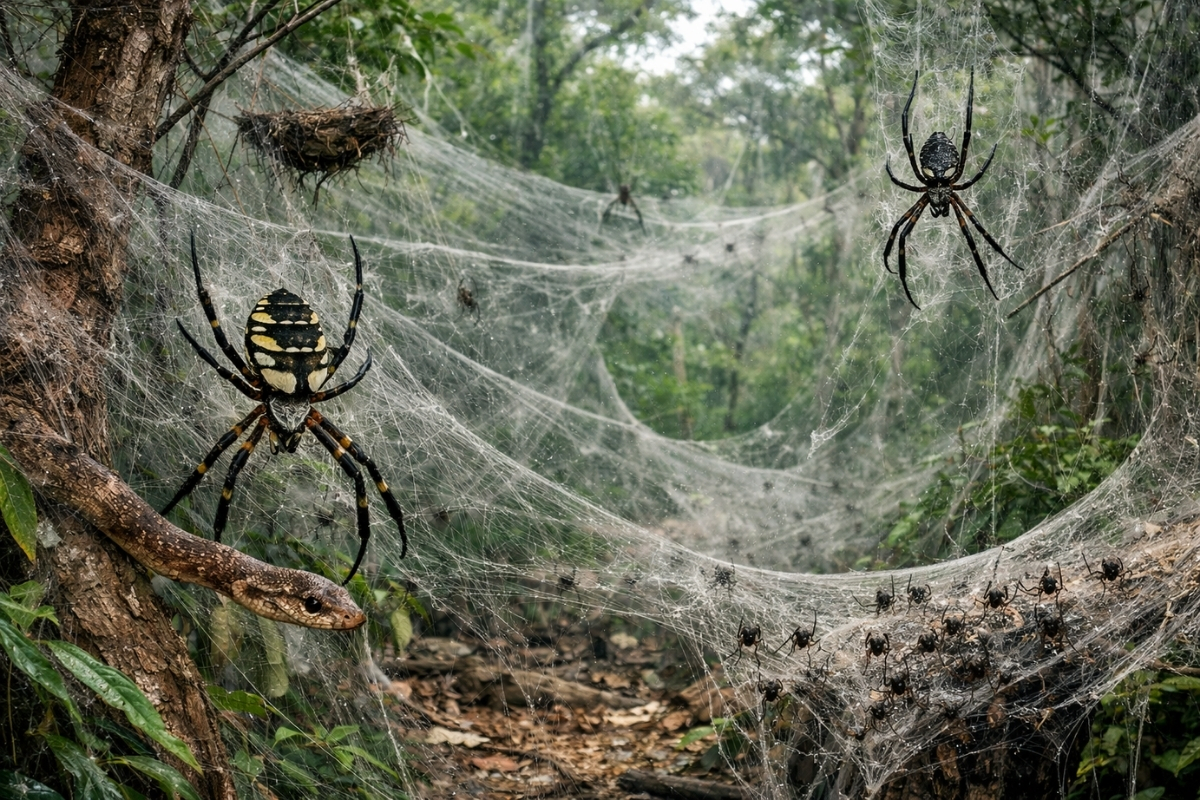


Accelerated Growth of Spiders Transforms Guam Forests and Creates One of the Most Extreme Ecological Scenarios on the Planet
The forests of Guam Island have undergone a deep transformation that has completely changed the dynamics of the local ecosystem. The environment today is marked by millions of spider webs, spread from the ground to the treetops, forming a continuous and dense scene.
This accelerated growth did not happen by chance. It arose after a dramatic reduction of native birds, which played a central role in controlling insect and arachnid populations.
With the disappearance of these birds, spiders began to occupy spaces that were previously regulated naturally, creating one of the most extreme examples of ecological imbalance ever recorded on tropical islands.
-
A strong earthquake in Indonesia affects houses and schools, causes panic, triggers a tsunami alert, and records a rise in sea level of up to 30 centimeters in some areas.

-
The Argentine government celebrates the lowest poverty rate in 7 years, but experts warn that the methodology has changed, real wages have fallen, unemployment has risen, and the number of people on the streets of Buenos Aires has increased by 57% since Milei took office.

-
7.8 magnitude earthquake in Indonesia frightens the population, triggers tsunami alert, and hits an island with over 200,000 inhabitants this Thursday.
-
Google will finally let you change that embarrassing Gmail address you created in your teenage years without losing any accounts, logins, or old emails: the feature is already available in the United States.

What Led to the Disappearance of Native Birds and Why It Affected the Entire Forest

The reduction of birds in Guam occurred after the introduction of the brown tree snake, an invasive species that spread rapidly across the island. Without natural predators and facing birds that had no evolutionary defenses against snakes, predation intensified over a few decades.
Of the 12 species of native birds, 10 were locally extinct, while the two remaining survived only in urban areas or difficult-to-access caves. This collapse virtually eliminated the entire avian community from the forests.
As a result, one of the main mechanisms of biological control in the environment disappeared, paving the way for chain changes that directly affected the spider population.
Why the Absence of Birds Favored the Extreme Growth of Spiders
The birds played a dual role in the ecosystem. In addition to directly feeding on spiders, they also competed for insects, reducing the availability of prey for arachnids.
With the elimination of this control, spiders began to find more food and fewer threats, creating ideal conditions for large-scale reproduction. This new scenario favored both the increase in the number of individuals and the expansion of webs.
The result was an abnormal growth, with species occupying all levels of the forest and exploring areas that were previously inaccessible or contested.
The Scale of the Increase in Spider Population Surprised Field Surveys

Measurements taken in the forests of the island revealed an extreme difference compared to nearby regions. During the rainy season, Guam had a spider population 40 times greater than neighboring islands such as Rota, Tinian, and Saipan.
Even in the dry season, when spider populations typically increase across the region, Guam maintained numbers 2.3 times higher. The webs of the species Argiope appensa also grew about 50 percent larger, indicating an abundance of food and low environmental pressure.
In some areas, between 1.8 and 2.6 webs per meter of observed line were recorded. Extrapolating this data for the entire forest area, the estimate reaches 508 to 733 million spiders living just within the first two meters above the ground.
Giant Webs Changed the Structure and Circulation Within the Forest
The increase in spiders transformed the experience within the forest. Trails began to be covered with silvery threads, requiring manual intervention to allow people to pass.
Some species started to build large communal webs, known as condominiums, that house dozens of spiders in a single structure. These formations can occupy areas equivalent to the size of an entire room.
Any free space between trees tends to be quickly filled, creating a visually dense and physically difficult environment to traverse.
Changes in Spider Behavior Indicate Adaptation to the New Environment
In addition to numerical growth, some species altered their behavior. Argiope appensa significantly reduced the use of stabilimenta, a zigzag structure made with opaque white threads.
This element usually serves as a visual alert for birds, preventing collisions with the webs. With the almost total absence of birds in the forest, this function has lost relevance.
The change indicates a direct adaptation to the new ecological scenario, reinforcing how the environment has come to fully favor spiders.
The Indirect Impact of Spiders on the Future of Guam’s Forest
The dominance of arachnids occurs at the same time that the forest faces increasing difficulties in regeneration. About 70 percent of native trees depended on birds to disperse seeds, a process that has practically ceased to happen.
Without dispersion, many fruits rot on the ground and several seeds do not germinate. Areas opened by fallen trees cease to be filled, altering the structure of the forest over time.
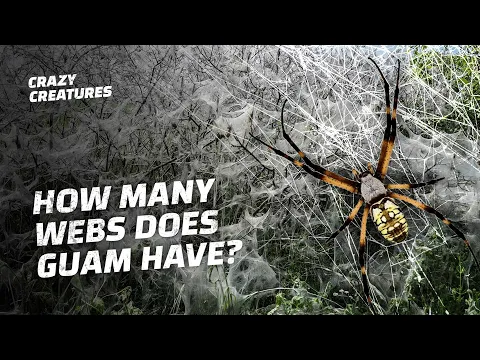

The current scenario combines hundreds of millions of spiders thriving with vegetation that is struggling to renew itself. This contrast shows how the loss of birds triggered a sequence of profound changes, transforming Guam into one of the clearest examples of ecological imbalance in island environments.
This article was prepared based on information originally released by the BBC.







AARRRMARIAA MORRO DE MEDO DE ARANHAS!!!
/Ilha Macquarie não está em colapso atualmente, mas enfrentou ameaças severas de colapso ecológico devido à caça predatória de pinguins e focas no passado, e mais recentemente, à infestação de espécies invasoras como gatos, ratos e coelhos, que causaram erosão e desequilíbrio; no entanto, programas de erradicação bem-sucedidos estão levando a uma recuperação ambiental notável, com a vida selvagem retornando, sendo hoje um exemplo mundial de restauração, embora desafios como poluição plástica persistam. (Inf. AI do Google)
Muito legal ver as várias mudanças num ecossistema vindo de uma só mudança grande, quem diria que menos pássaros criariam uma floresta que é uma rede de teias!
Check out the change of the Yellowstone eco system after introducing 31 wolves in the 90s! Its remarkable the way 1 missing factor in an eco system can throw it into a tailspin.