





 Portuguese
  English
  Spanish
  7 min of reading
  2 comments


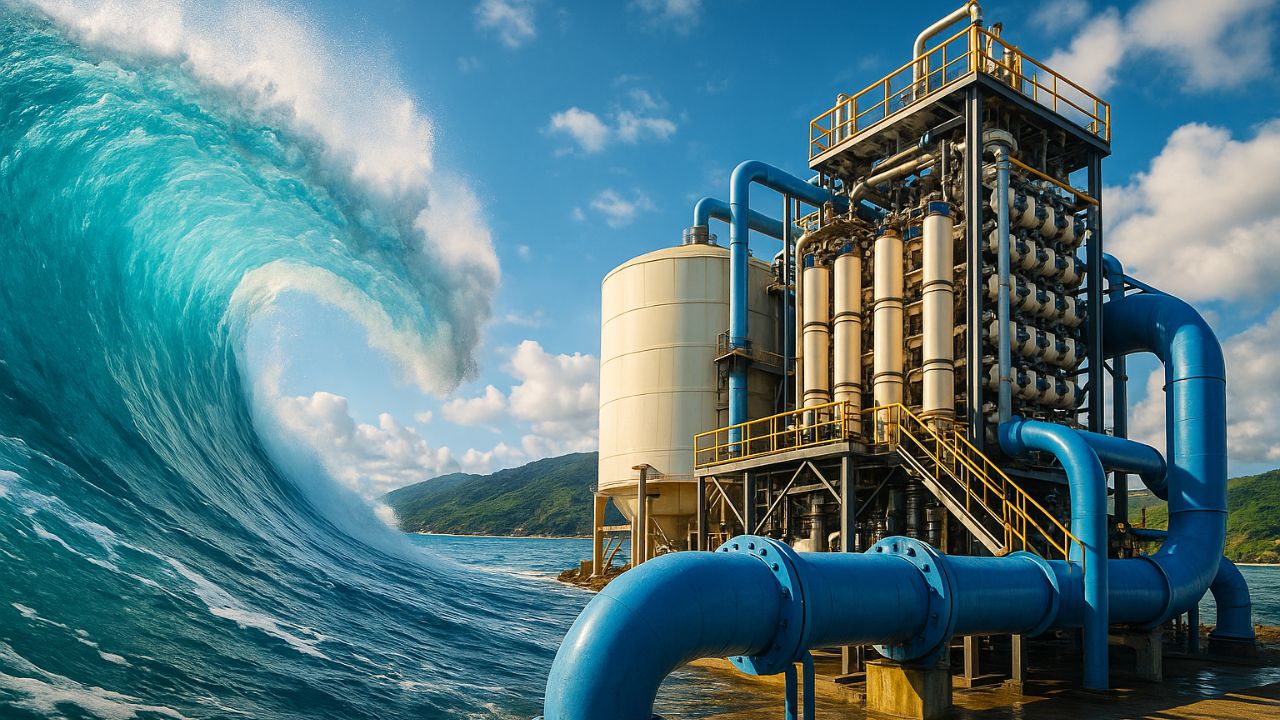


First Plant in São Paulo to Desalinate Seawater Promises to Increase the Supply to the Island by 22%, Tackle the Water Crisis, and Launch the Era of “Infinite Water” on the Brazilian Coast
Ilhabela, one of the most desired destinations on the São Paulo coast, is preparing to desalinate seawater with a pioneering plant from Sabesp that is expected to be ready by 2026 and promises to ensure drinking water precisely during periods when taps tend to run dry. The idea is to use the ocean as a strategic source of supply in a project that could change the way Brazil manages water scarcity in coastal cities.
During holidays and peak seasons, the population jumps from 35,000 to over 100,000 people, putting pressure on a system that still leaves about 8,779 residents without access to treated water. The new facility, installed at the mouth of the Água Branca stream, will have the capacity to produce 30 liters of drinking water per second, enough to supply about 8,000 people and represent an increase of approximately 22% in the current water supply on the island, paving the way for a new standard of water supply on the northern São Paulo coast.
The Hidden Water Crisis in Paradise
From the outside, Ilhabela is a postcard: crystal-clear beaches, mountains covered with Atlantic Forest, and a perfect refuge climate just a few hours from the country’s largest metropolis. However, on the inside, reality is much less romantic. The chronic scarcity of drinking water is already part of the daily lives of thousands of residents, who deal with dry taps precisely during the hottest and busiest months.
-
Luciano Hang revealed that Havan’s air fleet has already accumulated more than 20,000 landings, 10,000 flight hours, and 6 million kilometers traveled, and he says that without the planes, the company would never have grown so quickly.

-
A historical discovery in the Andes Mountains reveals a gold deposit valued at 770 billion reais hidden over 4,000 meters above sea level on the border between Chile and Argentina, and the whole world is watching.

-
With just joint compound, white glue, and pigment, you can make a homemade paint that yields double the conventional amount, saves up to 70%, and leaves the wall with a finish that no one would believe wasn’t store-bought paint.

-
Home environment can influence the brain, mood, and well-being: studies indicate an increase of up to 15% in productivity, a reduction of 12% in stress with plants, and a direct impact of the circadian rhythm on the 24 hours of the day.


During long holidays and in the summer, the island practically changes scale. The population nearly triples, going from about 35,000 permanent residents to over 100,000 people circulating through the streets, beaches, and inns. It’s as if a new city emerges overnight, demanding a volume of water that simply does not exist today. In this scenario, the concerning fact is not surprising: approximately 8,779 inhabitants still lack access to treated water.
According to the 2022 Census from IBGE, about 83.05% of Ilhabela’s population receives potable water through the general distribution network. When looking at access to public water supply services as a whole, the index drops to about 74.87%. In other words, even in one of the most coveted destinations on the coast, treated water still does not reach everyone.
Adding to this is the geographic isolation. Ilhabela is an archipelago accessible only by ferries departing from São Sebastião, which makes any infrastructure expansion more complex and costly. Despite being surrounded by water sources and one of the largest preserved areas of Atlantic Forest, the island faces a paradox: it has water all around, but struggles to transform that potential into safe and continuous supply.
The First Plant in São Paulo to Desalinate Seawater

It was against this backdrop that the state government, through Sabesp, decided to take an unprecedented step: in 2023, it launched the bidding process to build the first seawater desalination plant in São Paulo.
The choice of Ilhabela was not by chance. In addition to the local water crisis, the island serves as a perfect laboratory to test a solution that can be replicated in other parts of the Brazilian coast.
The location of the project is also strategic. The plant will be installed at the mouth of the Água Branca stream, with direct access to the sea, near urban infrastructure, and integrated into the existing supply system.
The goal is simple to explain and ambitious to achieve: transform seawater into drinking water every day, continuously and in a controlled manner.
The plant will have the capacity to produce up to 30 liters of drinking water per second, enough to supply about 8,000 people. This represents an increase of approximately 22% in Sabesp’s current capacity in the region.
The structure will include intake units, pre-treatment and filtration systems, reverse osmosis modules, remineralization stages, and finally, pumping into reservoirs that distribute water to homes, businesses, and services.
From an economic standpoint, the construction of the plant is expected to generate around 300 direct and indirect jobs, involving engineers, technicians, operators, construction workers, and support teams.
It is a project that combines infrastructure, technology, and income generation in a region highly dependent on tourism.
The project is part of the investments of the new PAC, the Growth Acceleration Program, and was prioritized for its high social impact, environmental viability, and technological innovation.
The bet is clear: if it works in Ilhabela, the model could be expanded to other coastal cities in São Paulo, and later, to regions in the Northeast that suffer from increasingly severe droughts.
How Technology Will Desalinate Seawater in Ilhabela
In practice, the Ilhabela plant will desalinate seawater using reverse osmosis technology, already applied in various countries with water scarcity.
First, the seawater is captured by underwater pipelines and undergoes pre-treatment, which removes sand, algae, sediments, and microorganisms. It’s a kind of “sieve” before the more delicate stage.
Then, in reverse osmosis, high-pressure pumps push the saline water through special membranes, which block salts and impurities. On the other side, purified water comes out, with up to 99% of the salts removed.
Next, this water is remineralized with calcium and magnesium to adjust the pH and quality for human consumption. The concentrated brine generated in the process is returned to the sea in a diluted form, with environmental control and monitoring.
The entire structure will be integrated with the Água Branca Water Treatment Station and powered by the electric grid, with studies for the use of solar panels, making the system more sustainable.
What the World Has Already Learned About Desalinating Seawater

Although the Ilhabela plant is a pioneer in São Paulo, the idea of desalinating seawater has long been a reality in other regions of the planet. Countries with arid climates or severe water scarcity have bet on this solution to ensure drinking water on a large scale.
Israel is one of the most well-known examples. The Sorek plant, located about 15 kilometers south of Tel Aviv, is considered one of the largest and most efficient reverse osmosis desalination plants in the world.
Its capacity reaches 624 million liters of water per day, a volume sufficient to supply over 4 million people daily. The impact was so significant that Israel, once highly dependent on rain, can now even export treated water to neighboring countries.
In Saudi Arabia, desert conditions have made the country the world’s largest producer of desalinated water. The Ras Al Khair plant stands out as a mega-structure that combines thermal and reverse osmosis methods to meet both population and industrial demands. Without this type of solution, several cities simply could not grow.
Australia also turned to desalination after facing a severe drought from 2001 to 2009. Coastal cities like Perth, Sydney, and Melbourne installed plants that now account for a significant share of urban water supply. In Spain, especially in Catalonia and the Canary Islands, desalination has been part of water planning for decades, helping to cope with the Mediterranean climate and constant tourism pressure.
The Ilhabela plant follows the same technical principles: use of reverse osmosis, careful pre-treatment, and environmental management of brine disposal. The big difference lies in the Brazilian context. Here, the country has the chance to learn to desalinate seawater not only out of desperation, but as a preventive strategy to diversify the water matrix before the crisis becomes irreversibly severe.
Ilhabela and the Beginning of the Era of “Infinite Water” on the Brazilian Coast
If the project works as planned, the Ilhabela desalination plant could become a true watershed in the water supply of the northern São Paulo coast. The impacts go beyond the tap of the resident. They involve water security, local economy, tourism, and, mainly, the way Brazil views the ocean itself.
Practically speaking, the plant should increase the supply of drinking water during the most critical summer periods when the population triples and the current system reaches its limits.
By leveraging an abundant source like the sea, the island reduces reliance on distant and vulnerable water sources, while gaining room to grow with more planning and less improvisation.
From an economic perspective, the construction and operation of the plant will generate jobs and services, strengthening one of the pillars of the local economy, which is tourism. With more guaranteed water, inns, restaurants, and businesses can face holiday seasons and peak times with less risk of supply collapse.
In the environmental and strategic context, the project connects to a larger scenario. In a country with over 8,000 kilometers of coastline, learning to desalinate seawater safely and sustainably can become a key piece of adaptation to climate change, which brings prolonged droughts and increasing pressure on natural resources.
Cities like Santos, Ubatuba, Florianópolis, Recife, and other coastal regions that face rapid growth and supply networks at their limits can look to Ilhabela as a case study. If the model proves efficient technically, economically, and environmentally, nothing stands in the way of a network of plants emerging along the Brazilian coast, each adjusted to local realities.
The Ilhabela plant is still surrounded by expectations and open questions, but it already has the potential to launch a new phase in water management in Brazil. Instead of seeing the sea merely as scenery, the country is beginning to treat it as an active part of the solution.
And you, do you think projects to desalinate seawater like the one in Ilhabela should spread across the entire Brazilian coast in the coming years?





Ilhabela nao precisa nada disso, se tem um lugar que tem mais água doce que la desconheço, são mais de 30 cachoeiras de porte, e outras 300 corredeiras, mas claro que aí tem corrupção e sera caríssimo essa construção e vai pesar bem no bolso do consumidor.
Os bilhões gastos na transposição do São Francisco daria para construir centenas de dessalinizadores osmoze reversa levando água do mar para todo sertão.