





 Portuguese
  English
  Spanish
  5 min of reading
  0 comments


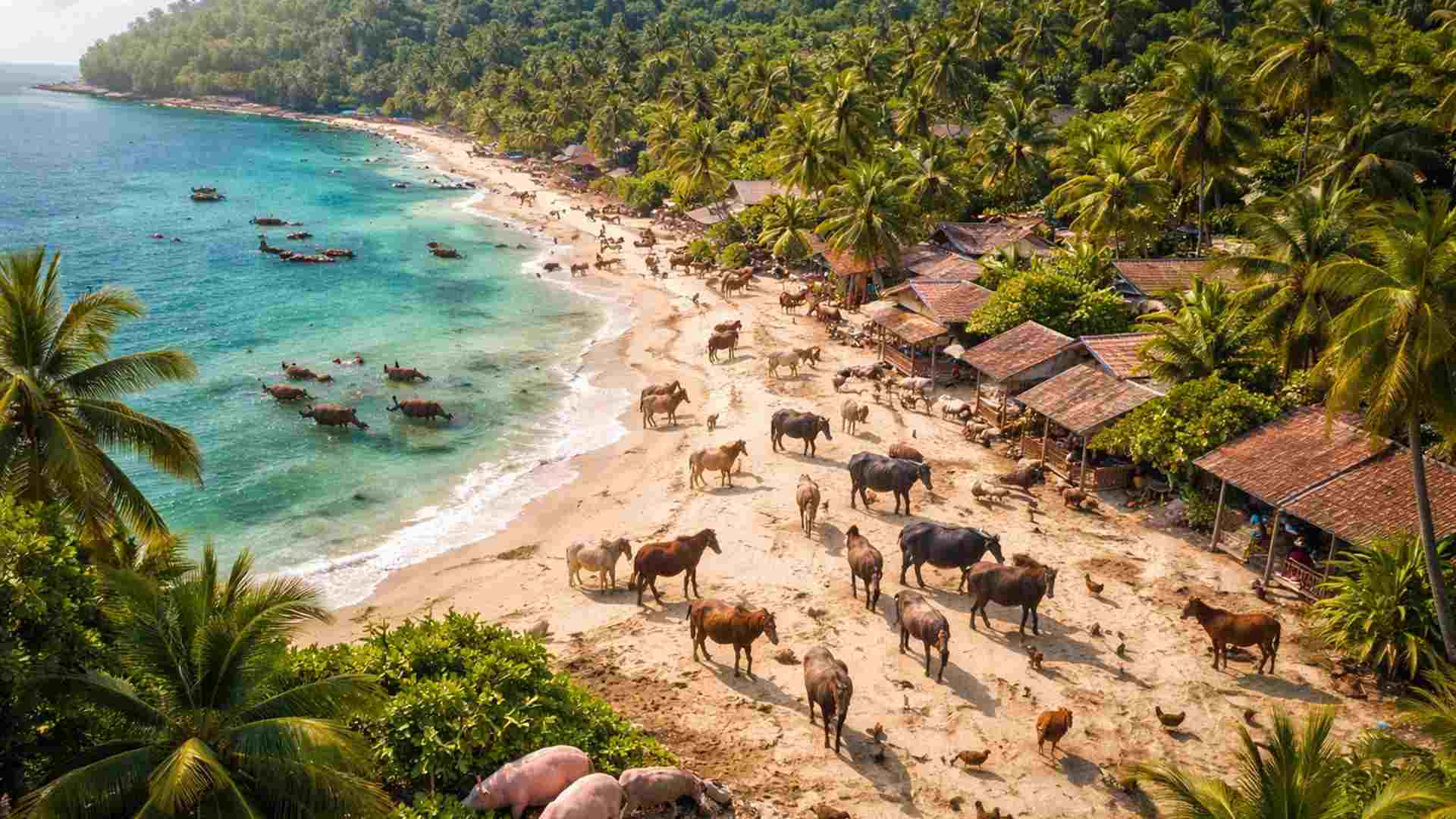
Documented Cases of Wild Islands in Canada, United States, Caribbean, Brazil, and Europe, Where Horses, Chickens, Pigs, Buffaloes, and Cows Multiplied without Control, Dominated Entire Islands, and Caused Environmental, Economic, Social Impacts and Permanent Management Challenges for Local Authorities
Wild Islands around the world present a documented and recurring phenomenon: populations of animals introduced by humans, intentionally or not, that multiplied without control and came to dominate vast areas.
In isolated environments, the absence of natural predators, coupled with favorable climatic conditions, has allowed these animals to shape ecosystems, local economies, and even public policies.
Cases of Wild Islands in Canada, United States, Bahamas, Brazil, and Europe show how historical decisions continue to have concrete effects centuries later.
-
He started running at 66 years old, broke records at 82, and is now a subject of study for having a metabolic age comparable to that of a 20-year-old, in a case that is intriguing scientists and inspiring the world.

-
Oldest tree on the planet reappears after 130 years of searches: Wattieza, 385 million years old, was 10 meters tall and had no leaves or seeds; Gilboa fossils in New York solved the mystery in 2007.

-
A 48-square-meter house assembled in hours with 4,000 bricks made of recycled plastic that does not absorb moisture, has natural thermal insulation, and costs less than 90,000 reais in a complete kit.

-
Luciano Hang revealed that Havan’s air fleet has already accumulated more than 20,000 landings, 10,000 flight hours, and 6 million kilometers traveled, and he says that without the planes, the company would never have grown so quickly.


Wild Horses Completely Occupy Sable Island, Canada

Located about 300 kilometers off the coast of the Canadian province of Nova Scotia, Sable Island is a narrow strip of sand approximately 42 kilometers long, surrounded by the Atlantic Ocean.
The site currently hosts a stable population of feral horses, estimated between 250 and 500 individuals, according to assessments by the Canadian government.
These horses descend from animals brought to the island between the 17th and 18th centuries by European settlers. Historical records indicate that the animals were introduced for use in colonization attempts, farming, and as a potential resource for shipwreck survivors, as the region became known as the “graveyard of the Atlantic” due to the high number of shipwrecks.
Without continuous human management, the horses adapted to the island’s extreme conditions, characterized by constant winds, scarcity of natural shelter, and vegetation limited to salt-resistant grasses. Studies indicate that over generations, the animals have become smaller, sturdier, and with thicker coats, characteristics that favor survival in harsh winters.
Since 2013, Sable Island has been officially protected as a National Park of Canada. Direct human interference is prohibited, and visitors can only access the area with special permission. The horses are not provided with food, veterinary care or population control, being considered an integral part of the local ecosystem.
The Island of Kaua‘i Coexists with Tens of Thousands of Loose Chickens

In the Hawaiian archipelago, the island of Kaua‘i presents one of the most well-known cases of domestic bird proliferation in urban and natural environments. It is estimated that tens of thousands of chickens and roosters roam freely around the island, occupying beaches, streets, residential gardens, parking lots, and commercial areas.
The origin of this population dates back to two distinct moments. The first occurred centuries ago when Polynesians introduced the red junglefowl, the ancestor of domestic chickens. The second happened starting in the 19th century, with the arrival of domestic chickens brought by European settlers.
The uncontrolled growth occurred after the passage of major hurricanes, such as Iwa (1982) and Iniki (1992), which destroyed coops and released thousands of birds. Without significant natural predators and with favorable weather year-round, the chickens began to reproduce freely.
Local authorities recognize difficulties in controlling the population. Measures such as large-scale capture, removal, or sterilization have proven costly and ineffective. Currently, public campaigns seek to reduce artificial feeding by residents and tourists, considered one of the main factors supporting population growth.
Swimming Pigs Transformed Big Major Cay into a Global Tourist Attraction

In the Bahamas, the small island of Big Major Cay gained international fame for hosting pigs that roam freely and swim in the sea. Popularly known as Pig Beach, the island has no permanent human population and has started receiving daily visits from tourists attracted by the unusual behavior of the animals.
The exact origin of the pigs is not consensual. Historical accounts and local investigations point to distinct hypotheses, including sailors who may have left the animals on the island as a food reserve, abandoned tourist projects, or intentional introductions to keep the pigs away from urban areas.
What is proven is that the animals quickly adapted to the environment. They learned to swim long distances and associate boats with food offerings. Currently, the pigs depend almost entirely on the food provided by visitors.
Veterinary reports and environmental agency assessments alert to problems associated with intense tourism, such as stress, inadequate feeding, and mortality episodes during low visitation periods. Despite this, Pig Beach remains one of the most photographed spots in the Bahamas, generating indirect revenue for regional tour operators.
More Than 400 Thousand Buffaloes Shaped the Economy and Culture of Marajó Island

In Brazil, Marajó Island, located at the mouth of the Amazon River, presents one of the most impactful examples of successful large-scale animal introduction. Today, the island hosts an estimated herd of between 400,000 and 800,000 buffaloes, a number surpassing the local human population.
The buffaloes were introduced in the late 19th century by farmers seeking animals capable of withstanding swampy terrain, flood-prone fields, and mangroves. The species demonstrated high adaptation to the Amazonian environment and multiplied rapidly.
Today, buffaloes are used for transportation, draught work, and the production of meat, milk, leather, and by-products. In some cities, the animals roam the streets and are part of the urban landscape.
One of the most well-known cases involves the use of buffaloes by the Military Police of Pará in rural areas of Marajó. The mounts allow access to regions where motor vehicles cannot travel, especially during the flood season.
In addition to the economic impact, the buffalo has become a cultural symbol of the island, present in gastronomy, handicrafts, and regional events.
Cows Dominate Productive Landscapes on São Jorge Island and Generate Point Conflicts in Corsica
On São Jorge Island, in the Azores archipelago, the massive presence of cows is directly linked to the local economy. The island has extensive natural pastures and concentrates one of the most traditional dairy productions in Portugal, the basis for the well-known São Jorge cheese.
Thousands of cows occupy hillsides, fields, and rural areas, integrating a regulated and monitored production system. Unlike other cases, this is not a feral population but an organized extensive farming system.
On the island of Corsica, in France, there are documented records of loose cows roaming beaches, roads, and urban areas. During certain periods, especially outside the high tourist season, these animals have taken to coastal areas, generating occasional conflicts, material damage, and temporary restrictions on beach access.
French authorities treat these episodes as localized rural management issues, rather than as a widespread ecological phenomenon across the island.
Cases Reveal Lasting Impacts of Human Introduction on Wild Islands
The examples of Wild Islands analyzed show that islands function as natural laboratories, where small human interventions can produce lasting and, in some cases, irreversible effects. The introduction of animals without natural predators or without long-term planning frequently results in populations out of control.
In some locations, such as Sable Island and Marajó, the animals have integrated into environmental balance and cultural identity. In others, like Kaua‘i and Pig Beach, management challenges continue to be debated among authorities, residents, and experts.
These cases in Wild Islands reinforce the importance of evidence-based environmental policies, especially in isolated environments, where human impact tends to be amplified over time.









-

-

-

-

-

-

400 pessoas reagiram a isso.