





 Portuguese
  English
  Spanish
  5 min of reading
  0 comments


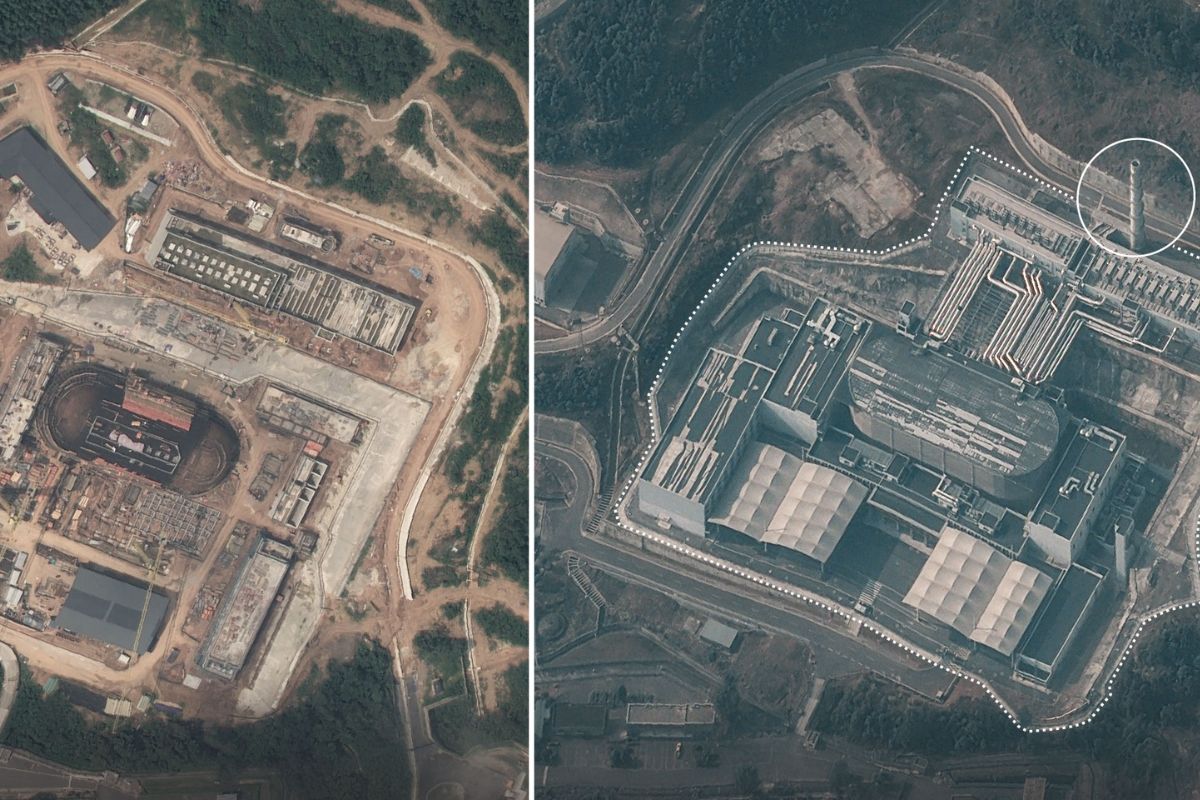
Satellite Images Show Discreet Construction in the Chinese Mountains, in Sichuan, Where Structures With Pipelines, Earth Ramps and Reinforced Perimeters Suggest Stages of the Nuclear Cycle. Analysts See Acceleration Since 2019, at a Time When International Brakes Are Weakening and Washington Calls for Including Beijing in Future Arms Agreements
In damp, fog-covered valleys in the mountains of China, satellite images show expanding nuclear facilities in Sichuan province, particularly in areas known as Zitong and Pingtong. What appears on the ground is new, but the logic is old, with buried infrastructure, reinforced perimeters, and work in silence.
However, the interpretation is far from consensus. Experts say the changes may indicate an accelerated expansion of the arsenal, but they also admit that the image alone has limits and may reflect security upgrades. The central question is whether the scale observed in Sichuan changes the strategic calculation by 2030.
Zitong and the Design of Tests That Do Not Appear on the Horizon

In the valley known as Zitong, in Sichuan, engineers have been erecting new bunkers and earth ramps, in a complex that draws attention for its fortified appearance.
-
After decades of failed attempts, Brazil is once again looking to space with an orbital rocket measuring 12 meters, weighing 12 tons, costing R$ 189 million, and scheduled for launch in 2026, in a new race to finally achieve autonomous access to orbit.

-
The Earth will plunge into a few minutes of darkness in broad daylight in August 2026, when a total solar eclipse transforms the sky into one of the most impressive astronomical phenomena in recent years.

-
How the terraforming of Mars can transform the planet: artificial aerosols can increase the temperature by up to 35°C in 15 years, creating conditions for liquid water.

-
Scientists drilled nearly 8,000 meters into the ocean floor above the fault that caused the 2011 tsunami in Japan and discovered that a layer of clay 130 million years old was responsible for making the wave much worse than any model had predicted.

A recent set is “armed” with visible pipelines, a signal associated with the handling of highly dangerous materials, according to the interpretation presented by experts monitoring the transformations of the site.
In addition to the fortified areas, there is a geometric cut that hints at the scale of the investment, an oval area described as having approximately the size of 10 basketball courts.
Bunkers and embankments suggest spaces for testing with high-powered explosives, the chemical layer that detonates to compress the core and enable the chain reaction.
Still, as physicist Hui Zhang reminds us, satellite imagery does not confirm the ultimate objective, it only reveals expansion and active construction.
Pingtong, the 360-Foot Chimney and the Message From Xi Jinping

In another valley in Sichuan, a facility surrounded by a double fence, known as Pingtong, appears as a key piece in the puzzle. Experts believe that “pits,” the metal cores of warheads, which typically contain plutonium, may be produced there.
The main building is marked by a 360-foot ventilation chimney, in addition to new openings, heat dispersers, and ongoing construction around the building.
The Pingtong complex has also been described as having undergone renovations in recent years and visible new interventions, such as air treatment equipment and heat exchange units.
Above the entrance, a slogan from Xi Jinping is said to have been applied in giant characters, visible from space, according to the description associated with the survey.
The same set of images suggests a new fenced area after 2023 and a security gate under construction.
The gesture mixes politics and engineering, and Renny Babiarz compares each nuclear site to a piece of a mosaic that, viewed together, reveals a pattern of rapid growth, with acceleration described since 2019.
What Changes When the Guardrails Disappear and No One Wants to Get Tied Down
The expansion in the mountains of China complicates the effort to resume global arms controls after the expiration of the last remaining nuclear treaty between the United States and Russia.
Washington argues that any successor agreement must include China, but Beijing has shown disinterest in binding itself to new limits, amplifying the sense of regulatory void.
In this context, Sichuan ceases to be just geography and becomes a signal. Nuclear weapons are treated as an integral part of superpower ambition, as Babiarz assessed when relating the construction to broader goals.
For Michael S. Chase, who now works at RAND, the Chinese objective would be to reduce vulnerability to U.S. nuclear coercion, something that could weigh in a crisis involving Taiwan even in a conventional conflict.
How Many Warheads, What Type of Test, and Why the Debate Became Public
The most cited numbers come from Pentagon estimates, with China expected to have over 600 warheads by the end of 2024 and on track to reach 1,000 warheads by 2030.
This is a smaller stockpile than the thousands held by the United States and Russia, but for analysts like Matthew Sharp, the pace and modernization are still a cause for concern, especially when there is no robust dialogue to reduce extreme interpretations.
The debate has also heated up with a public accusation from Thomas G. DiNanno of the State Department, who said this month that China conducted “nuclear explosive tests” in secret, contrary to a global moratorium.
Beijing rejected the allegation as false, and experts discuss how robust the evidence is. Without continuous conversation, the tendency to plan for the worst-case scenario increases, because it is difficult to separate, from the outside, technical modernization from behavior change in crisis.
The Legacy of the Third Front and the Leap After 2019 in Sichuan
The facilities in Sichuan did not arise now. They were built six decades ago as part of the “Third Front,” an initiative by Mao Zedong to protect laboratories and weapons production plants from potential attacks by the United States or the then Soviet Union.
Tens of thousands of scientists, engineers, and workers are said to have excavated the mountainous interior, creating what Danny B. Stillman described as “an internal nuclear empire.”
When tensions with Washington and Moscow eased in the 1980s, many Third Front complexes closed or shrank, and scientists migrated to a weapons laboratory in the nearby city of Mianyang. Zitong and Pingtong continued operating, but for years changes were incremental, consistent with a relatively small arsenal policy, according to Babiarz.
This period of restraint began to unravel about seven years ago, and acceleration on the ground has become clearer since 2019.
The new phase includes, in Mianyang, a large laser ignition laboratory that, according to description, may be used to study warheads without detonating real weapons.
For Zhang, some of the work in Zitong may also reflect security needs and the adaptation of warhead designs for new systems, such as submarine-launched missiles. The available evidence does not close the diagnosis, but points to an investment curve that is hard to ignore.
The story in the mountains of China, in Sichuan, is not just about new concrete in Zitong and Pingtong. It speaks of how satellite images, estimates of warheads, and political symbols of Xi Jinping fit in a moment when treaties expire and trust between powers diminishes.
The result may be a silent arms race, with little margin for error in crises.
If you had to choose an immediate point of attention, which would weigh more, the lack of agreements that include Beijing, the uncertain reading of satellite images, or the possibility that modernization might change behavior in a standoff over Taiwan? What type of transparency would you consider acceptable on such a sensitive topic?







-

Uma pessoa reagiu a isso.