





 Portuguese
  English
  Spanish
  4 min of reading
  12 comments


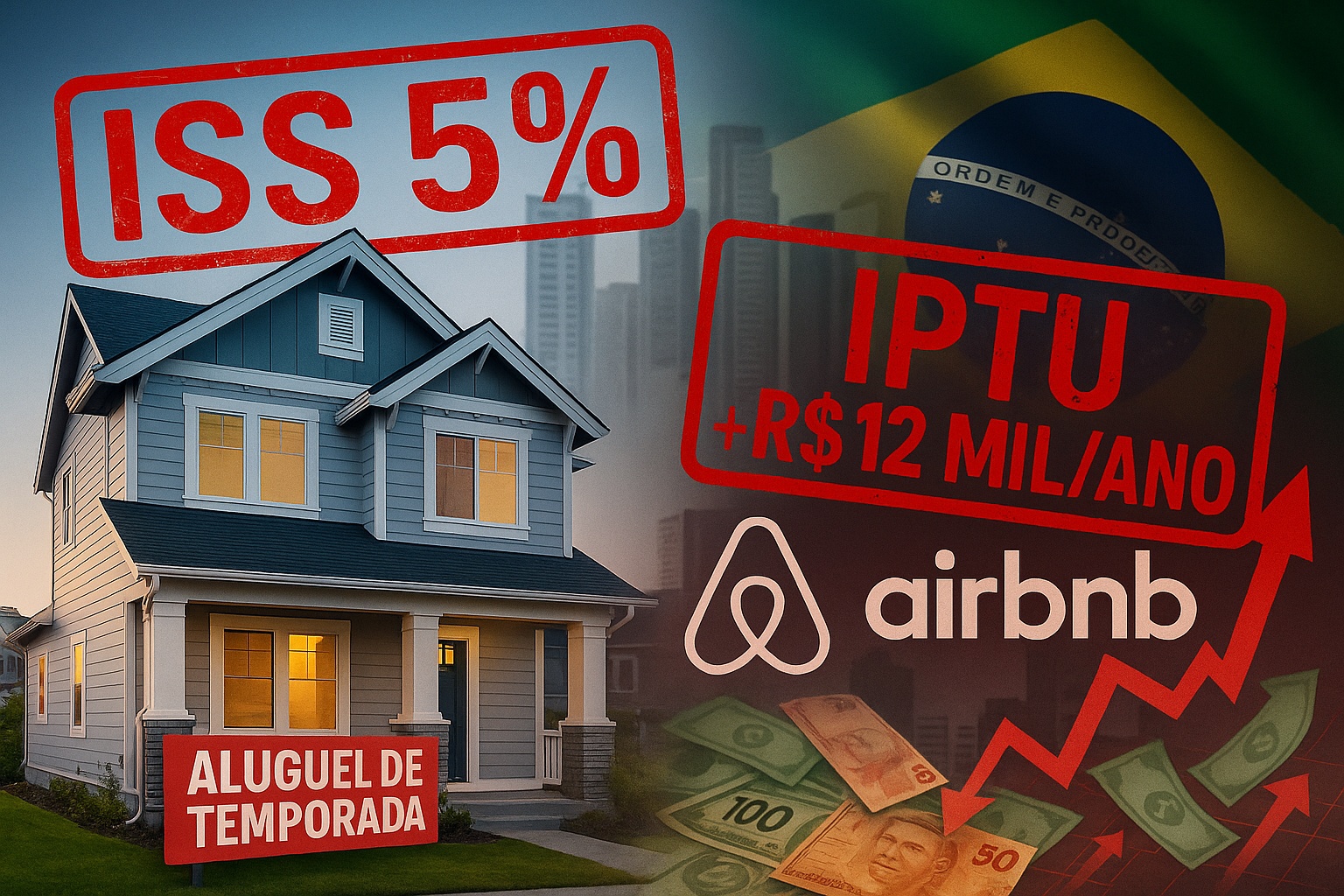


Airbnb May Get More Expensive: ISS of Up to 5% on Daily Rates and Progressive IPTU That Doubles in 5 Years May Raise Costs by Up to R$ 12 Thousand Annually for Vacation Rentals.
The explosive growth of Airbnb and other short-term rental platforms has put short-term properties in the sights of the authorities. Tourist cities and major capitals have begun discussing ways to tax properties used exclusively for temporary lodging, with two main fronts: the ISS (Service Tax) on daily rates and the implementation of a progressive IPTU, which can double taxes in up to five years.
For municipalities, it is about correcting distortions. For property owners, it could mean doubling taxes and annual costs that can reach R$ 12 thousand more in high-end properties.
What Is Being Studied: ISS of Up to 5% on Daily Rates
The ISS (Tax on Services of Any Nature) is a municipal tax that varies between 2% and 5% of the value of services rendered.
-
The institute that trained the greatest aerospace engineers in Brazil has just opened its first campus outside São Paulo after 75 years: ITA Ceará will have R$ 445 million, new courses in energy and systems, and classes are expected to start in 2027.

-
Luciano Hang, owner of Havan, goes to Juiz de Fora after the tragedy in February, brings R$ 1 million, hands out R$ 2,000 cards, and donates up to R$ 15,000 to victims in the region.

-
The Brazilian passport allows legal residence in dozens of countries without the need for a prior visa, and most Brazilians are unaware that they can apply for residency directly upon arriving in nations in South America, Africa, and even Europe.

-
Petrobras sends a message to Brazilian truck drivers after fuel collapse and reveals plan to have 100% domestic diesel.


Although traditional property rentals are exempt, temporary rentals through Airbnb are classified as lodging services by several cities.
- In Salvador, the city hall has already approved rules that classify short-term rentals as lodging, with ISS set at 3%.
- In São Paulo and Rio de Janeiro, discussions are advancing, and the rate may reach the ceiling of 5%.
In practice, a property owner renting an apartment for R$ 500 per night, 15 days a month, would have a monthly revenue of R$ 7,500. With an ISS of 5%, they would pay R$ 375 in taxes per month, or around R$ 4,500 per year.
Progressive IPTU on Properties Used Only for Short-Term Rentals
In addition to the ISS, municipalities are studying the implementation of progressive IPTU over time, as outlined in the City Statute (Law No. 10.257/2001), for properties that remain idle or are exclusively intended for temporary rental.
The logic is that these properties do not fully fulfill a social function, as they do not provide permanent housing.
The mechanism works as follows:
- The property owner is notified that the property is being used only for short-term rentals.
- The IPTU rate gradually increases each year.
- In up to five years, the tax may double or triple.
A property in São Paulo valued at R$ 1 million, which currently pays about R$ 8 thousand annually in IPTU, could see the tax raised to R$ 20 thousand annually within five years.
In other words, an additional cost of up to R$ 12 thousand per year.
Impact on Hosts’ Finances
Combining ISS and progressive IPTU, the financial impact on property owners can be significant:
- Average Apartment (R$ 500 thousand): IPTU of R$ 4 thousand may rise to R$ 8 thousand; ISS on daily rates adds about R$ 2 thousand per year. Total Additional Burden: R$ 6 thousand/year.
- High-End Property (R$ 1.2 million): IPTU of R$ 9 thousand may rise to R$ 21 thousand; ISS on daily rates can reach R$ 5 thousand annually. Total Additional Burden: R$ 12 to 15 thousand/year.
These amounts transform the financial equation for many hosts, who may be forced to reconsider whether Airbnb remains a profitable business.
The Argument of Municipalities
City halls argue that taxation has three main objectives:
- Revenue Generation: ensure that the explosion of the short-term market also benefits public coffers.
- Market Balance: correct the distortion between hotels, which already pay ISS, and Airbnb hosts, who until now operated without equivalent taxation.
- Social Function of Property: discourage residential properties in high-value areas from being removed from the market for permanent housing.
Criticism from Property Owners and the Real Estate Sector
Property owners and tenant associations argue that the increase in the tax burden may have negative effects:
- Cost Pass-Through: hosts may raise daily rates, reducing Airbnb’s competitiveness compared to hotels and inns.
- Reduction in Supply: properties currently used for short-term rentals may revert to the traditional rental market or remain vacant.
- Litigation: owners may legally contest the application of progressive IPTU, claiming that the property is not “idle” but in use.
Airbnb, as a company, also opposes the differentiation of taxes, arguing that the platform generates income for families and stimulates the local economy.
International Experiences
Taxation on Airbnb is not exclusive to Brazil. Several cities worldwide have already implemented specific taxes:
- New York has severely restricted short-term rentals and charges additional fees on lodging.
- Barcelona requires municipal licensing for each listed property and fines those who do not comply.
- Lisbon charges daily tourist taxes of up to € 2 per guest for short-term properties.
These examples show that the global trend is to regulate and tax the alternative lodging market.
Airbnb and the Future of Urban Taxation
The discussion about Airbnb is part of a larger debate: how cities should handle the intensive use of properties for profit in the digital market.
The ISS of up to 5% and progressive IPTU are just the first measures that could radically transform the business model.
For some, it is about tax justice and correcting distortions in the market. For others, it is an attack on the freedom of private property use.
The fact is that, if confirmed, these measures will hit hosts’ wallets: thousands of hosts may face additional costs of up to R$ 12 thousand per year just in taxes, forever changing the profitability equation of short-term rentals.









O governo só quer sugar o cidadão. E na prática, o retorno em benefícios para o cidadão com o pagamento de impostos, não acontece. Saúde é um caos, obrigando o cidadão a pagar plano de saúde, que também está cada vez mais caro e atendimento igualando ao público, transporte cada vez pior, ônibus locado e inseguro, metrô e trem sempre lotados, cada vez mais e até às linhas sob concessão privada estão ficando ruins. Ruas esburacadas, mal sinalizadas; segurança, nem se fala. Educação, onde?
Assim fica difícil viver em um país onde só te sugam, desde o governo municipal até o federal.
Não tenho imóvel no Airbnb mas vejo essas propostas como desonestas e ferindo diretamente o direito de propriedade. Medidas típicas de governos ditatoriais e parasitários.
Simples. Você pega o contato do proprietário e negocia direto sem usar a plataforma do Airbnb lógico que aumenta o risco para ambos, mas seria uma forma de fugir desses parasitas do governo.