





 Portuguese
  English
  Spanish
  4 min of reading
  0 comments


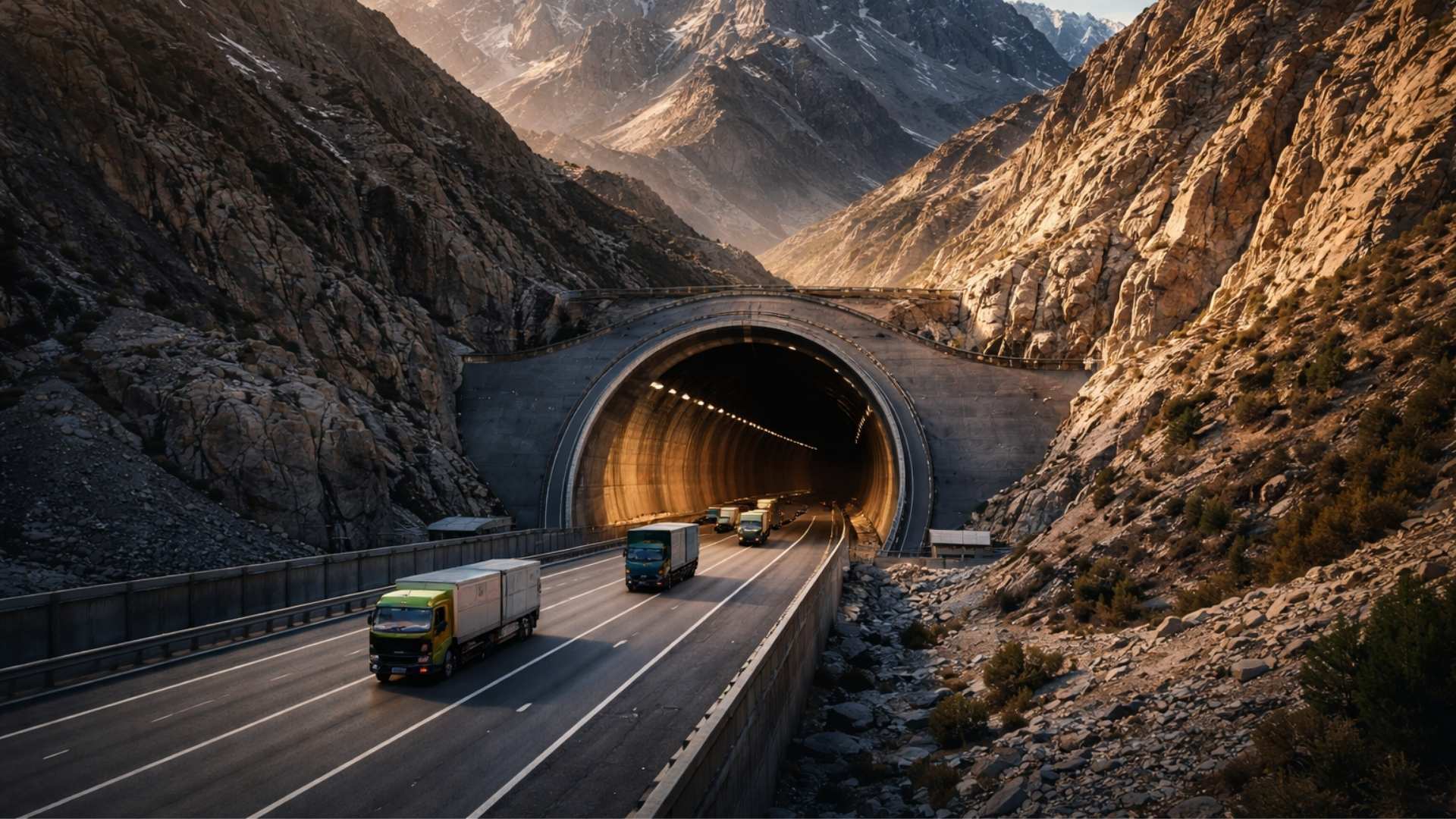
Record infrastructure crosses a historical mountain range and transforms regional logistics by drastically reducing travel time between isolated areas of Xinjiang, facing extreme engineering challenges, severe weather, and complex geology in one of the largest road works in China.
The Tianshan Shengli Tunnel, in the Chinese autonomous region of Xinjiang, began operations on December 26, 2025, as the largest expressway tunnel in the world, with a length of 22.13 kilometers.
The structure crosses the Tianshan mountain range and reduced a journey that previously took several hours on winding and riskier roads to about 20 minutes.
Tianshan Shengli Tunnel reduces travel time in Xinjiang
Integrated into the G0711 expressway, which connects Urumqi to Yuli, the tunnel has become a strategic axis for circulation between the north and south of Xinjiang, the largest administrative division in China by area.
-
More than one million North Americans were ordered to close their windows and stay indoors because the air in the southern United States became so toxic that pollution levels reached 18 times above the World Health Organization’s safety limit.

-
China has accumulated up to 1.4 billion barrels of oil in strategic reserves, invested 25 years in renewable energy, and purchased 80% of cheap Iranian oil: how Beijing has prepared for decades for the crisis that is now shaking the world.

-
A single lake holds 20% of the planet’s non-frozen freshwater and is also the deepest and oldest on Earth.

-
How 5,000 Indian dabbawalas manage to deliver around 200,000 lunchboxes a day in Mumbai for over 130 years using bicycles, crowded trains, and a manual system that continues to operate with impressive accuracy.

The opening of the route expanded the logistical capacity of a vast region marked by long distances, mountainous sections, and a strong dependence on road transport for cargo movement.
Tianshan Mountain Range has been a logistical challenge since the 1950s
The crossing of the Tianshan mountains is treated in China as an old infrastructure problem.
Reports published by Chinese state media indicate that since the 1950s, the country has sought to expand road connections between the two portions of Xinjiang, but economic growth and increased vehicle flow have begun to pressure the capacity of existing links.
This limitation became more sensitive with the expansion of goods transport in the region.
Before the new crossing, trucks and other vehicles had to travel narrow roads with successive curves and conditions that increased travel time, especially in mountainous sections subject to severe weather and more complex operations throughout the year.
Engineering faced extreme weather and geological failures
Construction began in April 2020 and was completed at the end of December 2024, after a series of technical challenges in one of the most difficult areas of the road project in Xinjiang.
According to information released by the Chinese government and the Xinhua agency, the work progressed under intense cold, high altitude, high geological pressure, seismic activity, and strict environmental requirements.
The Tianshan mountain range is described by Chinese official sources as a “geological museum,” due to the variety of rock formations and fault zones found in the massif.
The tunnel’s route crosses 16 of these zones, which helps explain why the excavation required dividing the work into smaller fronts, with continuous adjustments in the construction method to maintain safety, pace, and structural stability.
Ventilation tower of 706 meters impresses by scale
Among the most impressive elements of the infrastructure is ventilation shaft number 2, with 706 meters of depth.
This data was released by Chinese official sources, which highlighted the comparison with the Shanghai Tower, the tallest building in the country, to illustrate the scale of the structure installed in the tunnel’s ventilation system.
The function of this set is crucial for the operation of such a long crossing.
In long road tunnels, controlling air circulation, smoke removal, and response to incidents is a central part of the safety system, especially in a corridor that concentrates cargo transport and crosses a remote area with harsh environmental conditions in winter and summer.
Logistical and economic impacts in the region of Xinjiang
With the opening to traffic, the Tianshan Shengli has significantly shortened the travel time between urban centers and productive areas on both sides of the mountain range.
The work also integrates into a broader corridor of Chinese infrastructure in Xinjiang, designed to improve internal connectivity in the region and provide greater fluidity to the movement of goods in a territory that occupies more than 1.6 million square kilometers.
The practical impact is especially evident in heavy road transport.
By replacing part of a lengthy mountainous route with a continuous and direct passage, the new structure tends to reduce operational wear, logistical uncertainty, and exposure to more dangerous sections, which is relevant for supply chains that depend on regularity and predictability in a region of long distances.
Environmental measures and protection of the Tianshan mountain range
In addition to geological difficulties, construction had to meet environmental requirements in a sensitive area of the mountain range.
The Chinese government reported that measures were taken to contain wastewater on the construction site and reuse gravel, aiming to reduce impacts on the Tianshan No. 1 glacier and on habitats associated with local wildlife, including the snow leopard.
These provisions were incorporated into a project that sought to combine speed of execution and impact control.
According to official sources, segmenting the excavation into smaller sections helped shorten the original schedule by more than 25%, without eliminating the need for specific solutions for ventilation, operational safety, and adaptation to the extreme conditions of the terrain.
Strategic infrastructure strengthens regional integration in China
The completion of the tunnel reinforces a line of Chinese investments in large-scale works aimed at the territorial integration of Xinjiang.
By crossing the main natural barrier between the north and south of the region, the Tianshan Shengli becomes not just an engineering feat but operates as a permanent logistical piece, connected to a highway that reorganizes travel times and increases circulation capacity in the area.
More than the record length, the relevance of the work lies in the direct effect on a crossing that, for decades, concentrated technical limitations, higher costs, and operational risks.
With 22.13 kilometers, unusual-scale ventilation, and direct connection via G0711, the tunnel transforms a historically difficult corridor into a continuous passage between two central parts of Xinjiang.





Seja o primeiro a reagir!